Market Overview
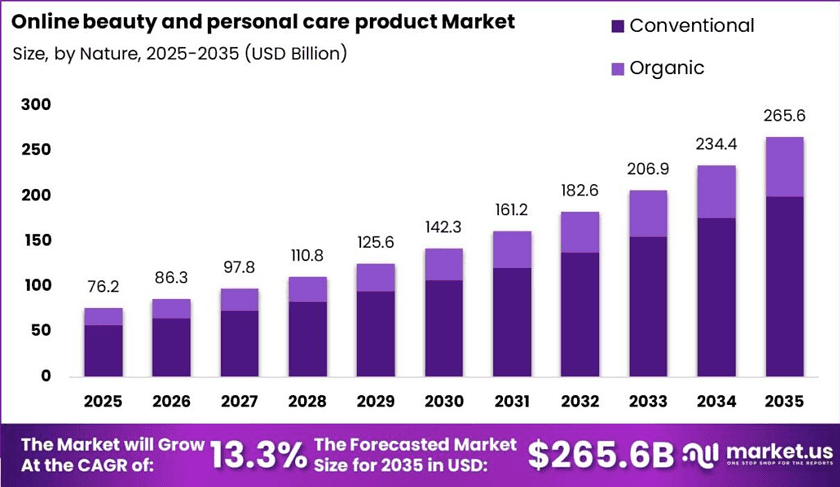
The global online beauty and personal care product market reached USD 76.2 billion in 2025. Analysts expect it to hit USD 265.6 billion by 2035, growing at a 13.3% CAGR from 2026 to 2035. Brands that scale digital operations early can capture share first.
This market covers skincare, makeup, hair care, and grooming items sold online. Sellers include brand storefronts, third-party marketplaces, and beauty retail websites. Consequently, buyers with different habits and purchase frequencies reach the market through many digital routes.
Search now drives purchases. PowerReviews found 83% of consumers bought skincare after an online search. Organic visibility and helpful content therefore work as primary acquisition channels. Consequently, brands that invest in search-friendly product pages win more first-time buyers.
Repeat spending is also rising. PowerReviews shows 37% of consumers spend over USD 101 monthly on online beauty, up from 24% a year earlier. Loyalty is deepening. Therefore, brands with subscriptions and repeat-purchase tools can capture a larger share of wallet.
Data-Driven Insights for Smarter Business Decisions: Explore the Full Report
Key Takeaways
- USD 76.2 billion in 2025, rising to USD 265.6 billion by 2035.
- Growth runs at a 13.3% CAGR from 2026 to 2035.
- Asia-Pacific leads with 38.4%, worth USD 29.29 billion.
- Conventional products hold 75.2% of the nature segment.
- Makeup and Color Cosmetics hold 38.5% of the type segment.
- Women hold 64.7% of the gender segment.
Market Segmentation Overview
Conventional products lead the nature segment with a 75.2% share. Mass-market buyers want familiar brands at lower prices. Consequently, conventional items anchor high-volume online replenishment. Meanwhile, organic shoppers research ingredients first and respond to transparent disclosure.
Moreover, Makeup and Color Cosmetics hold 38.5% of types because trend-driven buyers repurchase often. Online retailers therefore push this category through live shopping and video. However, skin and sun care suit monthly subscription replenishment, while hair care relies on prior brand experience.
Additionally, women hold 64.7% of gender demand because they buy across more subcategories. Bundling and loyalty programs work well with this audience. Men focus on shaving, oral care, and skin care, and they respond to straightforward product claims.
Drivers
Clean beauty and regulation push brands toward better formulas. The U.S. MoCRA framework reported over 15,000 active facility registrations by March 2026. Surveys show 63% of shoppers prioritize clean ingredients. Consequently, digital-native brands that update formulas quickly gain ground, adding 1.8 percentage points to growth.
Moreover, social commerce and influencer discovery speed up conversion. Shoppers find products through video and live sessions, then buy in the same app. This driver adds 2.8 percentage points to growth. Therefore, brands with strong creator networks shorten the purchase funnel and lower acquisition costs.
Use Cases
Shoppers use online search to research skincare before buying. PowerReviews found 57% start their journey on beauty retailer websites, while only 17% start on Amazon. Retailer sites therefore matter more than marketplaces. Consequently, brands focus on owned and retailer channels.
Additionally, shoppers rely on reviews to build trust. 99.5% of beauty shoppers read reviews at least sometimes. Strong review coverage lifts conversion quickly. However, weak coverage stalls sales even for known brands, so brands manage reviews carefully.
Major Challenges
EU rules raise compliance costs sharply. New limits cover Vitamin A derivatives, kojic acid, triclosan, and PFAS. A brand with over 200 active SKUs can pay EUR 8,000 to EUR 25,000 per affected product. Consequently, launch speed and innovation both slow.
However, fragmented rules across regions add burden. Brands in five or more regions may need 8 to 12 regulatory staff and over USD 500,000 yearly in testing. Reformulation extends launches by 4 to 9 months. Therefore, online-first brands lose their speed advantage.
Business Opportunities
Premium beauty demand grows across India, Southeast Asia, the Middle East, and Africa. India’s luxury beauty segment should grow fivefold between 2023 and 2035. The country recorded 393 consumer and retail M&A deals in 2025. Consequently, early buyers of digital-native brands can reach over 1 billion consumers.
Additionally, AI personalization and virtual try-on add 2.8 percentage points to potential growth. Social and live commerce add 2.2 points. Meanwhile, subscription models add 1.8 points. Therefore, brands that combine these tools can lift conversion and recurring revenue.
Data-Driven Insights for Smarter Business Decisions: Explore the Full Report
Regional Analysis
Asia-Pacific leads with a 38.4% share, worth USD 29.29 billion in 2025. High mobile commerce use and dense social commerce activity drive demand. Shoppers discover products through livestreams and short video. Consequently, regional platforms shape brand visibility and conversion.
Meanwhile, emerging markets show strong momentum beyond the leader. India, Southeast Asia, the Middle East, and Africa gain from rising incomes and digital adoption. Sub-Saharan Africa remains mass-market dominated. Therefore, premiumization leaves room for brands that suit local needs, including halal and Ayurveda-inspired formulas.
Key Players Analysis
Leading companies compete through retail partnerships, review strength, and sustainability moves. Amorepacific benefits from retailer-site discovery. Church and Dwight depends on strong review trust. Meanwhile, L’Oréal launched its #JoinTheRefillMovement campaign in June 2025. Packaging strategy now shapes online assortments.
- Amorepacific Corp.
- Church and Dwight Co. Inc.
- CLARINS France
- Coty Inc.
- Henkel AG and Co. KGaA
- Johnson and Johnson Services Inc.
- Kao Corp.
- Koninklijke Philips N.V.
- LOreal SA
- MacAndrews and Forbes Inc.
- Natura and Co Holding SA
Recent Developments
- June 2026 — Vacation expanded distribution through Sephora’s online platform.
- January 2026 — rhode teased 2026 launches, including hydrogel pimple patches.
- June 2025 — L’Oréal launched its #JoinTheRefillMovement campaign.
- May 2025 — e.l.f. Beauty agreed to acquire rhode in a deal worth up to USD 1 billion.
Conclusion
The online beauty and personal care market grows rapidly through 2035. Search discovery, social commerce, and repeat spending drive demand. Compliance costs and fragmented rules add pressure but reward agile brands. Consequently, the category stays among the faster-growing parts of global retail.
Therefore, companies must invest in content, reviews, and flexible compliance. Conventional products, makeup, women, and Asia-Pacific lead today. Firms that act early can capture a market worth USD 265.6 billion by 2035.
Looking for data tailored to your specific market, region, or business need? Request a custom report or consultation — write to us at sales@market.us
Discuss your needs with our analyst
Please share your requirements with more details so our analyst can check if they can solve your problem(s)