Market Overview
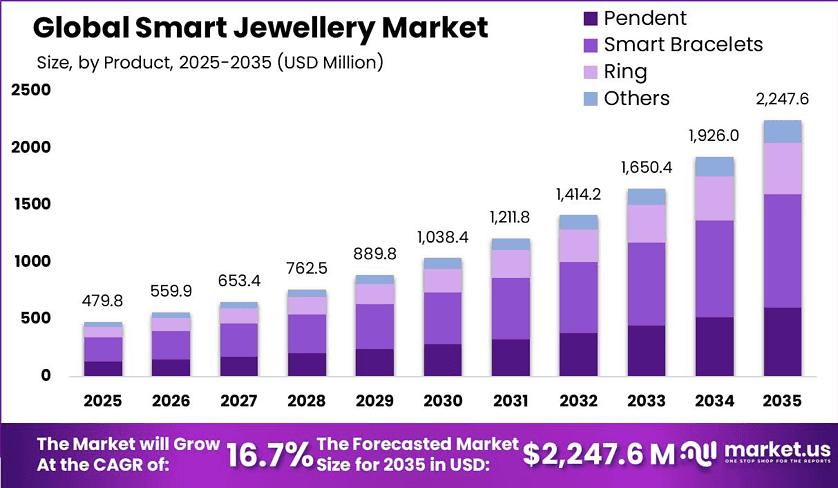
The global smart jewellery market reached USD 479.7 million in 2025. Analysts expect it to hit USD 2,247.60 million by 2035, growing at a 16.70% CAGR from 2026 to 2035. Health insights in a stylish format fuel this fast growth.
Smart jewellery blends fashion design with embedded sensors for everyday wear. Pendants, bracelets, and rings track heart rate, activity, and sleep. Consequently, consumers get health insights without wearing a traditional smartwatch, and manufacturers reach fashion and clinical wellness buyers alike.
Consumer pull is already strong. Oura Ring sales passed 5.5 million units globally by September 2025. This pace shows smart rings moving from niche gadgets to mainstream wearables. Therefore, brands that scale production early can capture outsized share before competition intensifies.
Rules are also becoming clearer. The market will grow nearly 4.7 times in value by 2035, and the FDA’s January 2026 wellness guidance lets makers offer SpO2 and HRV metrics without full device approval. Consequently, investors see wearable health jewellery as a strong opportunity.
Data-Driven Insights for Smarter Business Decisions: Explore the Full Report
Key Takeaways
- The global market was valued at USD 479.7 million in 2025 and will reach USD 2,247.60 million by 2035, growing at a 16.70% CAGR from 2026 to 2035.
- Smart Bracelets hold a dominant 44.20% share of the product segment in 2025.
- Adults hold a dominant 68.80% share of the age group segment in 2025.
- Android holds a dominant 69.10% share of the operating system segment in 2025.
- Activity Tracking holds a dominant 37.30% share of the application segment in 2025.
- North America holds a dominant 44.50% share of the regional segment in 2025, valued at USD 213.511 million.
Market Segmentation Overview
Smart Bracelets lead products with a 44.20% share. They combine continuous fitness tracking with all-day wearability across age groups. Pendants hold 27.00% by hiding sensors in familiar necklaces, while rings capture 20.00% for discreet biometric tracking.
Moreover, adults hold 68.80% of age group demand because they have income for premium devices and strong fitness interest. Pediatric users account for 20.00% through parental safety purchases. Geriatric buyers hold 11.20%, focused on fall detection and remote monitoring.
Additionally, Android leads operating systems with 69.10% because it covers more devices and price tiers. iOS holds 30.90% among premium buyers. Activity Tracking leads applications at 37.30%, followed by heart rate monitoring at 34.00% and sleep tracking at 28.70%.
Drivers
Regulatory clarity speeds product launches. The FDA’s January 2026 update lets makers offer blood pressure and HRV metrics without full approval, if they avoid diagnostic claims. Entry barriers fall as a result. Consequently, this driver adds 1.8 percentage points to growth, and brands that pursue 510(k) clearance reach insurers.
Moreover, health monitoring demand drives growth most strongly. Consumers want continuous heart rate, SpO2, and sleep data in discreet form. This driver adds 3.8 percentage points to growth. Therefore, companies that pair accurate sensors with elegant design win loyal buyers.
Use Cases
Older adults use smart jewellery for fall detection and remote health monitoring. They prefer jewellery formats over smartwatches for comfort and lower visibility of medical tracking. Therefore, makers design devices around safety alerts rather than fitness metrics.
Additionally, sleep trackers suit rings and pendants better than bulky wrist devices. Nighttime wear needs a compact, comfortable form. Sleep tracking holds 28.70% of applications. Consequently, compact designs gain ground as interest in recovery and rest quality grows alongside daytime activity features.
Data-Driven Insights for Smarter Business Decisions: Explore the Full Report
Major Challenges
Precious metal costs squeeze manufacturers. Gold rose about 65% in 2025, and silver surged nearly 150%. Metals make up 35% to 55% of manufacturing cost. Consequently, retail prices climb, and companies test thinner designs.
However, platform fragmentation drains engineering resources. Devices must support Bluetooth, NFC, and Wi-Fi across iOS and Android. This lack of a unified standard consumes 20% to 35% of software engineering effort. Therefore, brands run separate builds, which slows expansion.
Business Opportunities
Pharmaceutical and clinical research offer a major opportunity. Smart rings detected COVID-19 2.75 days before symptoms with 82% sensitivity. The FDA’s December 2025 guidance accepted de-identified wearable data. Meanwhile, data licensing deals earn 70% to 85% gross margins, which adds 2.8 percentage points to potential growth.
Additionally, digital health and insurance integration offers even larger upside, at 3.5 percentage points. Luxury co-brand licensing adds 2.2 points. Consequently, brands that link devices to insurers and fashion houses can build recurring revenue.
Regional Analysis
North America leads with a 44.50% share, worth USD 213.511 million in 2025. Strong spending on wearable health technology and dense retail distribution drive demand. Samsung’s Galaxy Ring offers up to 7 days of battery life. Consequently, premium ring devices gain appeal for daily wear.
Meanwhile, Asia-Pacific shows strong premiumization. Income growth in Tier-1 and Tier-2 cities drives hybrid luxury-tech demand. China shows a 20.4% CAGR, and India is the fastest-growing APAC sub-market. Therefore, this driver adds 2.6 percentage points to growth across China, India, South Korea, and Japan.
Key Players Analysis
Leading companies compete through niche focus and clinical credibility. Bellabeat targets women with cycle and stress tracking. Oura built category leadership through clinical-grade sensors and continuous validation studies. Therefore, Oura sustains premium pricing while competitors race to match its accuracy.
- Bellabeat
- Oura Health Oy.
- RINGLY
- Samsung
- Motiv, Inc.
- Ultrahuman
- Corsano Health
- Wellue
- Pebble
Recent Developments
- June 2025 — Amazfit launched the Helio Strap, a screen-free fitness and sleep wearable.
- January 2025 — Ultrahuman introduced 18K gold and platinum rings at CES 2025.
- October 2024 — A U.S. survey found 63% of respondents would pay subscription fees for health analytics.
- 2024 — Rock Health found 44% of U.S. consumers owned wearable health trackers.
Conclusion
The smart jewellery market grows rapidly through 2035. Health monitoring demand, clearer regulation, and sensor advances drive adoption. Metal costs and platform fragmentation raise pressure but reward disciplined makers. Consequently, the category moves from niche gadgets toward mainstream wearable health jewellery.
Therefore, companies must invest in clinical validation, data privacy, and cross-platform design. Smart bracelets, adults, Android, activity tracking, and North America lead today. Firms that act early can capture a market worth USD 2,247.60 million by 2035.
Looking for data tailored to your specific market, region, or business need? Request a custom report or consultation — write to us at sales@market.us
Discuss your needs with our analyst
Please share your requirements with more details so our analyst can check if they can solve your problem(s)