Market Overview
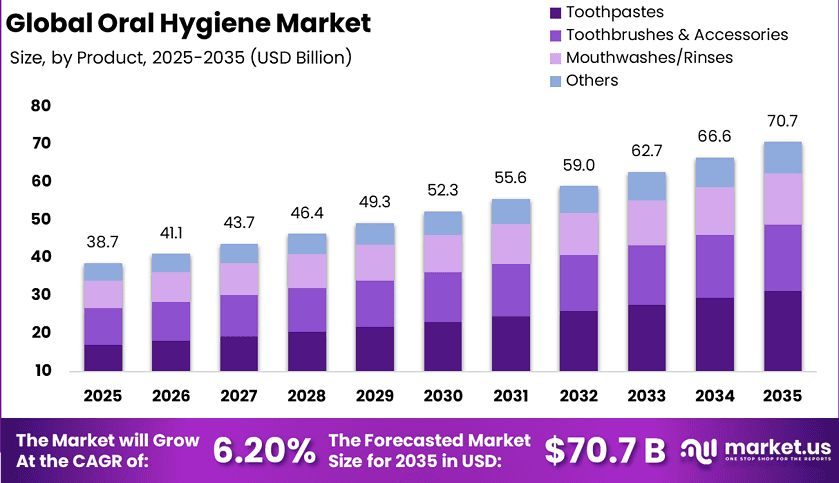
The global oral hygiene market reached USD 38.7 billion in 2025. Analysts expect it to hit USD 70.7 billion by 2035, growing at a 6.20% CAGR from 2026 to 2035. Daily household use and rising clinical engagement support this steady growth.
Oral hygiene products include toothpastes, toothbrushes, mouthwashes, and related items that protect oral health. Consumers buy them through offline stores and online channels. Consequently, the market reaches households across all age groups and regions.
Governments are pushing oral health programs. School-based schemes and public dental care create structured demand in low-penetration markets. Institutional procurement therefore shapes volume growth in emerging regions. Moreover, brands that supply these programs gain early access to new households.
Brushing habits still leave a large gap. A meta-analysis of 17,734 participants found only 44.6% of adults brush twice daily. Female and male rates fall to 25.8% and 12.2%. Consequently, brands that promote better habits access a large underserved group.
Data-Driven Insights for Smarter Business Decisions: Explore the Full Report
Key Takeaways
- The global market was valued at USD 38.7 billion in 2025 and will reach USD 70.7 billion by 2035, growing at a 6.20% CAGR from 2026 to 2035.
- Toothpastes hold a dominant 44.20% share of the product segment in 2025.
- Adults hold a dominant 69.40% share of the age group segment in 2025.
- Paste holds a dominant 56.80% share of the formulation segment in 2025.
- Offline channels hold a dominant 76.30% share of the distribution channel segment in 2025.
- Asia Pacific holds a dominant 39.50% share of the regional segment in 2025, valued at USD 15.29 billion.
Market Segmentation Overview
Toothpastes lead products with a 44.20% share. Daily use and prices from economy to premium sustain demand. Whitening, sensitivity, and herbal variants keep innovation steady. Consequently, vendors that differentiate by product, not price, hold stronger margins. Toothbrushes follow with 25.00%, and mouthwashes hold 19.00%.
Moreover, adults hold 69.40% of age group demand because they buy often and trade up to premium formulas. Kids account for 20.00%, supported by flavors and early cavity prevention. Geriatric buyers hold 10.60%, driven by denture care and dry-mouth treatment.
Additionally, paste leads formulations with 56.80%, and offline channels capture 76.30% of sales. Shoppers rely on stores for routine purchases. However, e-commerce grows fastest through subscriptions and quick-commerce replenishment, which raise purchase frequency for toothpaste and mouthwash.
Drivers
Digital and direct-to-consumer channels transform oral care sales. Subscription models lift operating margins by 15% to 25% by cutting intermediaries. Quick-commerce also speeds replenishment. Consequently, brands gain first-party data that supports personalized premium recommendations, and this driver adds 0.7 percentage points to growth.
Moreover, social media shapes discovery. About 53% of U.S. Gen Z consumers use social media for dental advice. Brands with strong digital presence reach younger, high-value buyers directly. Meanwhile, rising oral disease and preventive care shifts add 1.4 percentage points, the largest driver impact.
Use Cases
Electric toothbrush users create a recurring consumables stream. Adoption has crossed 28% in urban middle-income households. Owners buy replacement heads and compatible accessories regularly. Therefore, manufacturers earn more predictable revenue than they earn from one-time manual brush sales.
Additionally, older adults use denture care and dry-mouth products. Japan, Western Europe, and China form the main corridors for this demand. Aging populations drive purchases. Consequently, specialized developers find a clear entry point because the segment remains underpenetrated relative to clinical need.
Data-Driven Insights for Smarter Business Decisions: Explore the Full Report
Major Challenges
Ingredient bans create reformulation pressure. Europe banned titanium dioxide as a food additive, and toothpastes rely on it for whitening. No direct substitute matches its performance. Consequently, manufacturers face stability testing, consumer validation, and re-registration, which slow development timelines.
However, fluoride scrutiny adds further burden. More than 80% of European oral care SKUs use fluoride-based ingredients. Reformulation takes 18 to 36 months. Therefore, companies accelerate hydroxyapatite alternatives while managing regulatory fragmentation, which drags growth by 0.8 percentage points.
Business Opportunities
Oral and systemic health integration offers the biggest upside, at 2.0 percentage points. Periodontitis links to diabetes and heart disease. Insurers now include oral health in chronic disease programs. Consequently, therapeutic toothpastes and periodontal gels can reach patients through pharmacies and healthcare providers.
Additionally, behavior-change programs lift compliance. Twice-daily brushing rose from 60% to 73% after a 12-month program. Digital coaching and subscriptions capture this volume. Meanwhile, microbiome and probiotic formats add 1.8 percentage points to potential growth. Therefore, early movers can build lasting loyalty.
Regional Analysis
Asia Pacific leads with a 39.50% share, worth USD 15.29 billion in 2025. Large populations in China, India, and Southeast Asia and rising middle-class incomes sustain high volumes. Herbal and ayurvedic formats gain traction in India. Consequently, non-fluoride shoppers find options that match traditional preferences.
Meanwhile, Middle East and Africa remains an early-stage market. A study of 44,779 respondents in Saudi Arabia found 57.3% brush less than once daily. This gap reflects access and education limits. Therefore, brands that fund public education and affordable products can build future volume.
Key Players Analysis
Leading companies compete through broad distribution and smart technology. Colgate-Palmolive spans economy to premium tiers worldwide. Procter and Gamble anchors electric brushes through Oral-B. Meanwhile, Novateor Labs launched SmiloShine Herbafresh Toothpaste in April 2026, targeting herbal formulation gaps.
- Colgate-Palmolive Company
- Procter & Gamble
- Koninklijke Philips N.V.
- Unilever
- Johnson & Johnson
- Haleon
- Church & Dwight Co., Inc.
- Kenvue Inc.
- Sunstar Group
- Lion Corporation
Recent Developments
- April 2026 — vVARDIS received a minority investment from Apollo-managed funds.
- April 2026 — Novateor Labs launched SmiloShine Herbafresh Toothpaste.
- January 2026 — Gutology raised GBP 1.8 million for microbiome-focused oral care.
- July 2025 — vVARDIS secured USD 50 million to expand its Curodont treatment.
Conclusion
The oral hygiene market grows steadily through 2035. Public health programs, digital channels, and preventive care drive demand. Ingredient bans and fluoride scrutiny raise costs but reward adaptable brands. Consequently, the market stays resilient across income levels and regions.
Therefore, companies must invest in clinical validation, behavior-change tools, and reformulation. Toothpastes, adults, paste, offline channels, and Asia Pacific lead today. Firms that act early can capture a market worth USD 70.7 billion by 2035.
Looking for data tailored to your specific market, region, or business need? Request a custom report or consultation — write to us at sales@market.us
Discuss your needs with our analyst
Please share your requirements with more details so our analyst can check if they can solve your problem(s)