Market Overview
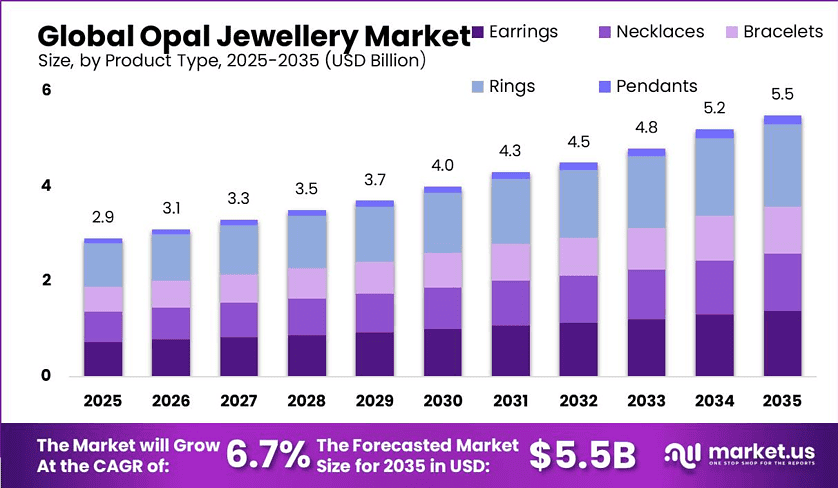
The global opal jewelry market reached USD 2.9 billion in 2025. Analysts expect it to hit USD 5.5 billion by 2035, growing at a 6.70% CAGR from 2026 to 2035. Supply limits keep this growth steady rather than explosive.
Opal jewelry includes earrings, necklaces, bracelets, rings, and pendants made from natural, synthetic, doublet, or triplet opal. Designs range from contemporary to traditional, artisan, and minimalist styles. Consequently, brands serve men, women, and unisex buyers across many price points.
Supply origin shapes pricing. Geoscience Australia says Australia produces about 95% of the world’s precious opal. Any disruption to Australian output therefore carries outsized price effects across the downstream jewelry trade. Consequently, investors must weigh production limits alongside demand growth.
Gifting also supports revenue. The NRF expected U.S. shoppers to spend USD 7.5 billion on Mother’s Day jewelry in 2026. Gemstone gifting stays strong. Therefore, opal brands that time launches with gifting calendars capture seasonal spikes better than year-round positioning.
Data-Driven Insights for Smarter Business Decisions: Explore the Full Report
Key Takeaways
- The global market was valued at USD 2.9 billion in 2025 and will reach USD 5.5 billion by 2035, growing at a 6.70% CAGR from 2026 to 2035.
- Rings hold a dominant 31.60% share of the product type segment in 2025.
- Natural Opal holds a dominant 48.50% share of the material segment in 2025.
- Contemporary designs hold a dominant 34.90% share of the design style segment in 2025.
- Women hold a dominant 69.30% share of the customer type segment in 2025.
- Asia-Pacific holds a dominant 37.40% share of the regional segment in 2025.
Market Segmentation Overview
Rings lead products with a 31.60% share because bridal and milestone gifting create steady demand. Earrings offer a lower-priced entry point that feeds later purchases. Necklaces support premium collections as statement pieces. Consequently, brands use each category for a distinct role.
Moreover, Natural Opal holds 48.50% of materials because buyers prize authenticity and origin. Synthetic opal serves cost-conscious shoppers, while doublet opal offers a middle tier. However, doublets need clear disclosure to protect buyer trust.
Additionally, Contemporary designs hold 34.90% of styles through alignment with fashion cycles and social media discovery. Women hold 69.30% of customers because they buy across the widest range of products and styles. Men and unisex buyers form smaller, developing verticals.
Drivers
Supply scarcity lifts pricing power. Black opal production has fallen so low that matched suites are nearly impossible to assemble, and no more than 25 operators work the boulder opal belt. Prices rise up to 25% yearly for boulder opal. This driver adds 1.4 percentage points to growth.
Moreover, social commerce converts younger shoppers. TikTok and Instagram shoppable content turns Gen Z and millennial viewers into opal buyers. This driver adds 1.1 percentage points. Meanwhile, self-gift buying has risen 58% since 2021. Therefore, brands that use social discovery widen their addressable audience.
Use Cases
Couples choose opal rings for bridal and milestone gifting. Rings dominate because occasions, not seasons, drive purchases. Brands market them as unique alternatives to traditional stones. Consequently, ring collections become the most reliable revenue anchor, supported by steady demand throughout the year.
Additionally, shoppers buy opal jewelry for self-expression and wellness. Crystal healing and astrological trends position opal as a spiritually resonant accessory. Direct-to-consumer and lifestyle channels carry this message. Therefore, this trend adds 0.5 percentage points to growth in North America, India, and Europe.
Data-Driven Insights for Smarter Business Decisions: Explore the Full Report
Major Challenges
Supply concentration creates risk. Small-scale miners run Australian fields with conventional tools. A 20% output drop at Coober Pedy can cut global white opal supply by about 10%. Consequently, manufacturer margins fall by 200 to 400 basis points per collection cycle.
However, Ethiopian opal adds competition and quality concerns. It sells at lower prices, and it is mostly hydrophane, a porous type that absorbs water and may lose color. Mid-market retailers face margin pressure as buyers confuse origins. Therefore, Australian brands must keep investing in provenance communication.
Business Opportunities
Lab-grown opal offers strong upside, adding 1.8 percentage points. India’s polished synthetic stone exports grew 342.07% year on year in Q2. Direct-to-consumer lab-grown collections can reach 58% to 65% gross margins, versus 35% to 42% for conventional retail. Consequently, certified lab opal can become a mass premium tier.
Additionally, Asia-Pacific luxury and astrology positioning adds 2.2 percentage points to potential growth. India, China, and Southeast Asia offer the main demand. Brands pricing lab-grown pieces from USD 80 to USD 350 can reach sustainability-minded buyers. Therefore, early movers build loyalty before competition grows.
Regional Analysis
Asia-Pacific leads with a 37.40% share. A growing base of colored gemstone buyers supports regional demand. Rising disposable incomes and wider luxury retail access drive purchases. Consequently, the region acts as the primary growth engine for opal jewelry demand going forward.
Meanwhile, North America and Europe form the consumption core. Trade shifts also open new corridors. The India–EU free trade agreement removes jewelry duties of up to 4% on Indian exports. Therefore, this driver adds 0.8 percentage points to growth across Asia-Pacific and Europe.
Key Players Analysis
Leading companies compete through online reach and digital catalogs. Etsy reported 95.5 million active buyers in 2024, which supports customized gemstone demand. Etsy also generated USD 12.6 billion in gross merchandise sales. Consequently, suppliers such as Fire Mountain Gems and Gemporia gain from strong online visibility.
- Fire Mountain Gems
- Gemporia
- Zales
- Rio Grande
- Swarovski
- Harry Winston
- Sapphire Manufacturing
- Tiffany & Co.
- JTV
- Kay Jewelers
- Blue Nile
- Stuller
Recent Developments
- June 2026 — Tiffany & Co. debuted its Blue Book 2026 Hidden Garden High Jewelry Collection.
- June 2025 — The Marathon Company acquired Kovel Collection, known for opal designs.
Conclusion
The opal jewelry market grows steadily through 2035. Supply scarcity, social commerce, and gifting demand drive revenue. Source concentration and Ethiopian competition add risk but reward strong provenance. Consequently, the market favors brands with clear sourcing and distinct design.
Therefore, companies must secure supply, verify origin, and explore lab-grown tiers. Rings, Natural Opal, contemporary designs, women, and Asia-Pacific lead today. Firms that act early can capture a market worth USD 5.5 billion by 2035.
Looking for data tailored to your specific market, region, or business need? Request a custom report or consultation — write to us at sales@market.us
Discuss your needs with our analyst
Please share your requirements with more details so our analyst can check if they can solve your problem(s)