Market Overview
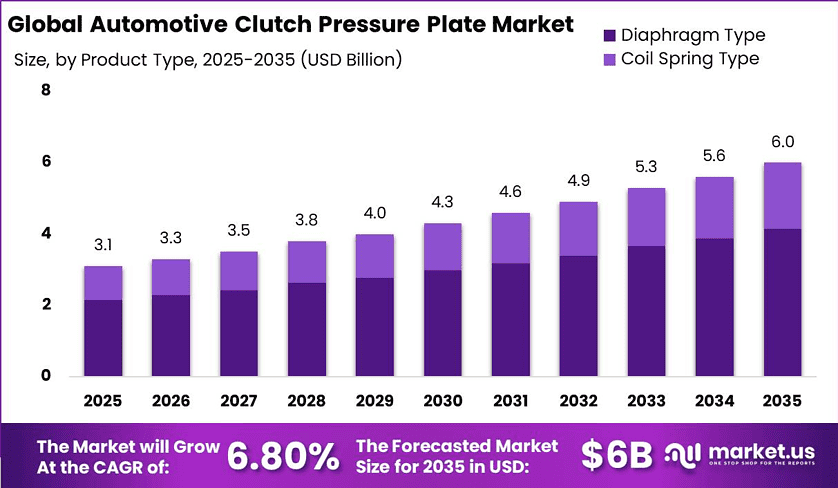
The Global Automotive Clutch Pressure Plate Market is projected to reach USD 6.0 Billion by 2035, up from USD 3.1 Billion in 2025. Analysts expect a CAGR of 6.80% from 2026 to 2035. Vehicle output in Asia and a large aging vehicle fleet support steady demand.
Clutch pressure plates are mechanical components that clamp the clutch disc against the flywheel to transmit engine torque to the drivetrain. Makers build diaphragm-type and coil spring-type designs. Two-wheelers, passenger cars, light commercial vehicles, and medium and heavy commercial vehicles use them through OEM and aftermarket channels.
Passenger cars drive the largest volume, while two-wheelers dominate in Asia Pacific. Fleet operators running manual light and heavy commercial vehicles generate steady replacement demand. Replacement cycles follow service intervals. Meanwhile, workshops and distributors serve older vehicles that need frequent clutch service, especially in India, Latin America, and Africa.
Engineering tools improve product quality. Finite element analysis models clamping force, thermal stress, and fatigue life before prototyping, which cuts tooling revisions. Self-adjusting designs compensate for friction disc wear automatically. High-heat friction materials also support downsized turbocharged engines. Consequently, suppliers shorten development cycles and lower fleet maintenance costs.
Get further insight into the global trends shaping the future of the automotive clutch pressure plate industry. Request Sample
Key Takeaways
- Market size is USD 3.1 Billion in 2025 and reaches USD 6.0 Billion by 2035.
- The market grows at a CAGR of 6.80% from 2026 to 2035.
- Diaphragm Type dominates product type with a 69.20% share.
- Passenger Car dominates vehicle type with a 49.80% share.
- OEMs dominate distribution with a 67.50% share.
- Asia Pacific leads with a 48.90% share.
Market Segmentation Overview
Diaphragm type dominates product type with a 69.20% share in 2025 because it delivers consistent clamping loads and reduces pedal effort. This mix of performance and comfort drives OEM preference across passenger car and light commercial platforms. Consequently, suppliers prioritize compact diaphragm designs in new platform programs.
Moreover, coil spring type holds 30.80% and stays relevant in heavy-duty applications where torque loads exceed diaphragm spring capacity. ACEA data shows diesel trucks made up 92.4% of new EU truck registrations in Q1 2026. Therefore, a durable base of heavy vehicles still needs coil spring clutch assemblies.
Passenger cars dominate vehicle type with a 49.80% share because they have the largest production base. ACEA reports global passenger car production reached 75.5 million units in 2024. Consequently, this volume guarantees direct assembly demand and a large future replacement pool for aftermarket suppliers.
Additionally, two-wheelers serve markets where motorcycles outnumber cars, and Asia Pacific leads their production. Manual clutches remain standard in price-sensitive markets, which sustains volume independent of car transmission trends. Light and heavy commercial vehicles add intensive duty cycles and frequent clutch replacement. Fleet operators running manual LCVs generate predictable aftermarket pull at regular service intervals.
OEMs dominate distribution with a 67.50% share because contracts lock in pressure plate specifications at the platform design stage. These multi-year relationships reward suppliers that co-develop with vehicle makers. Meanwhile, aftermarket holds 32.50% and depends on aging vehicles, service frequency, and strong catalog coverage across independent workshops.
Drivers
Asian vehicle output leads drivers, adding +1.3% to CAGR. Global production rose from 92.5 million units in 2024 to 96.4 million in 2025, with China near 34.5 million and India near 6.5 million. Therefore, suppliers near these assembly hubs gain cost, lead time, and compliance advantages in platform nominations.
Moreover, aging fleets add +1.1%. The average US vehicle reached 12.8 years in 2025, European cars average 12.5 years, and trucks 14.1 years. Older vehicles need more frequent clutch replacement. Consequently, aftermarket suppliers earn reliable revenue even as new vehicle electrification advances.
Use Cases
Passenger car makers fit diaphragm pressure plates on manual, AMT, and DCT platforms in China, India, and Southeast Asia. Consequently, OEM programs lock in multi-year supply contracts, while DCT and AMT migration adds a +0.6% CAGR impact by raising value per clutch assembly.
Additionally, repair workshops and remanufacturers serve aging vehicles. In June 2025, Schaeffler launched the LuK RepSet 2CT DMF, the first kit combining a double clutch and dual-mass flywheel. In April 2025, Valeo launched a remanufactured DQ250 Double Wet Clutch. Consequently, workshops handling dual-clutch vehicles reduce maintenance complexity.
Major Challenges
EV substitution creates the heaviest restraint, with a -2.3% CAGR impact. In the UK, only 82 new models offered a manual gearbox in 2025, down from 192 in 2015. Consequently, clutch-dependent drivetrains lose OEM platform share in developed markets, and BEVs took 17.4% of new EU registrations in 2025.
However, skilled labor shortages disrupt plants in Germany, Italy, Japan, India, and Mexico. Shortages raise overtime dependence by 3 to 6%, slow setup by 5 to 10%, and delay onboarding by 8 to 16 weeks. Therefore, suppliers that invest in apprenticeships and digitalization turn this constraint into a competitive barrier.
Get further insight into the global trends shaping the future of the automotive clutch pressure plate industry. Request Sample
Business Opportunities
Asia Pacific produced about 59.2 million vehicles in 2025, more than 61% of global output. Localizing stamping, spring production, and machining near India and ASEAN assembly can cut landed cost by 8 to 12%. Lead times can fall from 10 to 14 weeks to 4 to 6 weeks. Therefore, local suppliers win cost-sensitive platform nominations.
Additionally, dedicated LCV clutch platforms offer a 1.1% CAGR upside in India, ASEAN, Africa, and Latin America, and circular remanufacturing adds 0.8% in the EU and North America. Fleet buyers prioritize total cost of ownership. Therefore, longer service intervals and early remanufacturing certification build lasting trust.
Regional Analysis
Asia Pacific leads with a 48.90% share because it concentrates the largest share of global vehicle production. Manual, AMT, and DCT platforms remain standard across China, India, and Southeast Asia. Consequently, cost-sensitive passenger car and two-wheeler markets sustain high-volume OEM fitment, and localized suppliers win more nominations.
Meanwhile, Europe sees aging fleets support aftermarket demand while electrification erodes OEM volumes, with 10.6 million new EU car registrations in 2025. North America relies on aging vehicles and residual manual use, and USMCA rules add compliance complexity across the US, Canada, and Mexico corridor.
Recent Developments
- April 2025 — Valeo launched its remanufactured DQ250 Double Wet Clutch solution at Rematec 2025, expanding its aftermarket portfolio for dual-clutch vehicles.
- June 2025 — Schaeffler Vehicle Lifetime Solutions launched the LuK RepSet 2CT DMF, the first repair kit combining a double clutch and dual-mass flywheel.
Conclusion
The automotive clutch pressure plate market nearly doubles, rising from USD 3.1 Billion in 2025 at a 6.80% CAGR. Asian output, aging fleets, and tighter driveline standards drive this growth. However, EV substitution and labor shortages weigh on the outlook, so suppliers must manage platform exposure carefully.
Diaphragm type, passenger cars, and OEMs lead their segments with shares of 69.20%, 49.80%, and 67.50%. Asia Pacific leads regionally with 48.90%. Meanwhile, Europe and North America add aftermarket demand from aging vehicles. Each leader reflects comfort, volume, and long-term platform contracts.
Companies must localize production in Asia, invest in simulation and heat-resistant materials, and build aftermarket and remanufacturing channels to capture this opportunity. Suppliers should also train skilled workers. Those that act early will win platform nominations and loyal customers as the market reaches USD 6.0 Billion by 2035.
Looking for data tailored to your specific market, region, or business need? Request a custom report or consultation — write to us at sales@market.us
Discuss your needs with our analyst
Please share your requirements with more details so our analyst can check if they can solve your problem(s)