Market Overview
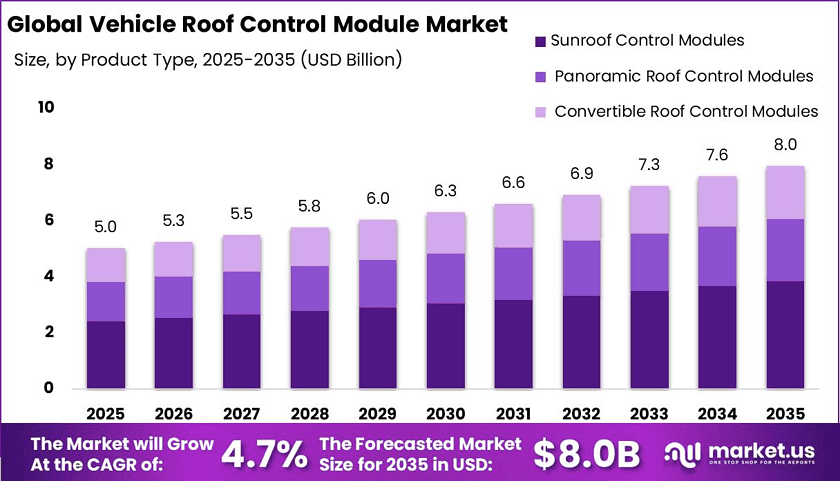
The global vehicle roof control module market will reach USD 8.0 Billion by 2035, up from USD 5.0 Billion in 2025. Market revenue grows at a 4.7% CAGR from 2026 to 2035. Automakers invest steadily in electronic roof systems across passenger, electric, and commercial vehicles, driving consistent long-term demand for qualified module suppliers.
Moreover, vehicle roof control modules include electronic control units, actuator drivers, and communication interfaces. These components manage sunroof, panoramic roof, and convertible roof operations smoothly. Automotive OEMs and aftermarket suppliers deploy these systems across global vehicle platforms to deliver reliable cabin comfort and automated roof movement.
Additionally, passenger cars, commercial vehicles, and electric vehicle platforms drive global adoption. Passenger car makers standardize sunroofs to boost trim appeal, while commercial fleets prioritize operator comfort. Consequently, electric vehicle brands use advanced roof electronics to combine environmental sensing, transparency control, and modern cabin styling.
Furthermore, smart glass and sensor integration transform modern roof control architectures. Webasto embeds 14 camera and lidar sensors into its prototype panoramic roof module for autonomous perception. Meanwhile, the Porsche Taycan uses a 7-layer liquid-crystal roof operating below 20 watts, proving that advanced electronics enhance comfort without draining vehicle batteries.
Get further insight into the global trends shaping the future of the vehicle roof control module industry. Request Sample
Key Takeaways
- The global vehicle roof control module market stands at USD 5.0 Billion in 2025 and will reach USD 8.0 Billion by 2035.
- Global market revenue expands at a 4.7% CAGR during the 2026 to 2035 forecast period.
- Sunroof control modules lead the product type segment with a 48.3% market share.
- Passenger cars dominate the vehicle type segment, capturing a 67.2% share in 2025.
- Automotive OEMs control the end user segment with a 61.8% market share.
- Asia-Pacific leads all global regions with a 43.81% market share.
Market Segmentation Overview
Sunroof control modules hold a 48.3% share of the product type segment in 2025. Automakers standardize sunroofs across mid-size and upper-segment SUVs, creating steady procurement volumes. Consequently, established module suppliers gain strong negotiating leverage in multi-year sourcing contracts. Meanwhile, panoramic roof control modules expand fastest across China, India, and European SUV platforms.
Moreover, passenger cars dominate the vehicle type segment with a 67.2% share. High global production volumes across Asia-Pacific, Europe, and North America generate the largest aggregate module demand. Therefore, qualified suppliers achieve lower per-unit costs and predictable margins. Electric vehicles also emerge as a key sub-segment requiring zonal computing and smart glass compatibility.
Additionally, automotive OEMs lead the end user segment with a 61.8% market share. Factory-fit programs lock in multi-year supply agreements requiring strict functional safety compliance and calibration traceability. Consequently, these high qualification barriers protect established vendors from low-cost challengers. Tier 1 electronics suppliers and aftermarket retrofit providers serve secondary integration and upgrade channels.
Drivers
Strict safety mandates under U.S. FMVSS 118 drive demand for intelligent roof electronics. Regulators require powered roof panels to stop or reverse at least 200 mm upon detecting obstructions. Consequently, automakers purchase advanced modules with current sensing and infrared detection, lifting average selling prices even when overall roof fitment rates remain stable.
Moreover, mid-SUV premiumization adds an estimated 1.9% positive impact to the market CAGR forecast. Consumers in China, India, Europe, and North America actively choose panoramic and sunroof-equipped trims. Therefore, automakers consolidate roof electronics into Body Control Module architectures, turning roof control into a high-volume platform-level sourcing decision.
Use Cases
Electric vehicle manufacturers deploy smart glass roof modules to improve cabin thermal efficiency. In simulated South African summer tests, the Porsche Taycan liquid-crystal roof kept headroom 9 degrees Celsius cooler than roller shades. Consequently, automakers reduce air conditioning energy loads and extend battery driving range while offering instant matte-to-clear glass switching.
Additionally, luxury convertible automakers integrate automated roof modules for convenient open-air driving. The KUFATEC Cabrio Pro module lets drivers open and close convertible roofs at speeds up to 60 km/h via switch or remote. Therefore, specialized suppliers maintain strong pricing power in performance vehicle programs where smooth actuation defines perceived quality.
Major Challenges
Trade and tariff friction disrupts cross-border supply chains for roof control module manufacturers. These systems combine electronics, precision mechanics, and glass parts that cross multiple borders before assembly. Consequently, suppliers face 8% to 15% higher launch capital expenses and project delays of 6 to 12 months, straining smaller vendors with limited budgets.
However, a shortage of embedded software engineers also slows product development across the industry. Personnel costs for experienced body electronics and functional safety engineers rose by 12% to 18%. Furthermore, vacancy fill times stretch from 3 to 6 months, compressing supplier margins on fixed-price OEM contracts and delaying new program launches.
Get further insight into the global trends shaping the future of the vehicle roof control module industry. Request Sample
Business Opportunities
Compliance-ready safety electronics create a strong revenue opportunity for specialized module vendors. Suppliers offering force monitoring, jam detection, and calibration traceability command 5% to 10% pricing premiums over basic actuation modules. Consequently, North American and European premium vehicle programs offer immediate execution windows for qualified safety-focused suppliers.
Moreover, underserved aftermarket and electric vehicle channels offer fresh expansion pathways. Retrofit automation kits convert manual sunroofs to electric operation in used vehicles across emerging economies. Additionally, smart roof glass control stacks add a potential 2.2% CAGR upside as EV makers seek lightweight, zonal-compatible roof architectures.
Regional Analysis
Asia-Pacific dominates the global vehicle roof control module market with a 43.81% share. Massive passenger vehicle production in China and India drives strong OEM demand for sunroof and panoramic trims. Moreover, China’s expanding electric vehicle output accelerates smart roof adoption, giving localized module suppliers major cost and lead-time advantages.
However, Latin America and the Middle East and Africa represent promising emerging markets. Brazil and Mexico expand local OEM assembly programs, gradually adding electronic roof options to compact trims. Meanwhile, hot climates in GCC countries boost demand for climate-responsive ventilation and light-control roof modules, supporting higher aftermarket profit margins.
Recent Developments
- April 2025 — Webasto presented new roof system innovations for battery electric vehicles at Auto Shanghai, strengthening its position in EV-specific roof architectures.
- November 2025 — Gabriel India and Inalfa Roof Systems finalized updated governance terms for their sunroof joint venture, enabling continued manufacturing expansion for India-focused OEM programs.
Conclusion
The global vehicle roof control module market follows a steady expansion path driven by SUV premiumization and strict safety rules. Automakers increasingly consolidate roof electronics into central body architectures to cut wiring weight. Consequently, module suppliers with validated anti-pinch software and smart glass capabilities capture durable long-term growth.
Moreover, sunroof control modules, passenger cars, and automotive OEMs anchor global revenue with shares of 48.3%, 67.2%, and 61.8% respectively. Asia-Pacific leads regional demand at 43.81%, supported by high vehicle output in China and India. Meanwhile, North America and Europe sustain high module values through strict safety standards.
Therefore, suppliers must invest in embedded software talent, regionalized supply chains, and EV-ready smart glass controls. Companies that deliver compliant, energy-efficient roof electronics will secure multi-year platform contracts. Ultimately, these strategic investments will help manufacturers capture their share of a market reaching USD 8.0 Billion by 2035.
Looking for data tailored to your specific market, region, or business need? Request a custom report or consultation — write to us at sales@market.us
Discuss your needs with our analyst
Please share your requirements with more details so our analyst can check if they can solve your problem(s)