Market Overview
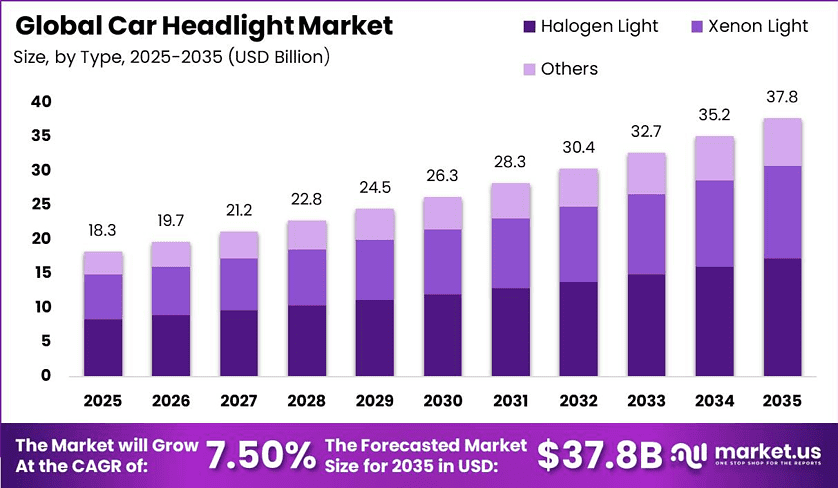
The global car headlight market reached USD 18.3 billion in 2025. It should climb to USD 37.8 billion by 2035, growing at a CAGR of 7.50% from 2026 to 2035. Consequently, lighting suppliers gain a market that more than doubles in a decade.
Car headlights are the forward-facing lighting assemblies that illuminate the road ahead. The market spans halogen, xenon, and LED-based systems, plus adaptive beam units. OEM production lines and aftermarket channels buy these assemblies worldwide for passenger cars and commercial vehicles.
Passenger car makers drive most demand, while commercial fleet operators buy durable lamps to limit downtime. Two-wheeler manufacturers in India and ASEAN adopt LED headlights as component costs fall. Aftermarket retailers also supply retrofit and replacement lamps for older vehicles.
Pixel-level matrix LED architectures shape light beams in real time instead of using fixed optics. Digital micromirror projection headlights can project symbols onto the road. Moreover, software-defined lighting lets automakers change headlight behavior through vehicle software, which opens recurring revenue streams.
Get further insight into the global trends shaping the future of the car headlight industry. Request Sample
Key Takeaways
- Market value stands at USD 18.3 billion in 2025, forecast to reach USD 37.8 billion by 2035.
- The market grows at a CAGR of 7.50% from 2026 to 2035.
- Halogen Light dominates the type segment with a 45.60% share in 2025.
- Passenger Car dominates the application segment with a 74.20% share in 2025.
- Asia-Pacific leads all regions with a 42.8% share, valued at USD 7.83 billion in 2025.
Market Segmentation Overview
Halogen Light dominates types with a 45.60% share because of low cost and broad vehicle compatibility. AAA data shows halogen lamps remain in over 80% of vehicles on the road. Consequently, aftermarket replacement demand stays steady even as OEMs move toward LED.
Moreover, Xenon Light holds 36% in mid-premium vehicles where HID performance justifies the cost. HID and LED systems light roads 25% further than halogen. However, LED systems now reach price parity in OEM supply chains, which erodes xenon’s position over time.
Others, at 18.4%, covers LED matrix, laser, and adaptive beam systems. AAA reports European adaptive driving beam headlights raise roadway lighting by up to 86% over US low beams. In January 2025, FORVIA HELLA built LED Matrix headlamps for the smart #5 in China.
Passenger Car dominates applications with a 74.20% share because of high global production volumes and DRL mandates. AAA data shows 64% of Americans do not regularly use high beams. Therefore, adaptive systems that adjust beams automatically lift content value per vehicle.
Additionally, Commercial Vehicle accounts for 25.80%, driven by fleet safety requirements and heavy transport lighting rules. Operators face strict downtime penalties, so they prefer long-life LED systems. Consequently, suppliers offering integrated front and rear lighting with unified light signatures hold an advantage in this segment.
Drivers
The upgrade from halogen and basic LED to projector, matrix, and adaptive beam systems adds about 2.2% to the CAGR. Adaptive systems need costlier optics, drivers, control units, and software calibration. Consequently, suppliers grow faster than vehicle output through a richer product mix.
UNECE-compliant smart lighting adoption adds about 1.8% to the CAGR. UNECE Regulation No. 149 supports standard engineering for adaptive lighting across passenger and commercial platforms. Therefore, suppliers scale one product design across many OEM programs, which cuts per-unit compliance cost.
Use Cases
Passenger car makers use adaptive driving beam headlights to optimize beam output automatically. Most low beams fall short at speeds above 39 mph, according to AAA. As a result, drivers see further without manual high-beam switching, and automakers raise lighting content per vehicle.
Moreover, commercial fleets use combined front and rear lighting such as FORVIA HELLA’s LeanLED II, which entered series production in June 2026. The unified light signature suits commercial and special vehicles. Consequently, operators gain durable, compliant lighting from a single supplier.
Major Challenges
Homologation burdens suppliers that manage US DOT, UNECE, and regional standards at once. Adaptive beams and software-managed lighting face different testing pathways, creating a drag of about 0.9 percentage points on CAGR. Consequently, validation lead times grow by one or two development gates.
However, tariffs raise costs for OEMs and suppliers. A March 2025 US action imposed a 25% tariff on imported automobiles and extended it to certain parts. As a result, OEMs limit advanced lighting on cost-sensitive trims and press suppliers for price cuts.
Get further insight into the global trends shaping the future of the car headlight industry. Request Sample
Business Opportunities
ADB mass-market scaling offers the largest near-term upside at 2.3%. NHTSA’s 2022 rule amended FMVSS 108 to permit ADB, yet adoption stays mostly in premium trims. Therefore, take rates rising by 6 to 8 percentage points could add an estimated USD 80 to USD 150 per vehicle.
Additionally, retrofit channels remain underused because halogen lamps sit in over 80% of vehicles and LED conversion kits are scarce in emerging markets. Suppliers that build distribution in India, ASEAN, Latin America, and the Middle East and Africa capture recurring replacement revenue without competing for OEM contracts.
Regional Analysis
Asia-Pacific leads with a 42.8% share, valued at USD 7.83 billion in 2025. High-volume vehicle production in China, India, and Southeast Asia drives large OEM headlight procurement across all vehicle classes. Consequently, the region becomes the main battleground for OEM supply contracts.
North America faces a delayed regulatory path. Toyota petitioned NHTSA for ADB approval in 2013, but the final rule arrived in 2022. Consequently, OEMs now accelerate ADB integration. Meanwhile, Europe scales adaptive lighting through UNECE Regulation No. 149 and DRL mandates in force since 2011.
Recent Developments
- January 2025 — FORVIA HELLA developed customized LED Matrix headlamps for the new smart #5 in China.
- February 2025 — FORVIA HELLA expanded its SlimLine family with an LED lamp combining daytime running, position, and indicator functions for commercial and off-highway vehicles.
- September 2025 — Valeo and Ennostar introduced a Mini LED high-definition exterior display at IAA Mobility 2025, enabling V2X communication.
- October 2025 — FORVIA HELLA launched FlatLight DRL technology, cutting installation depth to 5 mm and improving energy efficiency by up to 40%.
- June 2026 — FORVIA HELLA began series production of LeanLED II, a combined front and rear lighting system for commercial and special vehicles.
Conclusion
The car headlight market grows from USD 18.3 billion in 2025 at a CAGR of 7.50%. Adaptive LED upgrades, smart lighting rules, and rising electronic content per vehicle power this growth. Meanwhile, tariffs, chip allocation pressure, and homologation costs temper the pace.
Halogen Light leads types with 45.60%, and Passenger Car leads applications with 74.20%. Xenon Light follows at 36%, while Commercial Vehicle holds 25.80%. Asia-Pacific anchors regional demand with 42.8%. These leaders show where installed-base volume, aftermarket demand, and OEM production concentrate.
Companies must invest in adaptive beam platforms, modular compliance engineering, and retrofit distribution to capture growth. Moreover, suppliers with domestic or Mexico-US integrated supply chains can offset tariff costs. Those moves position the market to reach USD 37.8 billion by 2035.
Looking for data tailored to your specific market, region, or business need? Request a custom report or consultation — write to us at sales@market.us
Discuss your needs with our analyst
Please share your requirements with more details so our analyst can check if they can solve your problem(s)