Market Overview
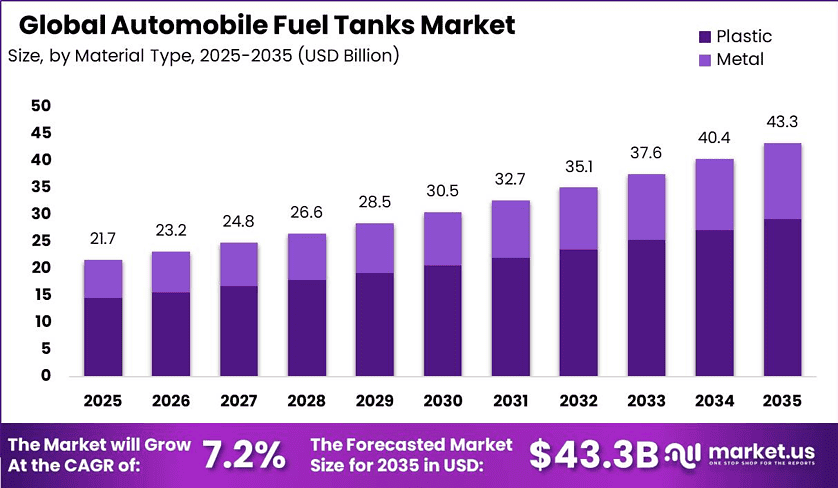
The Global Automobile Fuel Tanks Market is projected to reach USD 43.3 Billion by 2035, up from USD 21.7 Billion in 2025. Analysts expect a CAGR of 7.2% from 2026 to 2035. Vehicle production growth, emissions compliance, and hybrid-ready tank designs sustain this demand.
Automobile fuel tanks are onboard storage systems fitted to passenger cars, light commercial vehicles, and heavy commercial vehicles. Makers build them from plastic or metal in capacities below 45 L, between 45 L and 75 L, and above 75 L. OEMs buy original-fit systems, while aftermarket channels supply replacements.
Passenger cars and entry-level SUVs drive most volume, since they form the largest share of global vehicle output. Light commercial fleets use mid-capacity tanks for last-mile delivery and municipal services. Meanwhile, heavy trucks need large, reinforced tanks for long-haul freight, and full-size SUVs and pickups also need extended range.
Technology and materials keep evolving. Multilayer plastic barrier constructions meet strict permeation limits, while smart fuel-system sensing adds monitoring. In January 2025, TI Fluid Systems announced it was adapting blow-molded plastic tank technology for hybrid vehicles. Consequently, suppliers with hybrid-ready engineering win stronger OEM relationships and higher value per unit.
Get further insight into the global trends shaping the future of the automobile fuel tanks industry. Request Sample
Key Takeaways
- Market size reached USD 21.7 Billion in 2025 and will reach USD 43.3 Billion by 2035.
- The market grows at a CAGR of 7.2% during 2026 to 2035.
- The 45 L to 75 L segment dominates capacity type with a 48.6% share.
- Plastic tanks lead material type with a 67.4% share.
- Passenger Cars account for 62.7% of vehicle type share.
- Asia-Pacific dominates with a 46.82% share.
Market Segmentation Overview
The 45 L to 75 L segment dominates capacity type with a 48.6% share in 2025. It matches fuel system needs on mainstream passenger cars and entry-level SUVs. Consequently, suppliers that optimize blow-molding tooling and barrier-layer stacks for this range capture the highest volume throughput.
Moreover, tanks below 45 L serve compact vehicles in dense urban markets across Asia and Latin America, where production in India and ASEAN keeps expanding. Tanks above 75 L serve full-size SUVs, pickups, and heavy trucks. SUVs reached 48% of global car sales in 2023, per the IEA, which sustains demand for high-capacity multilayer tanks.
Plastic tanks dominate material type with a 67.4% share because they cut weight by up to 40% versus steel. Lighter tanks improve fuel efficiency and help OEMs meet fleet-average CO2 targets. Consequently, plastic is the default engineering choice for passenger car and light commercial platforms worldwide.
However, metal tanks stay relevant where structural durability, puncture resistance, or extreme temperature performance outweigh weight. Heavy commercial vehicles and off-highway equipment form their main base. Therefore, metal suppliers face a narrowing passenger market but preserve volume in commercial and industrial categories where plastic cannot yet fully substitute.
Passenger cars dominate vehicle type with a 62.7% share because they have the highest global production and sales. Global BEV and PHEV sales exceeded 17 million units in 2024, yet most cars still need conventional or hybrid tanks. Light and heavy commercial vehicles add stable demand through delivery fleets and long-haul freight.
Drivers
Hybrid powertrain adoption is the highest-impact driver, adding +2.6% to CAGR. Hybrids keep onboard fuel storage but need compact, pressure-tolerant tanks. Consequently, suppliers that engineer hybrid-compatible architectures build stronger OEM relationships and earn higher per-unit value than standard tank producers.
Moreover, evaporative emissions tightening adds +1.8%, and lightweight plastic tank adoption adds +1.6%. Stricter rules and fuel-efficiency goals push OEMs toward multilayer barrier plastics. Therefore, suppliers with certified low-permeation designs win OEM programs in regulated markets such as the US, EU, Japan, Korea, and China.
Use Cases
Carmakers fit blow-molded plastic tanks to mainstream passenger cars and entry-level SUVs. These tanks cut weight and support emissions compliance. Up to 40% weight reduction drives this choice. Consequently, automakers improve fuel efficiency while meeting hydrocarbon permeation limits in regulated markets.
Additionally, light commercial fleets use ethanol-rated tanks for last-mile delivery, municipal services, and light construction. Operators value range, uptime, and low total cost of ownership. Therefore, suppliers offering certified ethanol-rated tanks with extended warranties hold a pricing advantage in fleet procurement.
Major Challenges
BEV substitution creates the heaviest drag, estimated at -2.7% on CAGR. The EU, China, and North America lead BEV policy support and charging investment. Consequently, suppliers concentrated in European or Chinese passenger platforms face the steepest long-term volume exposure as BEVs displace ICE tank fitments.
However, production footprints are shifting. Asia-Pacific output rose 7.6% to 59.2 million vehicles in 2025, more than 61% of global output, while European production fell 0.8%. Therefore, suppliers must duplicate tooling, relocate production, and rebuild qualification networks, and hybrid packaging adds a -1.6% drag.
Get further insight into the global trends shaping the future of the automobile fuel tanks industry. Request Sample
Business Opportunities
Hybrid-optimized tank platforms offer the highest upside, at +2.3% CAGR within 2 years. Hybrids need pressurized, compact, low-permeation tanks that conventional ICE suppliers cannot immediately serve. Therefore, early movers with certified hybrid programs can secure multi-year OEM supply commitments in the EU, Japan, Korea, and North America.
Additionally, APAC localized platform supply adds +2.1%. Local-content optimization can cut delivered system costs by 5–12%, giving regional suppliers a durable cost and responsiveness advantage over importers. Moreover, multilayer plastic migration adds +1.9%, so suppliers that invest in regional engineering and barrier technology capture both trends.
Regional Analysis
Asia-Pacific leads with a 46.82% share, valued at USD 10.2 Billion. The region produced about 59.2 million vehicles in 2025, including 34.53 million in China and 6.49 million in India. Consequently, suppliers with regional manufacturing capability enjoy a dense, high-volume procurement environment.
Meanwhile, North America favors multilayer barrier designs because EPA evaporative standards are strict and buyers prefer full-size SUVs and pickups. Europe faces output declines of 0.8% and a UK drop of 15.5%. Yet hybrid transition sustains demand for compact, lightweight tanks, while Latin America and MEA offer longer-horizon growth.
Recent Developments
- January 2025 — TI Fluid Systems announced it was adapting blow-molded plastic fuel tank technologies for hybrid vehicles.
- April 2025 — ABC Technologies completed the acquisition of TI Fluid Systems, with the combined business operating under the TI Automotive brand.
- July 2025 — TI Automotive announced plans to showcase ultra-light pressurized hybrid fuel tank technologies at IAA Mobility 2025.
Conclusion
The automobile fuel tanks market doubles in a decade, rising from USD 21.7 Billion in 2025 at a 7.2% CAGR. Vehicle output recovery, hybrid adoption, and emissions rules drive this growth. However, BEV substitution and compliance costs weigh on conventional tank demand, so suppliers must adapt their portfolios.
Mid-capacity tanks, plastic, and passenger cars lead their segments with shares of 48.6%, 67.4%, and 62.7%. Asia-Pacific leads regionally with 46.82%. Meanwhile, North America and Europe add strict emissions standards and hybrid demand. Each leader reflects high volumes, lighter weight, and mainstream platform fit.
Companies must develop hybrid-ready tanks, localize production in Asia-Pacific, and invest in multilayer barrier technology to capture this opportunity. Suppliers should also add smart sensing and ethanol-rated designs. Those that act early will secure long-term OEM contracts as the market reaches USD 43.3 Billion by 2035.
Looking for data tailored to your specific market, region, or business need? Request a custom report or consultation — write to us at sales@market.us
Discuss your needs with our analyst
Please share your requirements with more details so our analyst can check if they can solve your problem(s)