Market Overview
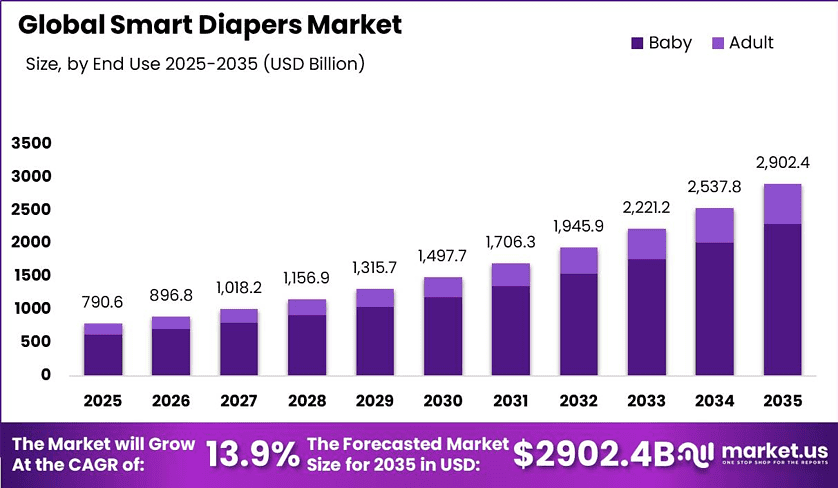
The Global Smart Diapers Market is projected to reach USD 2,902.4 Billion by 2035, up from USD 790.6 Billion in 2025. Analysts expect a CAGR of 13.9% from 2026 to 2035. Sensor-driven monitoring is turning a basic hygiene product into a connected care tool.
Smart diapers are sensor-embedded absorbent products that detect moisture and track urination patterns. They send caregiver alerts through wireless protocols. Two core technologies, RFID and Bluetooth, power these products. Parents use them for baby care, while nursing homes and families use them for adult continence management.
Nursing homes and long-term care facilities lead institutional adoption. NCBI data shows more than 50% of long-term care residents have urinary or fecal incontinence. Consequently, smart diapers answer a documented care burden, not a premium add-on. Meanwhile, hospitals and home eldercare managers use them to cut manual checks.
Technology keeps improving. Battery-free sensors, AI analytics, and printed flexible circuits lower costs and improve care. In January 2026, Asahi Kasei Microdevices presented a battery-free smart diaper at CES that generates power from urine. Consequently, institutional buyers avoid battery replacement costs and maintenance work.
Data-Driven Insights for Smarter Business Decisions: Explore the Full Report
Key Takeaways
- Market size is USD 790.6 Billion in 2025 and will reach USD 2,902.4 Billion by 2035 at a CAGR of 13.9%.
- RFID tags dominate technology with a 63.9% share in 2025.
- Baby leads end use with a 79.3% share.
- Online channels hold 59.7% of distribution.
- North America leads with a 36.9% share, valued at USD 291.75 Billion.
Market Segmentation Overview
RFID tags dominate the technology segment with a 63.9% share in 2025 because passive sensing keeps unit costs low. RFID tags need no battery and embed directly into the diaper during manufacturing. Consequently, institutional buyers trust RFID platforms over power-dependent alternatives. Real-world deployments strengthen this confidence.
Moreover, Bluetooth sensors hold 36.1% and enable two-way data transmission with caregiver dashboards and mobile apps. A hospital study recorded 390 urination episodes from 30 patients using a Bluetooth-connected system. Therefore, Bluetooth platforms generate clinically useful datasets for each patient and support EHR integration.
Baby dominates the end use segment with a 79.3% share because infant care drives frequent diaper use. Households buy weekly, which creates strong volume across premium and standard tiers. First-time parents in higher-income brackets also willingly pay for real-time wetness alerts.
Additionally, adult use accounts for 20.7% and concentrates in institutional eldercare. The JMIR study found 89% of participants had dementia and 89% had two or more comorbidities. Therefore, adult products need caregiver dashboard integration and alert escalation features that infant products do not.
Online channels dominate distribution with a 59.7% share because subscriptions reduce churn and caregivers value convenience and comparison. Offline holds the rest and serves hospitals, nursing homes, and long-term care buyers who use vendor contracts and bulk supply. For example, Ontex and Henkel expanded the Orizon rollout for institutional buyers in Europe in March 2026.
Drivers
Aging-led continence demand is the strongest driver, with a +2.7% CAGR impact. WHO projects the population aged 60 and older will rise from 1.0 billion in 2020 to 2.1 billion by 2050. Consequently, eldercare facilities become the most reliable volume buyers for sensor-embedded continence products.
Moreover, nursing labor productivity adds +2.2%. Dementia, stroke-related disability, and incontinence raise caregiver intervention needs, and facilities face caregiver shortages. Therefore, sensor-driven monitoring replaces manual rounding, especially in Japan, Europe, North America, and South Korea. Predictive scheduling also reduces labor demand per patient-day.
Use Cases
Nursing homes use automated urine-volume monitoring in place of manual rounding. Smart continence platforms can reduce manual checks by 20 to 35%. Orizon data from March 2026 shows savings of up to eight caregiver working hours per resident each month. Consequently, facilities build a measurable return on investment.
Additionally, parents use smart diapers for real-time wetness alerts, and home caregivers track patterns through smartphone dashboards. Smartphone dashboards let one caregiver monitor several people at once. Subscription bundles deliver repeat supplies automatically. Therefore, home-based users gain convenience and earlier alerts, while manufacturers gain steadier recurring revenue.
Major Challenges
Premium pricing limits mass adoption. Sensor-embedded disposable diapers cost more, so adoption concentrates among higher-income households. Reimbursement pathways remain limited, and the report assigns premium pricing a -2.3% CAGR impact. Consequently, volume growth beyond early adopters depends on lower sensor costs and clearer reimbursement.
However, birth declines and integration gaps add friction. US births fell 1% to 3,606,400 in 2025, tightening infant volume. Meanwhile, smart diaper data must connect with electronic health records. Without this link, nurses log alerts manually, which weakens the institutional return case.
Business Opportunities
Eldercare continence platforms offer the biggest upside, at +2.8% CAGR within 2 years. The UN estimates one in six people will be over 65 by 2050. Therefore, vendors that show staffing savings in a single facility trial can win nursing home and assisted living contracts.
Additionally, hospital workflow automation adds +2.1%, and home-care subscription bundles add +1.9%. Latin America and the Middle East and Africa remain early-stage, and GCC countries invest in smart hospitals. Consequently, vendors meeting local compliance standards can enter private urban care facilities with limited competition.
Data-Driven Insights for Smarter Business Decisions: Explore the Full Report
Regional Analysis
North America leads with a 36.9% share, valued at USD 291.75 Billion in 2025. Advanced connected healthcare, high long-term care adoption, and strong premium infant spending drive this lead. The United States holds most regional revenue through nursing home procurement and direct-to-consumer subscriptions.
Meanwhile, Europe benefits from aging populations in Germany, France, Italy, and the Nordics, where public eldercare funding embeds continence care. Asia Pacific expands fast, led by Japan’s acute eldercare labor shortage and China’s premium infant market, while South Korea and Australia show emerging adoption.
Recent Developments
- September 2025 — Monit Corp. launched the MECS PRO AI-IoT smart diaper care system for institutional elderly-care facilities.
- January 2026 — Asahi Kasei Microdevices presented an updated battery-free smart diaper at CES 2026 that generates power from urine.
- March 2026 — Ontex and Henkel expanded the European rollout of the Orizon smart incontinence solution.
Conclusion
The smart diapers market grows rapidly, rising from USD 790.6 Billion in 2025 at a 13.9% CAGR. Aging populations, caregiver shortages, and cheaper sensors power this climb. However, premium pricing, limited reimbursement, and integration gaps remain barriers, so vendors must prove value with clear savings.
RFID tags, baby care, and online channels lead their segments with shares of 63.9%, 79.3%, and 59.7%. North America leads regionally with 36.9%. Meanwhile, Europe and Asia Pacific add eldercare demand. Each leader reflects low costs, frequent use, and convenient subscription buying.
Companies must build adult continence platforms, integrate with health records, and secure data privacy compliance to capture this opportunity. Brands should also develop low-cost printed sensors and institutional sales teams. Those that act early will secure leadership as the market reaches USD 2,902.4 Billion by 2035.
Looking for data tailored to your specific market, region, or business need? Request a custom report or consultation — write to us at sales@market.us
Discuss your needs with our analyst
Please share your requirements with more details so our analyst can check if they can solve your problem(s)