Market Overview
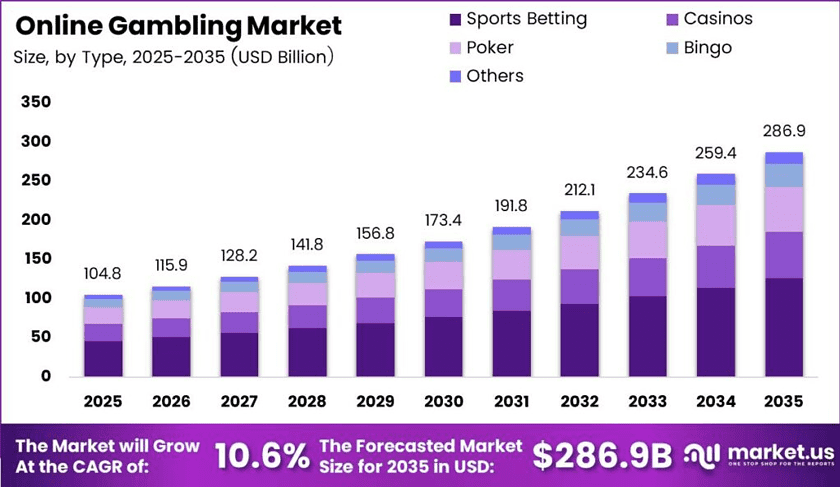
The Global Online Gambling Market is projected to reach USD 286.9 Billion by 2035, up from USD 104.8 Billion in 2025. Analysts expect a CAGR of 10.6% from 2026 to 2035. Regulation, mobile access, and channel migration from retail to digital formats drive this growth.
Online gambling covers real-money wagering on digital platforms, including sports betting, casino games, poker, bingo, and related verticals. Operators deliver services through desktop browsers and mobile apps across regulated and transitional jurisdictions. The market also includes consumer-facing platforms, technology suppliers, and payment infrastructure providers.
Sports betting leads usage, followed by casinos, with poker and bingo adding variety. U.S. commercial gaming revenue reached a record USD 71.92 Billion in 2024. Digital channels generated about 30% of that revenue, up from 13% in 2021. Consequently, players are migrating from physical to digital formats at scale.
Technology sharpens competition. AI-powered personalization tailors odds presentation, bet suggestions, and session pacing, while generative AI chat supports customers during live events. Blockchain provably fair systems add verifiable randomness for transparency-focused players. Consequently, platforms with these tools raise engagement and attract users who distrust traditional casinos.
Data-Driven Insights for Smarter Business Decisions: Explore the Full Report
Key Takeaways
- Market value is USD 104.8 Billion in 2025 and reaches USD 286.9 Billion by 2035.
- The market grows at a CAGR of 10.6% from 2026 to 2035.
- Sports Betting dominates the type segment with a 43.9% share.
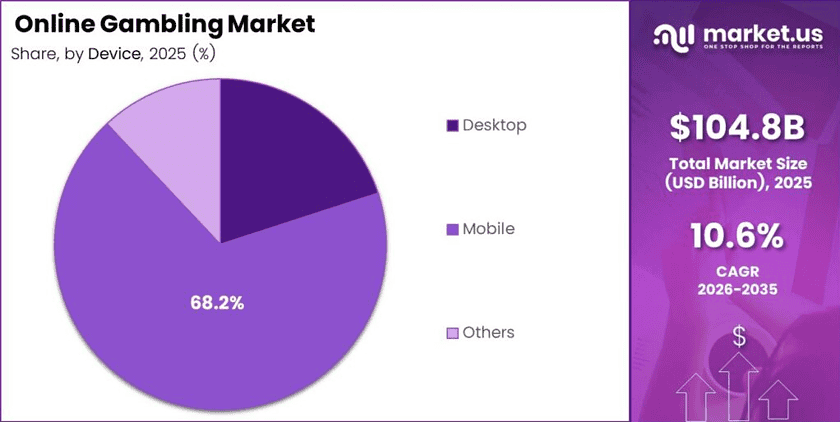
- Mobile dominates the device segment with a 68.2% share.
- Europe leads with a 38.5% share, valued at USD 40.4 Billion.
Market Segmentation Overview
Sports betting dominates the type segment with a 43.9% share because regulated markets are broad and live wagering offers depth. Legal US sportsbooks accepted nearly USD 150 Billion in wagers in 2024, up 22.2%. Consequently, sportsbook expansion directly lifts total revenue for operators holding multi-state licenses.
Moreover, casinos form the second major vertical. Online casino revenue in the seven US states with full legal iGaming reached USD 8.41 Billion in 2024, up 28.7%. This growth beats overall commercial gaming, so regulated casino products gain share from retail formats. Poker, bingo, and others add breadth.
Mobile dominates the device segment with a 68.2% share because apps enable continuous in-play wagering. Operators that invest in app performance and push notifications capture higher session frequency and bet volume. Consequently, desktop-first competitors lose ground, even though desktop still supports casino and poker sessions with higher transaction values.
Additionally, other devices, including smart TVs and connected gaming devices, hold a smaller but developing share. Streaming and wagering are converging on these surfaces. Therefore, operators that embed betting mechanics into broadcast and streaming experiences reach audiences who never open dedicated gambling apps today. This opens new acquisition paths.
Drivers
Brazil-led legalization is the largest driver, with a +2.2% CAGR impact. Only SPA-authorized operators may serve Brazilian bettors, and illegal sites face blocking. Consequently, gray-market leakage falls, and compliant brands improve conversion economics, especially those that secured licenses before 2025.
Moreover, US iGaming and sportsbook scaling adds +1.9%. U.S. sports betting revenue reached a record USD 13.71 Billion in 2024, up 25.4%. State-by-state legalization keeps adding addressable players. Therefore, operators with early licenses in high-population states build compounding retention advantages.
Use Cases
Sportsbooks use live and same-game parlay products to keep bettors engaged during events. Mobile apps deliver in-play markets in real time. Consequently, operators raise session frequency and average bet volume, especially among mid-tier depositors who respond to gamification and loyalty tiers.
Additionally, operators use account-to-account payment rails to speed up cashiers and withdrawals. SEPA Instant settles within 10 seconds and can trim payment costs by 50 to 150 basis points of net gaming revenue. Therefore, faster withdrawals lift first-withdrawal satisfaction and 12-month retention by roughly 3 to 5 percentage points.
Data-Driven Insights for Smarter Business Decisions: Explore the Full Report
Major Challenges
Compliance costs keep rising. A mid-to-large operator across 10 to 20 jurisdictions can see compliance headcount grow 12 to 18% yearly, plus onboarding drop-off of 8 to 15%. Consequently, EBITDA faces 40 to 90 basis points of pressure, and compliance cuts the market’s CAGR ceiling by about 1.3 points.
However, AML and KYC rules move earlier in the customer lifecycle. UK-focused expectations require early intervention, sanctions screening, and checks on crypto deposits. Therefore, operators face more verification fallout and slower withdrawals, which divert capital from product development and expansion, with an estimated -1.3% CAGR deduction.
Business Opportunities
M&A roll-ups in mid-tier European, LatAm, and select APAC markets offer the highest long-term upside, at +2.7% CAGR. Fragmented markets contain licensed operators with local customers but limited technology scale. Therefore, acquirers can layer proprietary platforms onto existing regulatory footprints without waiting for new licenses.
Additionally, regulated LatAm localization offers a +2.4% upside, and cross-selling sports bettors into iGaming adds +2.1%. Verified sportsbook accounts reduce acquisition cost for casino and poker. Consequently, operators with unified platforms activate cross-sell without rebuilding KYC for each product line.
Regional Analysis
Europe leads with a 38.5% share, valued at USD 40.4 Billion. Mature regulation across the UK, Germany, the Nordics, and Spain drives this lead. The UK introduced online slot stake limits of GBP 5 per spin for adults over 25 and GBP 2 for ages 18 to 24. These limits reduce short-term revenue per user but reward compliant operators.
Meanwhile, North America is the fastest-formalizing region as states legalize new markets. Latin America is the most active expansion frontier after Brazil’s licensing regime. Asia Pacific remains complex, mixing regulated markets in Australia and Japan with large unregulated corridors, while GCC markets restrict most gambling formats.
Recent Developments
- July 2025 — Intralot announced the acquisition of Bally’s International Interactive Business in a cash-and-shares deal valued at about EUR 2.7 Billion.
- February 2026 — Flutter Entertainment reported nearly 40 Million customers across its global portfolio during 2025.
Conclusion
The online gambling market grows steadily, nearly tripling from USD 104.8 Billion in 2025 at a 10.6% CAGR. Brazil’s legalization, US scaling, and mobile engagement drive this climb. However, tax loads, tighter regulation, and compliance costs remain pressures, so operators must manage margins carefully.
Sports betting and mobile lead their segments with shares of 43.9% and 68.2%. Europe leads regionally with 38.5%. Meanwhile, North America formalizes quickly and Latin America opens new licensed demand. Each leader reflects regulated access, live wagering depth, and app-based convenience.
Companies must secure licenses early, invest in compliance technology, and build unified platforms to capture this opportunity. Operators should also optimize payments and pursue selective acquisitions. Those that act early will secure strong positions and loyal players as the market reaches USD 286.9 Billion by 2035.
Looking for data tailored to your specific market, region, or business need? Request a custom report or consultation — write to us at sales@market.us
Discuss your needs with our analyst
Please share your requirements with more details so our analyst can check if they can solve your problem(s)