Market Overview
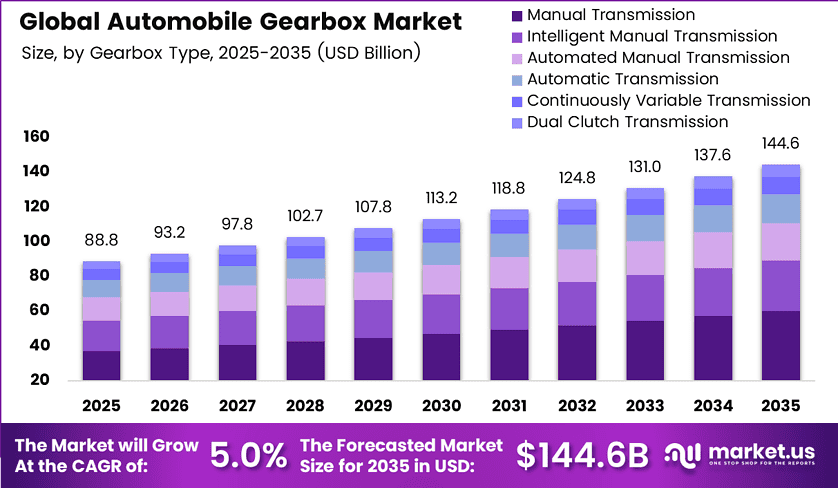
The Global Automobile Gearbox Market is projected to reach USD 144.6 Billion by 2035, up from USD 88.8 Billion in 2025. Analysts expect a CAGR of 5.00% from 2026 to 2035. Vehicle production recovery, hybrid adoption, and commercial fleet expansion support this steady growth.
Automobile gearboxes transfer engine torque to the drivetrain in passenger cars, light commercial vehicles, and heavy commercial vehicles. Makers supply manual, automated manual, automatic, dual-clutch, continuously variable, and intelligent manual types. These systems serve powertrains from pure ICE to hybrid and battery electric configurations.
SUVs and passenger cars lead demand, while commercial fleets sustain heavy-duty needs. Asia-Pacific fleet expansion supports heavy-duty manual and AMT gearboxes. Meanwhile, hybrid models in Europe, Japan, and North America raise transmission content per vehicle, and cost-sensitive markets keep manual and AMT fitment high.
Technology raises gearbox complexity. Modern automatic, dual-clutch, and hybrid units rely on control units, sensors, power electronics, and software updates. Dual-clutch systems deliver about 6% better fuel economy than 6-speed manuals. Consequently, OEMs prefer them on compliance-driven programs, and suppliers invest in mechatronics.
Get further insight into the global trends shaping the future of the automobile gearbox industry. Request Sample
Key Takeaways
- Market size is USD 88.8 Billion in 2025.
- The market reaches USD 144.6 Billion by 2035.
- CAGR is 5.00% from 2026 to 2035.
- Manual Transmission dominates gearbox type with a 41.60% share.
- ICE dominates fuel type with a 69.40% share.
- SUV dominates vehicle type with a 41.70% share.
- North America leads with a 45.20% share, valued at USD 40.1 Billion.
Market Segmentation Overview
Manual transmissions dominate gearbox type with a 41.60% share in 2025 because cost-sensitive markets in Asia and Latin America still fit them widely. However, only about 32% of new European cars in 2023 had manuals. Therefore, this segment faces long-term volume pressure as automatics become more affordable.
Moreover, intelligent manual transmissions hold 20.00% by adding electronic clutch assistance at lower cost than full automatics. AMT holds 15.00% by automating gear selection on manual architectures. Consequently, fleets and cost-sensitive emerging markets use both as transition technologies in the manual-to-automatic shift.
ICE dominates fuel type with a 69.40% share because combustion vehicles still form most global production and registrations. Consequently, multi-gear demand remains the market baseline, especially in commercial and emerging market applications. HEV holds 20.00% and needs motors, planetary gearsets, and electronic controls, which raises transmission value per vehicle.
However, BEVs hold 10.60% and typically use single-speed reduction units. This cuts revenue per vehicle for multi-gear suppliers. Therefore, powertrain diversification becomes a strategic priority for Tier-1 suppliers over the forecast period. They must balance conventional gearboxes with e-axle and reducer offerings.
SUVs dominate vehicle type with a 41.70% share because consumers prefer high-riding vehicles. SUVs need higher torque and more all-wheel drive, which favors automatic and dual-clutch systems and lifts gearbox prices. Meanwhile, hatchbacks and sedans compete on cost, while LCV and HCV segments anchor commercial demand independent of passenger trends.
Drivers
Hybrid drivetrain expansion is the top driver, adding +1.9% to CAGR. Toyota sold 11.3 million vehicles in 2025, with hybrid models driving much of that volume. Consequently, suppliers with qualified hybrid transmission programs capture embedded demand that does not depend on BEV adoption timelines.
Moreover, China’s NEV scale-up adds +1.6% by lifting single-speed reduction gear and e-axle volumes. Euro 7 compliance adds +1.1% by pushing efficient calibration and lightweighting. Therefore, suppliers with e-axle capability and efficient multi-speed designs capture growth in both electrified and compliance-driven programs.
Use Cases
Premium automakers use multi-speed automatic transmissions for performance and efficiency. In February 2026, ZF Friedrichshafen and BMW signed a long-term agreement for 8-speed automatic transmission supply and development through the late 2030s. Consequently, ZF secures forward revenue and shields itself from short-cycle program cancellations.
Additionally, commercial fleets use AMT and step-AT systems. LCVs in urban logistics increasingly adopt AMT, while HCVs in long-haul freight rely on manual or step-AT units. Therefore, Asia-Pacific fleet expansion creates multi-year demand that operates independently of passenger car powertrain trends.
Major Challenges
ICE mix erosion and metal tariffs squeeze suppliers. ICE mix erosion carries a -2.1% CAGR drag, while metal tariff inflation adds -1.8%. Consequently, suppliers face lower multi-gear volumes and higher input costs, and OEM production deferrals further weaken forward revenue. North America, Mexico, and EU exporters face the sharpest tariff exposure.
However, software demands add friction. UNECE R155 and R156 force cybersecurity management and update traceability, creating 10 to 18% longer validation cycles and 15 to 25% more calibration variants. Therefore, suppliers without dedicated validation infrastructure face margin compression and program delays across multi-platform portfolios.
Get further insight into the global trends shaping the future of the automobile gearbox industry. Request Sample
Business Opportunities
E-axle and reducer roll-ups offer the biggest upside at +2.4% CAGR across China, Korea, the EU, and North America. Hybrid-dedicated gearsets add +1.9%, and units sell 10 to 20% above standard manual gearboxes. Therefore, suppliers can expand margins through mechatronically integrated products.
Additionally, shifting 12 to 18% of R&D and capital spending toward hybrid-dedicated units could open a new revenue pool. That pool could equal 8 to 12% of legacy passenger-car transmission sales by 2030. Electrified vehicles reached 22% of US light-duty sales in 2025. Consequently, hybrid demand signals are confirmed, not speculative.
Regional Analysis
North America leads with a 45.20% share, valued at USD 40.1 Billion. Consumers strongly prefer automatics across cars, light trucks, and SUVs, which command premium gearbox prices. Aftermarket replacement demand for aging automatic transmissions adds a second revenue layer beyond new vehicle fitment.
Meanwhile, Europe ranks second as Euro 7 timelines and hybrid adoption keep multi-speed and power-split transmissions relevant. Asia-Pacific drives the highest gearbox production volume, with China’s NEV scale-up and India and ASEAN demand for AMT and manual systems, while Latin America and MEA remain ICE-led.
Recent Developments
- November 2025 — General Motors announced a USD 300 Million investment to expand 10-speed automatic transmission capacity at its Romulus plant in Michigan.
- February 2026 — ZF Friedrichshafen and BMW signed a long-term agreement for 8-speed automatic transmission supply through the late 2030s.
- April 2026 — General Motors confirmed a combined USD 830 Million US manufacturing investment, including USD 300 Million for 10-speed transmissions at Romulus.
Conclusion
The automobile gearbox market grows steadily, rising from USD 88.8 Billion in 2025 at a 5.00% CAGR. Production recovery, hybrid adoption, and Euro 7 compliance support this climb. However, ICE mix erosion, tariffs, and software compliance weigh on margins, so suppliers must diversify their powertrain portfolios.
Manual transmissions, ICE, and SUVs lead their segments with shares of 41.60%, 69.40%, and 41.70%. North America leads regionally with 45.20%. Meanwhile, Europe and Asia-Pacific add hybrid demand and production volume. Each leader reflects affordability, installed vehicle base, and consumer preference.
Companies must build hybrid-dedicated gearsets, develop e-axle products, and invest in software validation to capture this opportunity. Suppliers should also secure long-term OEM agreements. Those that act early will protect revenue and lasting market share as the market reaches USD 144.6 Billion by 2035.
Looking for data tailored to your specific market, region, or business need? Request a custom report or consultation — write to us at sales@market.us
Discuss your needs with our analyst
Please share your requirements with more details so our analyst can check if they can solve your problem(s)