Market Overview
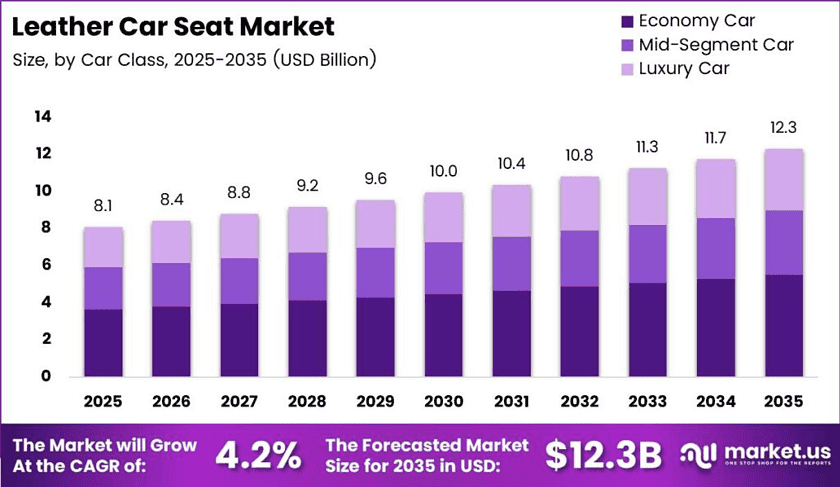
The global leather car seat market reached USD 8.1 billion in 2025. It should rise to USD 12.3 billion by 2035, growing at a CAGR of 4.20% from 2026 to 2035. Consequently, OEMs keep investing in premium cabin materials across conventional and electric vehicles.
Leather car seats include seating surface materials, trim assemblies, and upholstery systems for passenger vehicles. The market spans genuine and synthetic leather for economy, mid-segment, and luxury classes. Vehicle manufacturers buy them for factory programs, while aftermarket providers fit them after purchase.
Automakers use leather seating mainly in SUVs, sedans, and electric cars to lift perceived quality. Ride-hailing and fleet operators retrofit seats to extend vehicle life and improve passenger experience. Meanwhile, owners of older vehicles upgrade interiors where factory leather options are limited or costly.
Material science now shapes competition. Suppliers develop chrome-free leather, lightweight composites, and recycled leather content to meet environmental and weight targets. Additionally, engineers embed sensors beneath seat surfaces for occupant monitoring and posture detection, which turns a trim item into a smart cabin component.
Get further insight into the global trends shaping the future of the leather car seat industry. Request Sample
Key Takeaways
- Market value stands at USD 8.1 billion in 2025, forecast to reach USD 12.3 billion by 2035.
- The market grows at a CAGR of 4.20% from 2026 to 2035.
- Synthetic Leather Seats dominate the type segment with a 61.2% share.
- SUV dominates the car type segment with a 32.5% share.
- Economy Car dominates the car class segment with a 44.3% share.
- OEM Fitment dominates the application segment with a 65.2% share.
- Asia-Pacific leads with a 48.5% share, valued at USD 3.95 billion.
Market Segmentation Overview
Synthetic Leather Seats dominate types with a 61.2% share because they offer consistent quality, color matching, and lower cost at volume. Consequently, OEMs choose them for economy and mid-segment programs. Genuine Leather Seats keep premium pricing in luxury and flagship programs.
SUV leads car types with a 32.5% share because buyers spend more on interior features. OEMs use leather trim packages as a primary value-add. Moreover, Sedan demand stays strong in China and the United States, while Electric Car emerges as a premium seating differentiator.
Economy Car dominates car classes with a 44.3% share because high unit volumes across Asia-Pacific and Latin America generate large seating demand. However, Mid-Segment Car drives upgrades such as perforated leather, and Luxury Car sets design direction with heated, ventilated, and massage-enabled seats.
OEM Fitment dominates applications with a 65.2% share because multi-year sourcing contracts lock in supplier relationships. Strict quality and traceability standards also protect incumbents. Additionally, Aftermarket Fitment serves owners seeking post-purchase upgrades, and it offers higher margin potential per unit for specialized suppliers.
Drivers
Rising Asia-Pacific car output adds about 1.9% to the CAGR. The region produced about 59.2 million vehicles in 2025, over 61% of global output, with China at 34.53 million. Consequently, seat suppliers localize production and expand leather fitment beyond imported luxury models.
Hybrid and EV cabin premiumization adds about 2.0% to the CAGR. Electric models look alike mechanically, so automakers differentiate through seat materials and range-topping interior packages. Therefore, suppliers of premium leather and engineered synthetics win demand across the EU, China, Korea, and North America.
Use Cases
Automakers use leather trim packages in SUV ranges to add value for buyers with larger interior budgets. These packages sell through factory-fit and dealer-installed programs. As a result, leather seating becomes a main driver of trim-level pricing and supplier volume.
Moreover, ride-hailing and fleet operators retrofit seats with modular leather and synthetic systems. The upgrades extend vehicle life and improve the passenger experience. Consequently, aftermarket suppliers earn revenue from existing vehicles without competing for OEM contracts. Demand is growing in this channel.
Get further insight into the global trends shaping the future of the leather car seat industry. Request Sample
Major Challenges
Surface quality consistency challenges seat suppliers because OEMs demand identical appearance across plants and climates. Small deviations in dye absorption, embossing depth, or sewing tension can trigger rejection, rework, or warranty claims. Consequently, this challenge drags the CAGR by about 1.4%.
However, substitution pressure also hurts genuine leather suppliers. Automakers standardize platforms and favor synthetic materials with uniform grain and color, while natural leather needs extra grading. As a result, non-leather premium substitution cuts about 2.4% from the CAGR, and suppliers must add synthetic or bio-based lines.
Business Opportunities
Sustainable premium surfaces offer about 2.4% potential CAGR upside. Volkswagen is developing a 100% bio-based hemp-derived leather alternative for vehicles from 2028. Certified low-impact materials may earn 8% to 15% higher selling prices, which improves margins without needing extra volume.
Additionally, aftermarket and regional channels remain underserved. Aftermarket Fitment holds a minority share against OEM’s 65.2%, and Gulf Cooperation Council markets show high leather content per vehicle. Therefore, suppliers that build retrofit systems and GCC fitment partnerships access premium margins without full OEM program costs.
Regional Analysis
Asia-Pacific leads with a 48.5% share, valued at USD 3.95 billion. China and India deliver large vehicle output and a growing middle-income base. Consequently, OEMs and seat suppliers co-locate production, cutting lead times and logistics costs as domestic automakers add leather-optioned trims.
North America ranks as a strong secondary market, with high per-vehicle leather content in SUVs and trucks. Meanwhile, Europe’s sustainability mandates push automakers in Germany, France, and the UK toward certified synthetic and bio-based alternatives. Latin America develops gradually as Brazil and Mexico expand premium trim options.
Recent Developments
- February 2026 — Adient launched Sculpted Soft Trim technology, cutting sewing requirements by up to 50% while enabling complex premium leather seat designs.
- April 2026 — Apollo Funds agreed to acquire FORVIA’s Automotive Interiors Business for about €1.82 billion, creating a leading independent interior supplier.
- April 2026 — FORVIA announced the €1.82 billion sale of its Interiors Business Group to Apollo Funds to reduce debt and refocus on advanced seating and electronics.
Conclusion
The leather car seat market grows from USD 8.1 billion in 2025 at a CAGR of 4.20%. Rising vehicle output, EV cabin premiumization, and consumer demand for better interiors power this expansion. Meanwhile, material substitution and quality demands moderate the pace.
Synthetic Leather Seats lead with 61.2%, SUV with 32.5%, Economy Car with 44.3%, and OEM Fitment with 65.2%. Asia-Pacific anchors regional demand at 48.5%. These leaders show where volume, cost pressure, and long-term contracts concentrate. Genuine leather remains concentrated in luxury programs.
Companies must develop sustainable materials, tighten process control, and build retrofit and EV-ready seat offerings. Moreover, suppliers with regional production in China and India can serve local OEMs faster. Those moves position the market to reach USD 12.3 billion by 2035.
Looking for data tailored to your specific market, region, or business need? Request a custom report or consultation — write to us at sales@market.us
Discuss your needs with our analyst
Please share your requirements with more details so our analyst can check if they can solve your problem(s)