
Market Overview
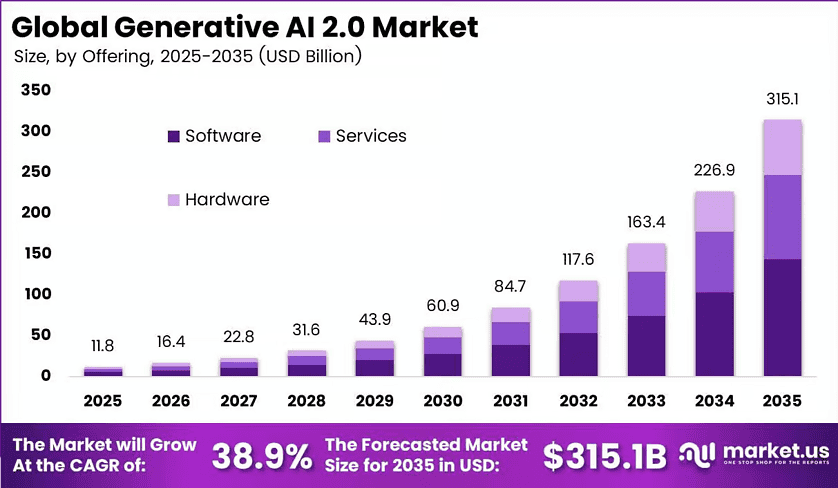
New York, NY – August 20, 2026 – The Global Generative AI 2.0 Market reached USD 11.8 billion in 2025 and may reach USD 315.1 billion by 2035. The market expects a CAGR of 38.9% from 2026 through 2035. Consequently, enterprises increasingly fund generative platforms, AI infrastructure, and specialized deployment services.
Enterprise adoption supports this strong market outlook. According to Stanford HAI, 78% of organizations used AI in at least one business function during 2024, compared with 55% a year earlier. Moreover, generative AI use rose from 33% to 71%, showing that businesses now move beyond early experimentation.
Organizations use generative systems for content, software development, search, customer support, and internal knowledge work. According to McKinsey, 88% of surveyed organizations reported regular AI use in at least one business function in 2025. Therefore, vendors gain broader demand for model access, governance tools, and workflow integration services.
North America led the Generative AI 2.0 Market during 2025, holding more than 45.0% share and generating about USD 5.31 billion in revenue. The United States drives this position through cloud investment, model developers, and venture funding. Additionally, regional capacity supports large-scale training and inference workloads.
Infrastructure suppliers benefit from enterprise demand for accelerated computing. According to NVIDIA, fiscal 2025 revenue reached USD 130.5 billion, while data center revenue reached USD 115.2 billion. These results show that customers continue purchasing compute capacity for generative workloads, which strengthens the wider AI technology supply chain.
Key Takeaways
- The market reached USD 11.8 billion in 2025 and may reach USD 315.11 billion by 2035, reflecting a CAGR of 38.9%.
- Software led the offering segment with a 57.85% share, while services represented the fastest-growing offering category.
- Text led data modalities with a 36.1% share, while multimodal systems grew fastest as users adopted combined text, image, audio, and video capabilities.
- Content creation led applications with a 38.2% share, while conversational AI expanded fastest across service and employee support workflows.
- Media and entertainment led industry verticals with a 29.7% share because studios increased use across visual effects, dubbing, and production support.
- North America led the market with a 45.0% share and USD 5.31 billion in revenue, supported by cloud capacity and enterprise investment.
➤ Unlock the Sample Version of This Premium Report with Detailed Tables & Figures – https://market.us/report/generative-ai-2-0-market/request-sample/
Market Segmentation
Software leads the offering segment with a 57.85% share because enterprises purchase subscription platforms, APIs, and integrated AI applications. Recurring licenses support predictable vendor revenue and faster enterprise rollout. Moreover, services grow rapidly because companies need implementation, model tuning, governance, security, and workforce support for production deployment.
Hardware remains essential because high-performance chips, networking equipment, memory, and data centers power advanced model training and inference. However, software platforms capture more direct enterprise spending because business teams access AI through applications. Consequently, technology providers increasingly combine infrastructure, managed services, and business software into complete generative AI offerings.
Text leads the data modality segment with a 36.1% share because language models support search, summarization, coding, writing, and knowledge retrieval. Text-based tools fit daily office workflows and require familiar user behavior. Additionally, multimodal systems grow fastest because they process text, images, audio, video, and documents within unified experiences.
Audio and speech tools support transcription, voice assistance, localization, and call-center automation. Image and video systems support design, advertising, visual effects, and product content. Consequently, code models help developers generate, test, and document software faster, while organizations use combined modalities to create richer automation across customer and employee journeys.
Content creation leads applications with a 38.2% share because marketing teams, agencies, and studios integrate AI into existing creative workflows. Generative tools help users draft copy, create images, edit video, and adapt assets. Moreover, conversational AI grows quickly as businesses deploy virtual agents for support, sales, and internal assistance.
Code generation supports software teams with development, testing, troubleshooting, and documentation work. Synthetic data helps teams improve model training where sensitive or limited datasets restrict access. Therefore, product discovery and visual effects tools help retailers and digital platforms recommend products, tailor messages, and improve customer experiences through relevant content.
Media and entertainment leads industry verticals with a 29.7% share because studios use generative tools for visual effects, dubbing, localization, and campaign production. Creative teams seek faster asset development without changing established pipelines. Additionally, healthcare, banking, retail, automotive, and advertising organizations adopt AI for specialized business workflows.
Healthcare organizations use generative solutions for documentation, patient communication, and clinical support under strict controls. BFSI firms apply AI to service, compliance, research, and risk workflows. Consequently, e-commerce, automotive, marketing, and advertising companies use intelligent systems to strengthen personalization, content production, product design, and consumer engagement.
Regional Analysis
North America dominates the Generative AI 2.0 Market with a 45.0% share and approximately USD 5.31 billion in revenue. United States hyperscalers, model developers, and investors build major training and inference capacity. Therefore, regional enterprises access mature cloud infrastructure and a broad ecosystem of AI suppliers.
Asia Pacific grows fastest as China, Japan, South Korea, and India expand cloud investment, local models, and digital skills. Europe also holds a strong position through sovereign computing programs and compliance-focused deployment. Moreover, Latin America and Middle East markets offer growing demand as local businesses seek practical automation and multilingual AI services.
Drivers
Hyperscaler capital investment drives market expansion by adding servers, custom processors, networking capacity, and data-center power. Large cloud providers build the infrastructure that enterprises need for advanced AI workloads. Consequently, wider capacity can improve access to model services and support faster rollout across global business operations.
Enterprise copilot standardization also drives adoption as companies embed AI assistants into productivity, customer service, coding, and analytics tools. Business teams value systems that work inside familiar applications. Moreover, falling inference costs help organizations test more use cases, reduce entry barriers, and move selected projects from pilots into daily operations.
Use Cases
Marketing and media teams use generative AI to create campaign concepts, product descriptions, images, video drafts, and localized material. Content teams can adapt messages for different audiences while keeping brand standards in view. Consequently, creative departments reduce repetitive work and spend more time on planning, review, and final decision-making.
Customer service teams deploy conversational AI for routine questions, account guidance, employee support, and knowledge search. These tools direct users toward relevant answers and transfer complex matters to human specialists. Moreover, service leaders can improve response consistency while helping agents focus on sensitive, high-value, or unusual customer needs.
Business Opportunities
Vertical-specific foundation models offer strong opportunities because regulated sectors need domain knowledge, traceable data, and tailored workflows. Healthcare, insurance, legal services, and industrial operations can benefit from focused solutions. Therefore, vendors that combine trusted data, compliance controls, and practical interfaces can build stronger customer value and premium service models.
Edge and on-device inference create opportunities for companies that need faster responses, privacy controls, or limited network dependence. Device makers can place selected intelligence closer to users and operations. Additionally, emerging-market businesses can adopt accessible AI tools for sales, support, education, and administration as digital infrastructure expands.
Major Challenges
AI talent shortages challenge market growth because organizations need skilled engineers, data specialists, product leaders, and governance teams. Competition raises hiring costs and can delay important deployments. Consequently, companies invest in internal training, partner ecosystems, and managed services to build practical capabilities without relying only on scarce specialists.
Model reliability and data governance also remain major concerns. Incorrect outputs, unclear data rights, fragmented rules, and weak controls can reduce business confidence. However, companies can manage these risks through human review, quality testing, access policies, documented data practices, and clear accountability for high-impact AI decisions.
Top Key Players in the Market
- OpenAI
- Alphabet Inc. (Google and Google DeepMind)
- Microsoft Corporation
- NVIDIA Corporation
- Amazon Web Services
- Meta Platforms, Inc.
- Anthropic
- IBM Corporation
- Adobe Inc.
- Salesforce, Inc.
- Oracle Corporation
- SAP SE
- Cohere
- Stability AI
- Baidu, Inc.
- xAI
Conclusion
The Generative AI 2.0 Market shows strong momentum as enterprises adopt intelligent software, cloud infrastructure, and specialized services across everyday workflows. North America currently leads, while Asia Pacific expands quickly and Europe strengthens compliant deployments. Consequently, vendors that improve reliability, control costs, address skills gaps, and build industry-focused solutions can capture durable demand across the evolving AI economy.
Discuss your needs with our analyst
Please share your requirements with more details so our analyst can check if they can solve your problem(s)