Market Overview
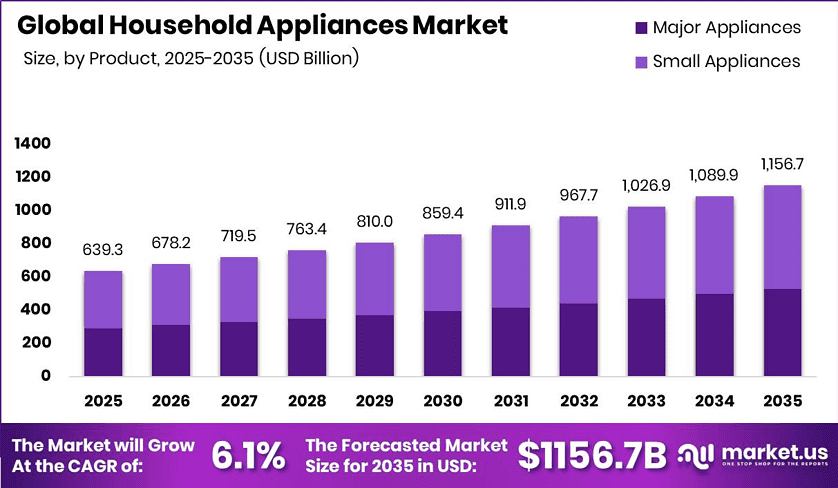
The Global Household Appliances Market is projected to reach USD 1,156.7 Billion by 2035, up from USD 639.3 Billion in 2025. Analysts expect a CAGR of 6.1% from 2026 to 2035. The market adds more than USD 517 Billion in value over the decade.
Household appliances are electrical and mechanical devices that handle food preparation, fabric care, climate control, and personal grooming at home. Major appliances include refrigerators, washing machines, and air conditioners. Small appliances include everyday products such as coffee makers, air fryers, and electric trimmers.
Households buy these products through electronic stores, supermarkets, exclusive brand outlets, and online channels. Urban families in Asia Pacific, India, and Southeast Asia buy first-time appliances as incomes rise. Meanwhile, mature markets in North America and Europe focus on replacing older units with smarter models.
Technology upgrades the category fast. AI and IoT integration, edge computing, and Matter and Thread interoperability create smart home ecosystems. In December 2025, LG Electronics unveiled a SIGNATURE refrigerator with generative AI functions. Consequently, premium makers now treat AI as core product architecture, not an optional feature.
Data-Driven Insights for Smarter Business Decisions: Explore the Full Report
Key Takeaways
- Market value is USD 639.3 Billion in 2025.
- The market reaches USD 1,156.7 Billion by 2035, at a CAGR of 6.1%.
- Small Appliances dominate the product segment with a 54.2% share.
- Electronic Stores lead distribution with a 37.2% share.
- Asia Pacific dominates with a 48.9% share, valued at USD 312.6 Billion.
Market Segmentation Overview
Small appliances dominate the product segment with a 54.2% share in 2025. Coffee makers, air fryers, hair dryers, and air purifiers carry lower prices and shorter replacement cycles. Consequently, vendors in this segment enjoy higher annual transaction volumes per household.
Moreover, major appliances hold 45.8% and cover refrigerators, washing machines, air conditioners, and dishwashers. Each sale carries higher value but happens less often. In June 2025, Samsung launched the Bespoke AI Laundry Combo, which merges washing and drying with AI fabric care for space-saving urban homes.
Electronic stores lead distribution with a 37.2% share because shoppers want hands-on comparison before high-value purchases. Strong placement there lifts brand visibility and lets makers demonstrate premium features at the point of sale. Consequently, complex products suit store demonstrations.
Additionally, supermarkets and hypermarkets hold 23%, serving convenience purchases of small appliances and accessories. Exclusive brand outlets hold 20% but face margin erosion as price comparison moves online. Therefore, brands must balance showroom experience with competitive pricing to protect margins and customer loyalty.
Online channels account for 15% of distribution, yet they matter more than the share suggests because they grow faster than physical formats. Online platforms lower entry costs for challenger brands and compress geographic barriers. Consequently, established brands face rising price pressure from digital-first rivals and price-comparison tools.
Drivers
AI and IoT integration leads all drivers, with a +1.8% impact on CAGR. Smart ecosystems combine AI, edge computing, and Matter and Thread interoperability. Consequently, brands that connect refrigerators, laundry, and cleaning devices into one platform win premium buyers in North America and fast-growing Asia Pacific corridors.
Moreover, urbanization and middle-class growth add +1.5%. Rising incomes in India and Southeast Asia drive first-time appliance ownership. Meanwhile, over 250 new or updated efficiency policies arrived in 2025. Therefore, regulation and income growth together lift replacement and first-time demand.
Use Cases
Households use heat pump water heaters with model-predictive control to cut energy bills. A 2025 field study found 37% lower energy use, plus electricity-cost cuts of 23% under time-of-use pricing and 28% under hourly pricing. Consequently, homeowners gain a measurable reason to replace legacy systems.
Additionally, urban families use multi-function appliances to save space. Samsung’s Bespoke AI Laundry Combo integrates washing and drying in one unit. ENERGY STAR certified clothes washers use about 20% less energy and 30% less water. Therefore, buyers gain convenience and lower running costs.
Major Challenges
Tariffs raise costs and reduce affordability. The US imposed a 145% tariff on Chinese imports at its 2025 peak, and aggregate tariffs on Chinese goods now sit near 48%. By mid 2026, ovens rose about 9% versus mid 2025. Consequently, manufacturers face a dual squeeze on revenue and costs.
However, new trade measures may add pressure. The US administration proposed 12.5% forced-labor tariffs in June 2026 and is consulting on a 15% copper tariff for 2027. Memory and semiconductor supply tightness adds further drag. Therefore, OEMs must diversify sourcing and protect margins.
Data-Driven Insights for Smarter Business Decisions: Explore the Full Report
Business Opportunities
Health sensing in major appliances offers an untapped adjacent market. Fewer than 8% of white goods shipped in 2025 included validated health sensing hardware. A premium tier with PM2.5 sensing, VOC detection, and nutritional analytics could command 25 to 40% price premiums, and the report assigns it +1.5% CAGR upside.
Additionally, frontier markets offer the biggest upside, at +2.2% CAGR across Sub-Saharan Africa, India Tier-2 and Tier-3 cities, Bangladesh, and Pakistan. Appliance-as-a-Service subscriptions add +1.8% within 2 years. Therefore, brands that localize products and test subscription models early can build recurring revenue in new regions.
Regional Analysis
Asia Pacific leads with a 48.9% share, valued at USD 312.6 Billion. Fast urbanization, a rising middle class in China, India, and Southeast Asia, and first-time ownership at scale drive demand. Manufacturing depth in China, Vietnam, and India also gives producers a cost advantage, which locks in regional leadership.
Meanwhile, North America is a high-value replacement market. In June 2025, GE Appliances announced a USD 490 million investment to move washing machine production from China to Kentucky. Europe, under Ecodesign rules and Digital Product Passports from 2027 to 2028, raises quality floors and keeps selling prices structurally high.
Recent Developments
- June 2025 — Samsung launched the Bespoke AI Laundry Combo with AI fabric care.
- June 2025 — GE Appliances announced a USD 490 million move of washing machine production to Kentucky.
- December 2025 — LG Electronics unveiled its SIGNATURE refrigerator with generative AI.
- December 2025 — Warburg Pincus and Bharti Enterprises agreed to buy a 49% stake in Haier India, valued near USD 1.67 billion.
- January 2026 — Bosch launched its first Matter-enabled refrigerator, the 100 Series French Door model.
- January 2026 — Hisense introduced the ConnectLife AI X-Zone Master Washer-Dryer with modular multi-drum design.
- January 2026 — Samsung unveiled the Bespoke AI Jet Bot Steam Ultra robotic vacuum with liquid detection.
- January 2026 — Bosch added Matter support across major appliance categories through Home Connect.
- January 2026 — Hisense showcased AI kitchen appliances with cross-device automation on ConnectLife.
Conclusion
The household appliances market is on a strong path, rising from USD 639.3 Billion in 2025 at a 6.1% CAGR. AI integration, urbanization, and efficiency rules drive this growth. However, tariffs and rising input costs squeeze margins, so manufacturers must manage supply chains carefully.
Small appliances and electronic stores lead their segments with shares of 54.2% and 37.2%. Asia Pacific leads regionally with 48.9%. Meanwhile, North America and Europe add high-value replacement demand. Each leader reflects frequent purchases, hands-on shopping, and rising incomes in emerging economies.
Companies must embed AI, build energy-efficient compliant products, and diversify sourcing to capture this opportunity. Brands should also test subscription models and expand into frontier markets. Those that act early will secure leadership and lasting customer loyalty as the market reaches USD 1,156.7 Billion by 2035.
Looking for data tailored to your specific market, region, or business need? Request a custom report or consultation — write to us at sales@market.us
Discuss your needs with our analyst
Please share your requirements with more details so our analyst can check if they can solve your problem(s)