Market Overview
The Global Wallpaper Market is projected to reach USD 4.0 Billion by 2035, up from USD 2.0 Billion in 2025. Analysts expect a CAGR of 7.40% from 2026 to 2035. The market doubles in value within a decade, so timing and segment choice matter for investors.
Wallpaper includes decorative and functional wall coverings for homes and commercial spaces. Producers make nonwoven, vinyl, paper, fabric, and other substrate types. Interior designers, contractors, retail chains, and e-commerce platforms carry these products to buyers. This structure creates both fragmentation risks and consolidation opportunities.
Homeowners drive most demand through frequent décor refreshes and renovation projects. Hotels, healthcare facilities, and retail environments choose durable vinyl for high-traffic walls. Meanwhile, designers and contractors specify wallcoverings for corporate, hospitality, and public buildings, which adds steady institutional volume, especially across Europe.
Technology improves buying and production. Digital printing enables on-demand customization, while AR visualization tools reduce purchase friction and returns in e-commerce. AI-powered generative design platforms also let brands offer print-on-demand patterns. Consequently, manufacturers that adopt these tools serve personalized orders faster.
Data-Driven Insights for Smarter Business Decisions: Explore the Full Report
Key Takeaways
- Market value stands at USD 2.0 Billion in 2025.
- The market will reach USD 4.0 Billion by 2035.
- The market grows at a CAGR of 7.40% from 2026 to 2035.
- Nonwoven is the dominant product sub-segment.
- Residential holds the dominant end use position.
- Asia-Pacific dominates with a 44.6% share, valued at USD 0.88 Billion in 2025.
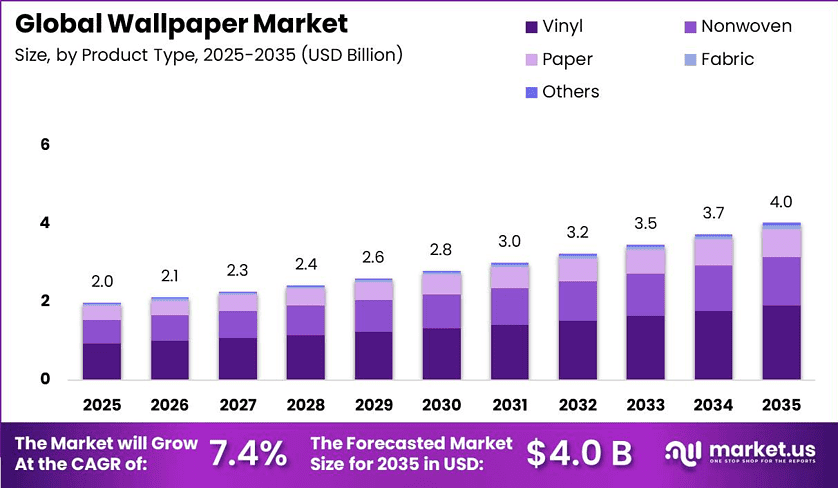
Market Segmentation Overview
Nonwoven wallpaper dominates the product segment with the leading share in 2025. It offers tear resistance, dimensional stability, and compatibility with low-VOC adhesives. Consequently, professional installers and DIY consumers prefer it, and brands targeting renovation-active homeowners treat nonwoven as their default substrate.
Moreover, vinyl wallpaper keeps strong demand in commercial spaces because it resists moisture, wears slowly, and cleans easily. Hotels and healthcare facilities depend on it. However, tightening EU sustainability rules limit vinyl’s growth ceiling, even though commercial use gives it stable baseline volume. Fabric and other substrates complete the product range.
Paper wallpaper serves the premium and heritage design niche, especially in European homes. Houzz data shows 56% of homeowners planned wall-surface renovation within 12 months. This active buyer pool suits curated, trend-led collections, as WallPops showed with its Morris & Co. peel-and-stick launch in February 2026.
Residential dominates the end use segment with the leading share, because homeowners refresh décor often and renovate actively. The NY Post found 59% of planned 2025 renovation projects focused on interiors. This interior bias directs most renovation spend toward wall surfaces and makes residential the primary demand engine.
Additionally, commercial end use captures hospitality, retail, healthcare, and corporate interiors. Sherwin-Williams data shows 74% of millennial homeowners planned interior painting within one year. As this cohort earns more, its spending on premium commercial and residential interiors should lift volumes for mid-to-premium wallpaper brands.
Drivers
Renovation activity powers demand. The NY Post reports 43% of US homeowners completed projects in 2025, 32% already plan projects for 2026, and 65% expect their biggest renovation year yet. This pipeline converts directly into wall-surface upgrades. Consequently, the report assigns residential renovation the top driver impact, at +1.2% on CAGR.
Moreover, sustainability mandates reshape products. Recycled-fiber wallpapers reached 28% penetration in EU retail by 2025, proving eco-certified products are mainstream. Therefore, manufacturers that align portfolios with EU Ecodesign and VOC rules now gain first-mover advantage as enforcement tightens through the decade.
Use Cases
Hotels, healthcare facilities, and retail stores use vinyl wallcoverings on high-traffic walls. These buyers need moisture resistance and easy cleaning. Consequently, commercial projects supply stable baseline volume, while antimicrobial and functional wallcoverings open a healthcare and hospitality niche with a +1.2% CAGR upside.
Additionally, renovating homeowners use peel-and-stick and heritage designs to refresh rooms quickly. In February 2026, WallPops launched eight Morris & Co. archive designs as peel-and-stick products. Therefore, renters and heritage-minded buyers gain an easy upgrade path without permanent installation or heavy labor.
Major Challenges
Vinyl cost swings and tariffs squeeze margins. US imports from China fell 28% in 2025, and many Chinese imports carry about 55% cumulative tariffs. Consequently, distributors absorb margin compression or raise prices, and lead times grow while product variety shrinks in cost-sensitive segments.
However, omnichannel logistics add friction. Online return rates for damaged or wrong wallpaper rolls run 18 to 24%, and 70% of logistics leaders report customs delays. Omnichannel technology also costs USD 200,000 to 600,000 yearly per unit. Therefore, smaller players lose share to well-capitalized, platform-native rivals.
Business Opportunities
The EU’s proposed Circular Economy Act, targeted for adoption by end-2026, will tighten sustainability rules in public purchasing. Europe also allocated EUR 101 Million to circular and bioeconomy initiatives in 2026. Consequently, early-certified suppliers capture 30 to 50% of contract value in regulation-driven procurement markets.
Additionally, AI-powered generative design and direct-to-consumer print-on-demand platforms offer a +1.8% CAGR upside within 2 years. Peer influence speeds adoption, as 27% of homeowners draw inspiration from neighbors’ projects. Therefore, brands that seed launches in design communities accelerate discovery without relying only on paid ads.
Data-Driven Insights for Smarter Business Decisions: Explore the Full Report
Regional Analysis
Asia-Pacific leads with a 44.6% share, valued at USD 0.88 Billion in 2025. Mid-income urbanization, residential construction in China, India, and Southeast Asia, and rising middle-class spending on interior finishes drive this lead. Consequently, early manufacturing or distribution presence there creates a structural cost advantage for volume-focused manufacturers.
Meanwhile, North America stays mature but renovation-active, with 77% of homeowners valuing curb appeal, which supports mid-to-premium demand. Europe benefits from strong sustainability rules and design culture, favoring certified low-VOC portfolios. Latin America and the Middle East and Africa remain earlier-stage markets with above-average growth potential.
Recent Developments
- January 2025 — Antalis launched its ID Wallcovering range with five customizable finishes from European suppliers.
- March 2025 — Feathr launched an eco-friendly collection with Grasscloth and Recycled Material wallcoverings made from natural and recycled fibers.
- February 2026 — WallPops launched the Morris & Co. collection with eight archive designs as peel-and-stick products.
- May 2026 — Leftbank Art launched Bespoke Art-Driven Wallcoverings for hospitality, commercial, and residential uses.
- June 2026 — Sangetsu launched its 2026–2029 FINE collection with 771 designs, including HARLEQUIN products and non-combustible wallcoverings.
Conclusion
The wallpaper market doubles within a decade, rising from USD 2.0 Billion in 2025 at a 7.40% CAGR. Renovation cycles, sustainability rules, and digital printing power this growth. However, tariffs, vinyl costs, and logistics friction remain real constraints, so operators must protect margins.
Nonwoven and residential demand lead their segments, supported by durability and frequent décor refreshes. Asia-Pacific leads regionally with 44.6%. Meanwhile, Europe adds regulation-driven premium demand, and North America adds steady renovation spending. Each leader reflects strong repeat purchases and lasting consumer interest. Therefore, suppliers should align with these strongholds.
Companies must certify sustainable products, invest in digital printing, and fix omnichannel logistics to capture this opportunity. Brands should also expand early in APAC and ASEAN markets. Those that act now will secure contracts and loyal buyers as the market reaches USD 4.0 Billion by 2035.
Looking for data tailored to your specific market, region, or business need? Request a custom report or consultation — write to us at sales@market.us
Discuss your needs with our analyst
Please share your requirements with more details so our analyst can check if they can solve your problem(s)