Market Overview
The global Oil Filter Elements Market is valued at USD 4.1 Billion in 2025 and is projected to reach USD 7.2 Billion by 2035, growing at a CAGR of 5.7% during the forecast period from 2026 to 2035. Steady replacement demand across multiple industries supports this consistent growth trajectory.
Oil filter elements remove contaminants from circulating lubricants, protecting engines and machinery from premature wear. Automotive vehicles, industrial equipment, commercial aircraft, and marine vessels all depend on clean lubrication oil to maintain operational performance. Recurring replacement cycles create predictable revenue streams for suppliers across the value chain.
Key Takeaways
- The global Oil Filter Elements Market is valued at USD 4.1 Billion in 2025.
- The market is forecast to reach USD 7.2 Billion by 2035.
- The forecast CAGR is 5.7% for 2026 to 2035.
- Cartridge filters lead Type segmentation with an estimated 61.27% share in 2025.
- Automotive leads Application segmentation with an estimated 43.78% share in 2025.
- Aftermarket leads Distribution Channel segmentation with an estimated 63.56% share in 2025.
- Asia-Pacific leads regional segmentation with an estimated 40.21% share and approximately USD 1.6 Billion in 2025 revenue.
- Middle East and Africa, spin-on filters, industrial applications, and aftermarket distribution are the fastest-growing respective categories.
- The base year is 2025, and the forecast period runs from 2026 to 2035.
Get further insight into the global trends shaping the future of the oil filter elements industry. Request Sample
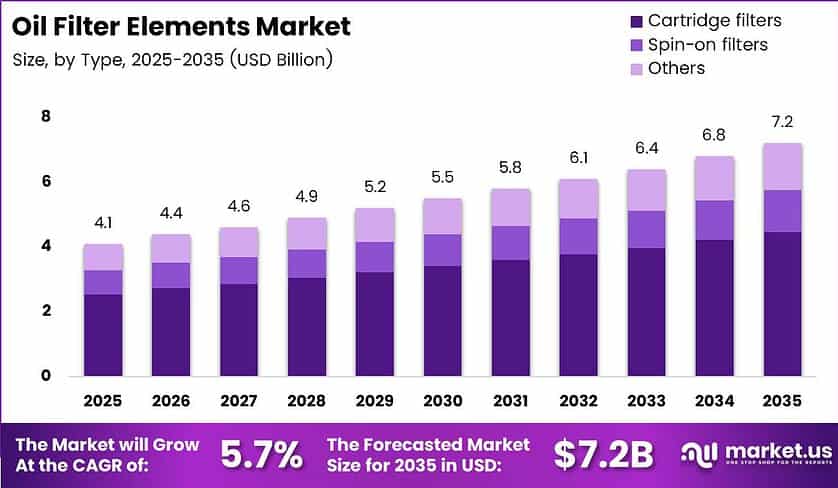
According to ACEA, the European Union recorded 252 million passenger cars in 2022, illustrating the scale of the vehicle service base that supports replacement demand. ICAO reported 37.4 million scheduled airline departures worldwide in 2024, highlighting aviation maintenance activity. These figures confirm the broad equipment base that sustains oil filter element consumption globally.
Automotive applications drive the largest share of demand, connecting filter sales with millions of combustion-engine vehicles in active service. Industrial machinery, hydraulic systems, and off-highway equipment create additional replacement volumes. Aviation and marine sectors add specialized demand tied to maintenance schedules and approved component specifications.
Market Segmentation Overview
Cartridge filters hold an estimated 61.27% share of the Type segment in 2025. These filters use replaceable elements within reusable housings, reducing material waste during servicing. Eaton data confirms high-resistance differential-pressure specifications of 160 bar for compatible elements, supporting demanding lubrication system applications across industrial and automotive platforms.
Spin-on filters combine the element and housing into a single replaceable assembly, simplifying maintenance procedures for compatible equipment. Eaton’s WPL range offers filter fineness of 10 micrometres, providing concrete contamination-control performance. Spin-on designs remain popular across vehicle fleets and off-highway machinery where service speed and ease of handling matter.
Automotive applications command an estimated 43.78% share of the Application segment in 2025. Combustion-engine vehicles require clean lubricating oil throughout their service lives, connecting vehicle fleet size directly with replacement filter demand. SIAM reports Indian passenger-vehicle domestic sales reached approximately 4.3 million units during fiscal 2024 to 2025, reflecting strong emerging-market vehicle activity.
Aftermarket channels capture an estimated 63.56% share of the Distribution Channel segment in 2025. Independent workshops, parts distributors, and retail chains serve the large installed vehicle fleet with replacement elements. ACEA data shows EU passenger cars averaged 12.3 years of age in 2022, confirming that older combustion vehicles continue generating steady replacement filter purchases.
Drivers
Expanding combustion-engine fleets create recurring replacement filter demand independent of new vehicle sales. ACEA recorded 249 million EU passenger cars in 2023, up 1.4%, with electrically chargeable vehicles representing only 3.9% of that total. The large serviceable fleet connects maintenance behavior directly with ongoing element consumption across global markets.
Commercial vehicle operations and off-highway equipment servicing add consistent replacement volumes across freight corridors and construction sites. Industrial machinery running at high utilization rates accumulates operating hours quickly, accelerating contamination buildup and maintenance intervals. These applications connect filter replacement with equipment uptime rather than vehicle production schedules alone.
Use Cases
Automotive service workshops represent the largest real-world application for oil filter elements. Technicians replace engine-oil filters during scheduled maintenance visits to protect combustion engines from wear-causing contaminants. Regular filter replacement extends engine life, reduces repair costs, and supports vehicle residual value across passenger cars, light trucks, and commercial vehicles.
Moreover, industrial facilities integrate oil filter elements into hydraulic and lubrication systems supporting production machinery. UNIDO data shows global manufacturing production increased 1.0% quarter on quarter in the final quarter of 2024. Higher production activity increases equipment operating hours, accelerating contamination accumulation and driving scheduled element replacement to maintain system efficiency and uptime.
Get further insight into the global trends shaping the future of the oil filter elements industry. Request Sample
Major Challenges
Battery-electric vehicles eliminate the combustion-engine lubrication circuit, removing original-equipment fitment opportunities for engine-oil filters. The IEA reported global electric-car sales exceeding 17 million units in 2024, though this figure includes plug-in hybrids that retain engines. Manufacturers should evaluate capacity by powertrain type rather than apply passenger-car electrification rates across entire filtration portfolios.
However, specialty media sourcing concentration creates supply chain exposure for filter manufacturers. Donaldson reported that purchased raw materials represented approximately 67% of company-wide cost of sales in fiscal 2025. A 5% material cost increase could raise total cost of sales by approximately 3.35%, pressuring margins and slowing product qualification timelines across global manufacturing operations.
Business Opportunities
Condition-linked industrial element contracts can shift selected accounts beyond individual product transactions toward service-based revenue models. Suppliers targeting a 5% to 8% annual account revenue premium and 3% to 5% lower fulfillment cost could recover acquisition costs within 18 to 24 months. Industrial clusters across North America, Europe, and Asia present the strongest near-term addressable base.
Additionally, circular cartridge take-back contracts and sustainable filter media create emerging growth pathways, particularly in regulated European markets. MANN+HUMMEL’s lignin-impregnated oil-filter offering covered applications serving approximately 17.6 million European vehicles as of March 2025. Material innovation allows suppliers to refresh established product lines and address sustainability requirements without waiting for new engine platforms.
Regional Analysis
Asia-Pacific dominates the Oil Filter Elements Market with an estimated 40.21% share in 2025, generating approximately USD 1.6 Billion in regional revenue. Strong automotive production, expanding industrial equipment bases, and accessible replacement distribution networks drive regional leadership. SIAM reports Indian passenger-vehicle exports reached approximately 0.77 million units during fiscal 2024 to 2025, supporting application development for export-destination service markets.
Middle East and Africa represents the fastest-growing region in the forecast period. IATA data shows African airlines’ passenger traffic increased 13.2% in 2024, reflecting rising aviation maintenance activity across the region. Automotive and industrial channel development alongside growing aviation servicing needs creates a multi-sector growth platform for filter suppliers entering or expanding in this emerging regional market.
Recent Developments
- January 2026 — Atmus Filtration Technologies completed its acquisition of Koch Filter Corporation for approximately USD 450 Million, establishing an industrial air-filtration platform adjacent to its existing filtration portfolio.
- February 2026 — Donaldson introduced ArmorSeal heavy-duty air-filtration technology, claiming a 30% reduction in filter-removal force, targeting engine-air filtration applications.
- February 2026 — Eaton launched laser-perforated industrial filter elements with ratings from 100 to 380 micrometres, compatible with DCF, MCF, and MCS filter housings for industrial process-filtration use.
- June 2026 — Ahlstrom expanded ECO filtration-media production to Turin, Italy, replacing approximately 30% of conventional fossil-based phenolic resin with sustainable alternatives for automotive filtration applications.
- August 2026 — Parker Hannifin completed its Filtration Group acquisition, targeting USD 220 Million in pre-tax cost synergies by end of year 3 across its broad filtration portfolio.
- March 2025 — Ahlstrom enhanced its ECO lignin-based filtration-media platform, reporting 50% to 70% lower formaldehyde emissions during curing across engine-oil and industrial applications.
- October 2025 — Hengst Filtration announced its Agritechnica hydraulic-filtration offering, rated for durability up to 2 million load cycles at 350 bar, with performance subject to product size selection.
- April 2024 — Eaton expanded its offline hydraulic-fluid filtration portfolio with the UM 15 unit, weighing approximately 15 kg with pump output of approximately 15 litres per minute.
- May 2024 — Eaton launched its WPL spin-on filter range with 5 selectable element sizes targeting hydraulic contamination control applications.
- September 2024 — Eaton introduced the VS6 electronic differential-pressure sensor for hydraulic and lubrication-oil filter monitoring at pressures up to approximately 420 bar.
Conclusion
The Oil Filter Elements Market is on a steady growth trajectory, supported by large combustion-engine fleets, active industrial equipment bases, and well-established aftermarket distribution networks. Recurring replacement demand across automotive, aviation, marine, and industrial sectors sustains revenue even as powertrain transition affects future original-equipment fitment volumes.
Cartridge filters lead by type with a 61.27% share, automotive applications lead by sector with a 43.78% share, and Asia-Pacific leads regionally with a 40.21% market share. These dominant segments reflect durable structural demand patterns rather than short-term cyclical factors, giving investors a stable foundation for market participation.
Companies that prioritize application coverage, service-channel access, and material innovation will capture the strongest positions as the market expands. Suppliers building condition-linked service contracts and sustainable media capabilities will differentiate beyond unit price competition. The global Oil Filter Elements Market is forecast to reach USD 7.2 Billion by 2035.
Looking for data tailored to your specific market, region, or business need? Request a custom report or consultation — write to us at sales@market.us
Discuss your needs with our analyst
Please share your requirements with more details so our analyst can check if they can solve your problem(s)