Market Overview
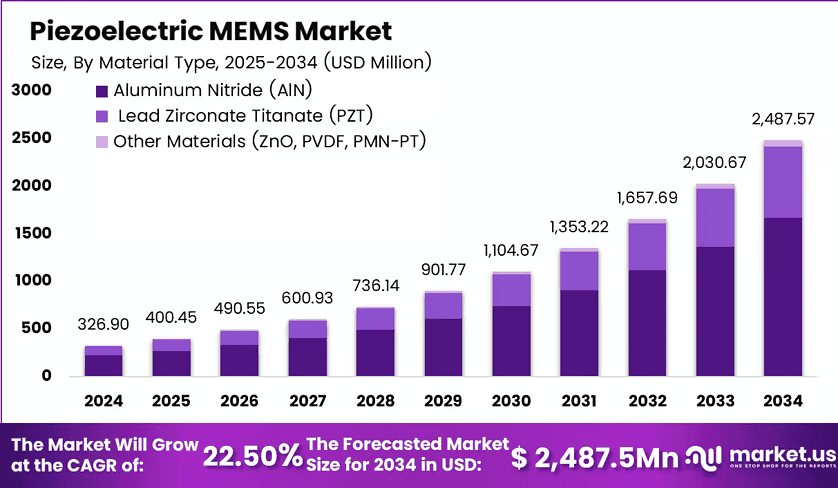
New York, NY – August 14, 2026 – The Global Piezoelectric MEMS Market reached USD 326.9 million in 2024. The market could reach USD 2,487.5 million by 2034, expanding at a 22.5% CAGR. This growth shows rising demand for smaller, power-efficient sensing and acoustic components across connected electronic products.
Connected devices strengthen demand for piezoelectric MEMS technology. According to the International Telecommunication Union, 5.5 billion people used the internet in 2024, while 51% of the global population received 5G coverage. Consequently, device makers need compact filters, microphones, and sensors that support faster wireless connections.
Consumer electronics companies use piezoelectric microelectromechanical systems in smartphones, wearable products, laptops, earbuds, and smart home equipment. Moreover, these components help manufacturers reduce device size while improving voice capture, motion detection, and energy use. Strong demand for connected personal devices therefore creates repeat purchase opportunities for component suppliers.
Semiconductor producers support market scale through advanced wafer fabrication, testing, and packaging capacity. Additionally, material innovation helps suppliers develop reliable devices for high-frequency communication, industrial automation, healthcare equipment, and defense systems. Piezoelectric MEMS vendors that combine strong manufacturing quality with application knowledge can build durable customer relationships.
Key Takeaways
- The global market measured USD 326.9 million in 2024 and may reach USD 2,487.5 million by 2034, reflecting a 22.5% CAGR.
- Aluminum Nitride held a 67.3% material share because it supports thermal stability and semiconductor-compatible manufacturing.
- Acoustic devices held a 53.6% product share as smartphones and 5G systems require compact filtering and voice functions.
- Consumer electronics represented a 60.1% end-use share, driven by demand for sensors and microphones in personal smart devices.
- Asia Pacific generated USD 122.5 million in 2024, supported by electronics manufacturing in China, Japan, and South Korea.
- China could reach USD 306.3 million by 2034, growing at a 47.07% CAGR through expanding chip production and smart sensor adoption.
➤ Access the Exclusive Sample Report Featuring Full TOC, Data Tables & Figures – https://market.us/report/piezoelectric-mems-market/request-sample/
Market Segmentation
Aluminum Nitride leads the material segment because chipmakers can integrate it with silicon-based manufacturing processes. Moreover, AlN supports high-frequency performance, heat stability, and lead-free product design. These qualities help manufacturers produce microphones, acoustic filters, sensors, and actuators at commercial scale for demanding electronic applications.
Lead Zirconate Titanate serves ultrasonic equipment, medical transducers, inkjet systems, and precision motion products. However, manufacturers often select PZT when applications need stronger output than AlN can provide. Other materials, including zinc oxide, PVDF, and PMN-PT, support specialized designs where flexibility, sensitivity, or performance needs differ.
Acoustic devices lead the product category because mobile and connected products need clear voice capture and reliable wireless signal control. Additionally, BAW filters support communication performance in compact devices. Piezoelectric microphones also resist dust and moisture, which improves product durability in everyday consumer and industrial environments.
Sensors, actuators, and energy harvesters create additional growth paths across the product portfolio. Sensors track pressure, motion, vibration, and ultrasonic signals. Consequently, industrial operators use them for condition monitoring, while actuator makers support printing, micromirror movement, precision valves, and positioning functions in advanced equipment.
Consumer electronics remains the largest end-use industry because brands produce high volumes of smart personal devices. Moreover, smartphones, earbuds, tablets, watches, and laptops require small sensing and audio components. This broad device base gives MEMS suppliers frequent design opportunities across product refresh cycles and premium feature upgrades.
Automotive, healthcare, industrial IoT, aerospace, defense, and telecommunications also expand demand. Vehicle makers deploy sensing modules for safety and cabin functions. Additionally, healthcare providers use ultrasonic and diagnostic devices, while factories deploy compact sensors to track equipment conditions, increase uptime, and improve process control.
Regional Analysis
Asia Pacific leads the piezoelectric MEMS market because China, Japan, and South Korea combine semiconductor production with large electronics supply chains. Moreover, regional smartphone, wearable, and IoT manufacturing supports high component volumes. Local research investment also helps companies develop advanced acoustic devices, sensors, and integrated chip solutions.
North America grows through aerospace, healthcare, defense, and high-value sensing applications. However, Europe maintains strong demand through automotive innovation and industrial automation. Latin America and the Middle East and Africa offer longer-term expansion as telecommunications networks, energy infrastructure, and connected industrial systems adopt more compact electronic components.
Drivers
Vehicle electrification drives demand because electric platforms need more sensing, acoustic control, pressure measurement, and battery monitoring functions. According to the International Energy Agency, electric car sales exceeded 17 million in 2024. Consequently, automotive suppliers can increase component content per vehicle through qualified piezoelectric MEMS modules.
Voice interface adoption also supports the market as consumers use voice commands across phones, earbuds, smart speakers, and connected appliances. Moreover, the International Telecommunication Union reported 5.5 billion internet users in 2024. This connected user base expands demand for reliable microphones and acoustic filters in everyday digital products.
Use Cases
Consumer device makers use piezoelectric MEMS microphones and filters in phones, earbuds, laptops, wearables, and smart speakers. Moreover, these components support voice calls, noise reduction, voice commands, and stable wireless connectivity. Compact designs help brands deliver thinner products while protecting battery life and improving user experiences.
Industrial and automotive companies use piezoelectric sensors for vibration tracking, pressure measurement, ultrasonic detection, and machine feedback. Consequently, operators can identify changing equipment conditions before failures interrupt production. Vehicle manufacturers also use these devices in cabin systems, parking assistance, battery monitoring, and safety-focused electronic functions.
Business Opportunities
Medical ultrasonic platforms offer a strong opportunity for suppliers that move beyond basic components into integrated modules. Moreover, diagnostic providers need compact devices that simplify system assembly and support point-of-care use. Companies that build validated solutions can improve margins while creating closer partnerships with medical equipment manufacturers.
Edge AI sensor modules present another opportunity because connected equipment needs faster local decisions. Additionally, suppliers can combine sensing, signal processing, and packaging expertise into application-ready solutions. Industrial customers value these modules because they can improve equipment monitoring, reduce integration work, and support responsive automation systems.
Major Challenges
Packaging capacity competition challenges suppliers because piezoelectric MEMS devices require specialized sealing, calibration, testing, and acoustic port designs. However, chip demand also competes for shared packaging equipment and technical talent. Manufacturers must secure reliable production partners and strengthen yield control to protect delivery schedules and customer confidence.
Material purity and wafer process yield create further pressure across advanced MEMS production. Moreover, small changes in film quality or fabrication steps can affect device performance. Companies need disciplined process control, skilled engineers, and extensive testing to meet customer requirements across automotive, healthcare, industrial, and communication applications.
Top Key Players in the Market
- STMicroelectronics
- Bosch Sensortec GmbH
- Analog Devices, Inc.
- Murata Manufacturing Co., Ltd.
- TDK Corporation
- Texas Instruments Incorporated
- Qualcomm Technologies, Inc.
- Broadcom Inc.
- NXP Semiconductors N.V.
- Honeywell International Inc.
- Panasonic Corporation
- Teledyne Technologies Incorporated
- Qorvo, Inc.
- Knowles Corporation
- Sensata Technologies, Inc.
- SiTime Corporation
- InvenSense, Inc.
- Robert Bosch GmbH
- Omron Corporation
- MEMSIC, Inc.
Conclusion
The Piezoelectric MEMS Market benefits from growing demand for connected electronics, electric vehicles, smart factories, healthcare tools, and advanced communication products. Moreover, AlN materials, acoustic devices, and consumer electronics provide the market’s current foundation. Suppliers that improve packaging capacity, maintain material quality, and develop integrated solutions can capture expanding opportunities across global high-growth applications.
Discuss your needs with our analyst
Please share your requirements with more details so our analyst can check if they can solve your problem(s)