
Market Overview
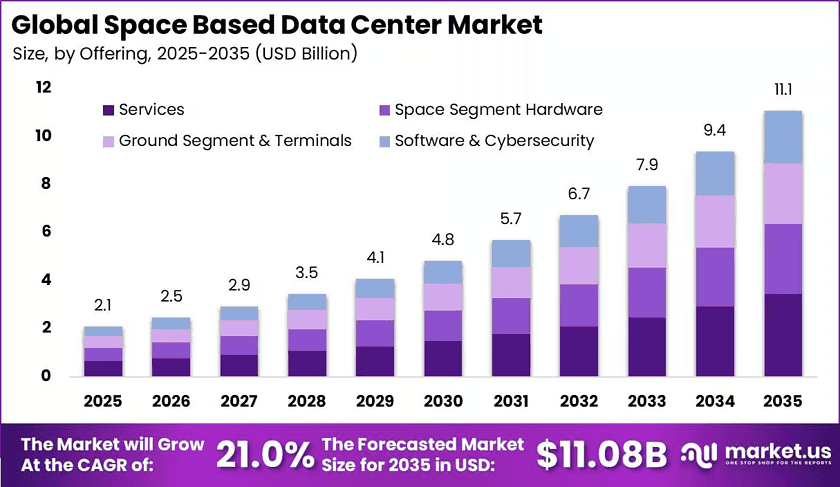
New York, NY – October 26, 2026 – The Global Space-Based Data Center Market reached USD 2.1 billion in 2025. Analysts expect it to hit USD 11.1 billion by 2035, growing at a CAGR of 21.0% from 2026 to 2035. Consequently, orbital computing is moving from an experimental idea toward a real commercial infrastructure category.
AI workloads are pushing this growth. According to the International Energy Agency, global data center electricity use rose 17% in 2025. Moreover, AI-focused facilities raised their power use by 50%. These numbers show that ground-based facilities are struggling to keep up with demand for computing.
The International Energy Agency also expects data center electricity demand to grow from about 485 TWh to 950 TWh by 2030. Therefore, land, power grids, cooling systems, and water supplies will face more strain. Orbital platforms run on solar energy, which makes them a practical option for future capacity.
Better launch access also supports commercial progress. According to the FAA, licensed commercial launch and reentry operations reached 148 in fiscal year 2024, up more than 30%. Additionally, the FAA expects activity could more than double by 2028. More frequent launches cut deployment delays for satellite computing operators.
Government funding strengthens the outlook further. According to NASA, its fiscal year 2025 budget exceeded USD 25 billion. That figure includes over USD 1.2 billion for space technology and USD 170 million for commercial space infrastructure. Consequently, public funding lowers technology risk and draws private investment into orbital computing.
Key Takeaways
- The Space-Based Data Center Market reached USD 2.1 billion in 2025. It should hit USD 11.1 billion by 2035 at a CAGR of 21.0%.
- Services led the By Offering segment with a 31.1% share.
- Low Earth Orbit (LEO) led the By Orbit segment with a 56.0% share.
- Below 1 kW led the By Power Capacity segment with a 42.9% share.
- Commercial led the By End User segment with a 36.1% share.
- North America led the market with a 37.0% share and earned USD 0.77 billion in revenue in 2025.
➤ Grab the Exclusive Preview of This Premium Research Report Now – https://market.us/report/space-based-data-center-market/request-sample/
Space-Based Data Center Market Segmentation
By Offering
Services lead the offering segment with a 31.1% share. Orbital data centers need ongoing ground support, data relay, monitoring, and maintenance. Hardware, by contrast, usually involves one-time purchases. Therefore, service providers earn steady revenue across each system’s full operating life, which makes this segment attractive.
Space Segment Hardware follows with 26.2%. Ground Segment and Terminals hold 23.0%, and Software and Cybersecurity hold 19.7%. Moreover, according to ITU, 99 administrations have registered non-geostationary satellite systems since 2019. This trend points to wider network activity that needs continuous support services.
By Orbit
Low Earth Orbit leads with a 56.0% share. LEO gives lower signal delay and cheaper access than higher orbits. According to the FAA, commercial launches hit a record 148 in fiscal year 2024. Many of those missions targeted altitudes below 2,000 km, which strengthens the case for LEO.
Medium Earth Orbit holds 26.1%, while Geostationary Earth Orbit holds 17.9%. However, GEO sits about 35,786 km above Earth, which creates longer communication delays. Consequently, operators favor LEO for scalable data processing because it needs less launch energy and offers better cost per kilogram.
By Power Capacity
The below-1-kW segment leads with a 42.9% share. According to NASA, small-satellite solar arrays usually provide 5 to 100 watts. Advanced deployable arrays reach about 200 to 275 watts. Therefore, most current orbital computers run on small, low-power platforms.
The 1–5 kW range holds 27.0%, 5–20 kW holds 19.0%, and above 20 kW holds 11.1%. Moreover, SpaceX rideshare pricing reached about USD 7,000 per kilogram in 2026. Heavier satellites cost more to launch, so operators prefer lightweight designs for now.
By End User
Commercial users lead with a 36.1% share. According to the U.S. Bureau of Economic Analysis, the U.S. space economy produced USD 240.9 billion in gross output in 2023. Private industries supported about 373,000 jobs. Consequently, private firms have become major buyers of space-based computing capacity.
Government (Civil) holds 18.9%, and Defense and Intelligence hold 17.0%. Critical Infrastructure and Enterprise hold 14.6%, while Research and Academia hold 13.4%. Additionally, according to ITU, about 5.5 billion people were online in 2024. That rising internet use drives demand for cloud and AI services.
By Data Source
Onboard-Generated Data leads with a 46.3% share. According to ESA, Sentinel satellites produce more than 20 terabytes of raw data each day. Satellites cannot always send this volume to the ground efficiently. Therefore, operators process the data in orbit before transmission, which raises demand for onboard computing.
Crosslinked Data from Other Satellites holds 22.0%. Data Uplinked from Ground holds 18.0%, and In-Situ Cislunar Data holds 13.7%. Moreover, NASA’s NISAR mission should generate about 80 terabytes of radar data daily. Large volumes like this will keep pushing the need for in-space filtering.
Regional Analysis of Orbital Computing
North America leads with a 37.0% share and about USD 0.77 billion in 2025 revenue. U.S. commercial providers completed 154 orbital launches in 2024, nearly 60% of the world total. Consequently, regional companies can deploy satellites faster and at lower cost than rivals elsewhere.
Europe follows with a 25.1% share and is the fastest-growing region. According to ESA, member states approved a record €22.3 billion budget for 2026–2029, up 31%. Therefore, stronger public funding is speeding up European satellite infrastructure and orbital data processing capacity.
Key Market Drivers
AI workload migration to orbit adds about 5.8% to the CAGR. AI facilities raised power use by about 50% in 2025. Moreover, grid connection queues in some North American markets now run 3 to 5 years. Consequently, AI firms are looking at orbital computing to add capacity faster.
Falling launch costs per kilogram add about 4.1% to growth worldwide. Additionally, hybrid orbital-terrestrial systems could cut customer acquisition costs by about 15% to 20% per unit of compute. Therefore, cheaper launches and better unit costs together make space-based data infrastructure easier for buyers to justify.
Use Cases of Space Data Centers
Earth observation operators use orbital data centers to process satellite images before sending them down. This approach cuts transmission load and gives faster results. Consequently, agriculture firms, disaster response teams, and climate agencies get useful insights within hours instead of waiting days for raw files.
Defense and government agencies run secure computing in orbit to support sensitive missions. Moreover, orbital platforms keep data away from vulnerable ground networks. Therefore, these agencies gain stronger data protection, faster intelligence processing, and reliable service during emergencies when terrestrial infrastructure fails.
Business Opportunities in Orbit
Lunar and cislunar data infrastructure is a largely untapped opportunity. Most commercial activity still focuses on low Earth orbit demonstrations. However, early providers that win anchor contracts with national space agencies could charge premium prices. Consequently, first movers may build strong margins before competition grows.
Orbital compute-as-a-service models offer another clear opening. Providers can rent processing power in space to cloud firms, AI developers, and satellite operators. Additionally, flexible subscription pricing lowers entry barriers for smaller buyers. Therefore, service-based models can widen the customer base and create steady recurring revenue.
Major Industry Challenges
Downlink bandwidth limits remain the main challenge. Satellites generate huge data volumes, but ground-station links move only a small part of it. Consequently, operators must invest in powerful edge-processing hardware in orbit. Specialized flight-grade chips cost more than standard options, which raises overall satellite development budgets.
Export controls on rare-earth magnets and advanced chips create serious supply risks. Moreover, tighter licensing rules can delay deliveries of processors, actuators, and solar-tracking parts. Therefore, satellite makers face longer lead times and higher component costs, which may slow deployment plans and squeeze project margins.
Top Key Players in the Market
- Axiom Space
- SpaceX
- Starcloud
- Kepler Communications
- Blue Origin
- Skyloom Global
- Thales Alenia Space
- Madari Space
- Sophia Space
- Lonestar Data Holdings
- Spacebilt Inc.
- Hewlett Packard Enterprise
Conclusion
The space-based data center industry is growing quickly because AI demand puts pressure on ground power grids, land, and water. Moreover, cheaper launches, strong government funding, and private investment are speeding up adoption. Services, LEO platforms, and commercial users lead demand, while North America and Europe drive regional growth. However, bandwidth limits and supply risks remain. Therefore, providers that offer scalable, secure orbital computing will gain a lasting edge.
Discuss your needs with our analyst
Please share your requirements with more details so our analyst can check if they can solve your problem(s)