
Market Overview
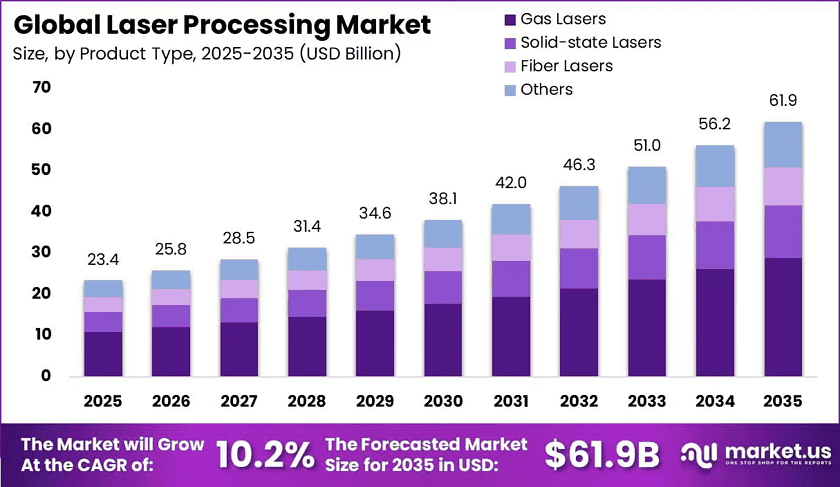
New York, NY – October 29, 2026 – The Global Laser Processing Market reached USD 23.4 billion in 2025. Analysts project it will hit about USD 61.9 billion by 2035, growing at a 10.2% CAGR. This growth shows that factories keep moving toward accurate, contact-free tools to make products faster and with less waste. Asia Pacific led the industrial laser sector in 2025 with more than 41.3% of the market. The region earned about USD 9.6 billion in revenue.
Additionally, car makers keep driving steady demand for laser equipment. According to OICA, global vehicle output rose from 92.7 million units in 2024 to 96.4 million in 2025. That is growth of 3.9%. Higher output means more body welding, battery assembly, and part marking, so plants need more laser systems.
However, chip production now matters just as much. According to the Semiconductor Industry Association, global chip sales rose 25.6% to a record USD 791.7 billion in 2025. This jump shows strong spending on new chip plants. As a result, wafer cutting, drilling, and marking tools see faster buying cycles.
Therefore, China stands out as a key demand center. According to OICA, China built 34.5 million vehicles in 2025, up 10.4% from the year before. That equals about 36% of global output. Furthermore, Asia Pacific made more than 61% of the world’s vehicles, which supports strong local demand for laser tools.
Key Takeaways
- The Laser Processing Market was worth USD 23.4 billion in 2025 and should reach USD 61.9 billion by 2035, growing at a 10.2% CAGR.
- Gas lasers held the largest product share at 46.5%, driven by steel processing and heavy industry.
- Material processing led the process category with a 62.3% share, supported by rising global factory output.
- Machine tools led the application category with a 32.4% share, driven by demand for precision manufacturing.
- Asia Pacific led the market in 2025 with a 41.3% share and about USD 9.6 billion in revenue.
➤ See the Full TOC, Market Tables & Figures in Your Sample Copy – https://market.us/report/global-laser-processing-market/request-sample/
Segmentation
By Product
Gas lasers, mostly CO2 systems, held a 46.5% share of the product segment. According to the World Steel Association, global crude steel output reached 1,849.4 million tonnes in 2025. This large steel base needs efficient cutting and welding. Therefore, steel fabricators keep buying gas laser systems for high-volume work.
Moreover, CO2 lasers can reach efficiency levels of up to 15%. They cut steel from 0.5 mm to more than 13 mm thick. This range suits shipbuilding, construction, and heavy machinery. Additionally, China produced about 961 million tonnes of steel in 2025, which keeps demand for this segment strong.
By Process
Material processing held a leading 62.3% share of the process segment. According to UNIDO, global factory output grew 1.3% in Q1 2025. Industrial economies made up 87.7% of global manufacturing value added. This steady growth means plants need more laser cutting, welding, drilling, and surface treatment tools.
Additionally, the International Aluminium Institute reported record primary aluminium output of 73.7 million tonnes in 2025, up 1.1%. These large metal volumes need exact shaping before use in cars and machines. Meanwhile, marking and engraving, along with micro-processing, serve traceability and fine electronics work across many plants.
By Application
Machine tools held a leading 32.4% share of the application segment. According to the Japan Machine Tool Builders’ Association, machine tool orders hit about JPY 1.6 trillion in 2025. That was the fourth-highest level on record. This shows that factories keep investing in advanced production equipment around the world.
Moreover, laser cutting centers handle hard materials with micron-level accuracy and less tool wear. Automotive, aerospace, electronics, medical, and packaging users also adopt these systems. Consequently, laser-equipped machines support a wide range of industries. Each sector values clean cuts, fast cycle times, and consistent part quality.
Regional Analysis of Laser Processing
Asia Pacific led the global market with a 41.3% share and about USD 9.6 billion in revenue in 2025. China, Japan, and South Korea host dense car, electronics, and heavy industry clusters. Therefore, local suppliers enjoy short delivery routes and steady repeat orders from large manufacturing customers.
However, North America is the fastest-growing region. As of Q1 2026, the U.S. CHIPS Program Office had given more than USD 36 billion in grants. These funds supported over USD 645 billion in announced private chip investment. As a result, demand for wafer dicing and micro-drilling tools is rising quickly.
Growth Drivers for Laser Processing
Electric vehicle battery makers are shifting from resistance welding to laser welding. Fiber laser welding ran in more than 70% of new cell-to-pack lines built in 2025. This shift shows that battery plants want better precision. Consequently, gigafactory spending turns directly into new orders for laser systems.
Moreover, laser welding cuts joint cycle time by about 30% compared with mechanical fastening. Faster cycles raise output and keep quality steady. Additionally, global EV stock additions passed 17 million units in 2024. This growth pushes battery makers to sign long-term tooling and service contracts with laser suppliers.
Laser Processing Use Cases
Battery manufacturers use laser welding to join cells, tabs, and busbars in electric vehicle packs. The process makes strong, clean joints with little heat damage. Moreover, automated laser stations work nonstop on high-speed lines. Therefore, carmakers get dependable battery packs and fewer quality defects during mass production.
Additionally, chipmakers rely on laser tools for wafer dicing, trimming, and package marking. These tasks need extreme accuracy on fragile materials. Lasers avoid physical contact, so they lower breakage risk. Consequently, semiconductor plants improve yields and keep a clear part history through permanent laser codes.
Business Opportunities in Laser Processing
Industrial laser companies can grow by entering medical and eye care markets. Recent deal activity shows strong interest in ophthalmology laser platforms. Moreover, healthcare buyers pay for high precision and reliable results. Therefore, suppliers can use their core laser skills to win higher-value customers outside traditional factories.
Furthermore, hybrid systems that combine 3D printing and laser processing offer a long-term opening. Service networks in Asia Pacific and Latin America also create room for growth. Additionally, AI-based predictive maintenance can turn machine data into paid services. As a result, suppliers can build steady recurring income beyond one-time equipment sales.
Major Challenges Facing the Market
China’s export controls on gallium, germanium, and heavy rare earth elements create serious supply pressure. Laser diodes and optical coatings depend on these materials. Consequently, buyers outside China face higher prices and longer waits. Moreover, these delays can push back production schedules and slow orders for new equipment.
However, the shortage of skilled laser technicians poses an equally serious problem. Plants struggle to find workers who can install, calibrate, and maintain advanced systems. Therefore, project start-ups often run late. Additionally, manufacturers now fund in-house training and remote support tools, which raises their operating costs.
Top Key Players in the Market
- Altec GmbH
- Alpha Nov laser
- Amada Co., Ltd.
- Bystronic Laser AG
- Epilog Laser, Inc.
- Eurolaser GmbH
- Han’s Laser Technology Industry Group Co., Ltd.
- IPG Photonics Corporation
- Newport Corporation (MKS Instruments, Inc.)
- LaserStar Technologies Corporation
- Coherent Inc.
- Trumpf GmbH + Co. KG
- Universal Laser Systems, Inc.
- Xenetech Global Inc.
Conclusion
The laser processing market keeps growing as car, battery, steel, and chip makers invest in precise, automated production. Asia Pacific leads in demand, while North America grows fastest through chip plant spending. Moreover, medical lasers and smart maintenance services open new revenue paths. However, material export controls and skilled worker shortages remain key risks. Therefore, suppliers that secure supply chains and build training programs will gain a clear advantage.
Discuss your needs with our analyst
Please share your requirements with more details so our analyst can check if they can solve your problem(s)