
Market Overview
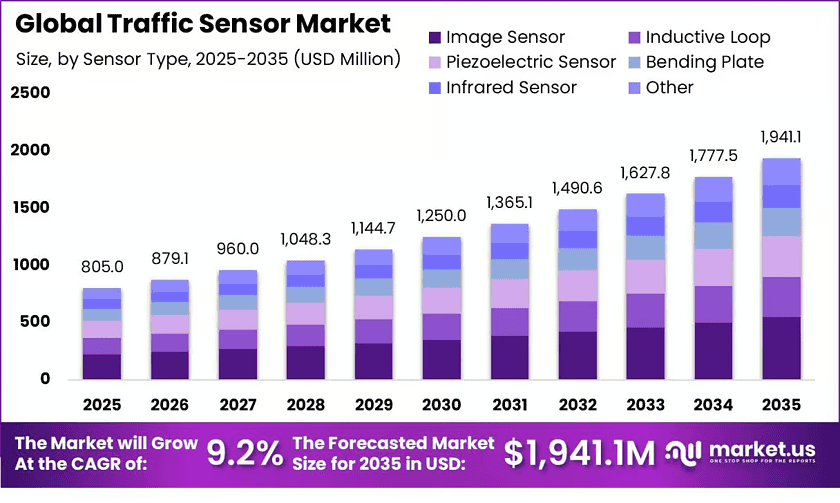
New York, NY – October 28, 2026 – The Global Traffic Sensor Market reached USD 805.0 million in 2025. Analysts project it to reach approximately USD 1,941.1 million by 2035, growing at a CAGR of 9.2% during 2026–2035. Rising vehicle volumes and rapid urban expansion are fueling this growth. North America led the market in 2025, holding more than 38.2% of total share and generating approximately USD 311.3 million in revenue.
Vehicle volumes are increasing steadily across the globe. According to OICA, global vehicle production rose from 92.7 million units in 2024 to 96.4 million units in 2025, an increase of 3.9%. More vehicles mean road authorities must detect and manage greater traffic volumes. Consequently, demand for sensing equipment continues to strengthen.
Urbanization adds another layer of demand. According to the World Bank, around 4.7 billion people, or nearly 58% of the global population, now live in urban areas. Denser cities require adaptive signals, congestion monitoring, and incident detection, which makes traffic sensors a practical necessity for city planners.
Congestion is also worsening on roads worldwide. According to TomTom, its 2026 Traffic Index found that global congestion rose from 20% to 25% during 2025. This shift shows that continuous traffic measurement is becoming essential for agencies that want to keep their networks running smoothly.
Key Takeaways
- The Traffic Sensor Market was valued at USD 805.0 million in 2025 and is projected to reach USD 1,941.1 million by 2035 at a CAGR of 9.2%.
- Image sensors lead the sensor type category with a 28.3% share, driven by camera-based freeway monitoring.
- Traffic monitoring leads the application category with a 34.5% share, amid rising congestion and road-safety concerns.
- North America led the market in 2025 with a 38.2% share and approximately USD 311.3 million in revenue.
➤ Download Exclusive Sample Of This Premium Report (Including Full TOC, Table & Figures)- https://market.us/report/global-traffic-sensor-market/request-sample/
Market Segmentation
Image sensors lead the sensor type category with a 28.3% share. A single camera feed supports accident verification, license-plate recognition, lane-change monitoring, and stalled-vehicle detection. According to the U.S. Federal Highway Administration, CCTV use for incident detection reached 85% among responding agencies in its 2023 Freeway Management Survey.
Other sensor types still play important roles in the market. Among surveyed agencies, radar and microwave detection recorded 69% adoption, while inductive loop systems stood at 57%. Piezoelectric, bending plate, and infrared sensors serve specialized tasks, giving agencies flexible options for different road conditions.
Traffic monitoring leads the application category with a 34.5% share. Growing congestion and road-safety concerns push agencies to adopt continuous monitoring tools. According to the Texas A&M Transportation Institute, U.S. commuters lost an average of 63 hours to delays in 2024, creating an estimated annual cost of USD 269 billion.
Vehicle measurement and profiling, weigh-in-motion, and automated tolling form additional application areas. Weigh-in-motion sensors measure axle loads without stopping trucks, while automated tolling depends on accurate vehicle detection. These applications help agencies plan infrastructure, enforce regulations, and collect revenue more efficiently.
Regional Analysis
North America dominates the market through strong federal backing. The U.S. Department of Transportation’s SMART grants support real-time traffic monitoring, connected signals, and sensor-based mobility systems. Consequently, steady demand for equipment upgrades and replacements continues across major cities, sustaining the region’s leading position.
Asia Pacific is the fastest-growing region because of large smart-city and highway programs. India’s Smart Cities Mission has an outlay of about USD 19.6 billion and has installed more than 83,000 CCTV cameras. Moreover, China has upgraded roughly 18,000 kilometers of expressways to smart-highway standards, expanding sensor deployment across the region.
Drivers
Road-safety sensing mandates turn traffic sensors from optional upgrades into essential tools. According to the National Highway Traffic Safety Administration, U.S. traffic deaths were estimated at 36,640 in 2025, a 6.7% decline. Persistent fatalities keep agencies focused on incident detection and speed monitoring, which could add about 2.1% to annual growth.
Urban signal modernization is another strong driver, particularly in Asia Pacific. Cities upgrade signals to manage denser traffic, and adaptive systems depend on continuous detection. The report estimates this driver contributes about 1.4% to annual growth over the medium term of two to four years.
Use Cases
Traffic agencies use camera-based sensors for incident verification and stalled-vehicle detection. A single camera feed supports several tasks, from lane-change monitoring to weather observation. As a result, agencies gain broader situational awareness without installing separate devices at every location.
Climate-resilient road monitoring is an emerging use case. Sensor-based systems can track real-time flooding and congestion on vulnerable corridors. Cities facing severe weather can therefore protect commuters and keep emergency routes open during difficult conditions.
Business Opportunities
Sensor-data subscription platforms represent a growing opportunity for vendors. Many transport agencies still rely on one-time capital budgets for traffic equipment. Recurring service models, such as congestion analytics and predictive maintenance, could give vendors more stable revenue and stronger margins over time.
Vehicle-to-infrastructure integration opens another path for suppliers. Connected roadside units, cameras, and edge devices enable communication between vehicles and traffic systems. Moreover, companies offering integrated hardware and software packages can serve both North America and Asia Pacific markets effectively.
Major Challenges
Semiconductor supply exposure presents a significant challenge for manufacturers. Traffic sensors depend on processors, image chips, and radar modules sourced through global supply chains. Elevated tariffs on Chinese-origin components raise sourcing costs, so manufacturers increasingly pursue dual sourcing and safety inventories.
Legacy-road retrofit funding remains a major barrier to deployment. Installing sensors on active roads requires civil works, lane closures, and lengthy public approvals. Because available funding remains limited compared with network needs, many authorities must upgrade their infrastructure gradually over several years.
Top Key Players in the Market
- International Road Dynamics, Inc.
- Kistler Group
- Flir Systems, Inc.
- TE Connectivity Ltd
- SWARCO AG
- Q-Free ASA
- SICK AG
- Raytheon Company
- Siemens AG
Conclusion
The Global Traffic Sensor Market is positioned for steady expansion as cities, highways, and transport agencies modernize their networks. Strong demand from road safety, congestion management, and smart-corridor programs supports long-term growth. Supply chain pressures and funding gaps remain obstacles. Vendors that adopt subscription models and connected infrastructure can still capture meaningful opportunities in the coming years. Industry stakeholders who plan carefully can benefit from this evolving landscape.
Discuss your needs with our analyst
Please share your requirements with more details so our analyst can check if they can solve your problem(s)