
Market Overview
New York, NY – November 05, 2026 – The Global Military Electro-optical and Infrared Systems Market reached a value of USD 9.9 billion in 2025. Analysts expect it to reach about USD 16.5 billion by 2035, growing at a CAGR of 5.3%. This steady growth shows that armed forces keep investing in better battlefield vision tools.
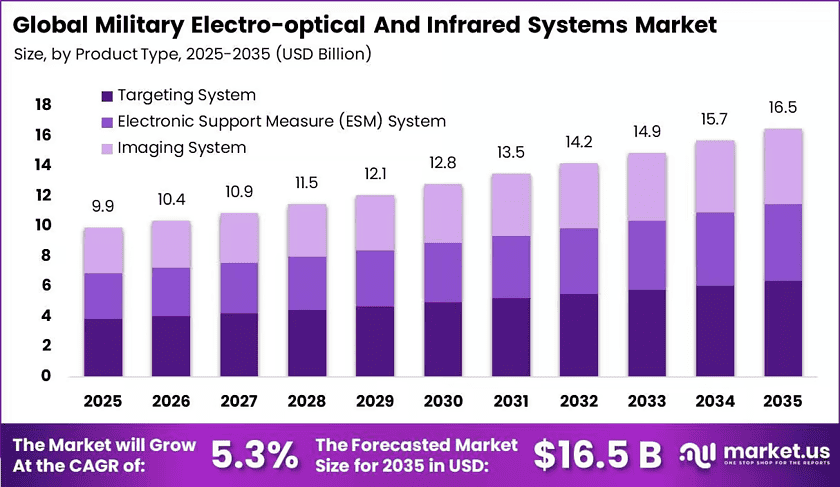
Moreover, higher defence budgets and the need for clear battlefield awareness drive this growth. EO/IR systems combine day cameras, thermal imaging, lasers, and tracking sensors. Armed forces fit these sensors on drones, aircraft, armoured vehicles, naval ships, satellites, and fixed surveillance sites. As a result, suppliers can sell across many different platforms.
Additionally, global military spending reached USD 2.7 trillion in 2024, up 9.4% in real terms. Spending also stood 37% above 2015 levels. This rise lifts demand for thermal cameras, infrared sensors, and stable imaging payloads used in surveillance and border security.
Furthermore, U.S. military spending hit USD 997 billion in 2024, up 5.7% from 2023. The United States made up 37% of global spending and 66% of NATO spending. This large budget makes the country the single biggest buyer of advanced defence imaging systems.
Consequently, the U.S. Space Force planned USD 826.3 million in FY2025 for sensing capabilities. This funding shows that demand for optical and thermal sensors now reaches into space. Therefore, suppliers can expect steady orders across land, air, sea, space, and border-security missions.
Key Takeaways
- The Military Electro-optical and Infrared Systems Market was worth USD 9.9 billion in 2025 and should reach USD 16.5 billion by 2035, growing at a CAGR of 5.3%.
- By system type, the targeting system segment led with a 38.7% share.
- By platform, the airborne segment led with a 62.1% share.
- By technology, the infrared segment led with a 41.3% share.
- By application, surveillance and reconnaissance led with a 45.4% share.
- North America led the market in 2025 with a 37% share and about USD 3.7 billion in revenue.
➤ Access the Exclusive Sample Report Featuring Full TOC, Data Tables & Figures – https://market.us/report/military-electro-optical-and-infrared-systems-market/request-sample/
Market Segmentation
By System Type
Targeting systems held a 38.7% share because they turn EO/IR images into accurate weapon strikes. These systems combine infrared imaging, visible cameras, laser rangefinders, laser designators, and automatic tracking. Moreover, the U.S. Army set aside USD 49.6 million in FY2025 for munition prototyping. This funding supports demand for precise targeting tools.
By Platform
Airborne platforms held a 62.1% share because aircraft and drones watch large areas while keeping crews safe. Additionally, the U.S. Army requested USD 149.1 million for 47 Future UAS assets in FY2025. These assets need thermal and day cameras. Therefore, larger drone fleets directly increase demand for airborne sensor payloads.
By Technology
Infrared technology held a 41.3% share because thermal sensors detect heat without daylight. Troops use them to spot people and vehicles through smoke, darkness, and camouflage. Moreover, the U.S. Army plans to buy 45 third-generation FLIR sights in FY2025. This order shows strong demand for upgrades on armoured vehicles.
By Application
Surveillance and reconnaissance held a 45.4% share because forces need constant threat detection and tracking. These systems pair daytime cameras with heat sensors for night work. Furthermore, U.S. Army funding for small drone research rose from USD 160.4 million to USD 204.2 million in FY2025. This increase points to growing demand for persistent monitoring.
Regional Analysis of Defence Imaging Demand
North America led the market in 2025 with a 37% share and about USD 3.7 billion in revenue. A strong defence industry and high purchase budgets support this lead. Moreover, the U.S. Department of Defense requested USD 961 billion for FY2026. This request keeps demand high for thermal imagers and laser designators.
However, Asia Pacific should grow fastest, driven by spending on air defence, maritime watch, and border security. Japan approved a defence budget of JPY 8.7 trillion, or about USD 55 billion, for 2025. Consequently, regional forces will likely buy more drones, sensors, and precision-strike systems in the coming years.
Key Growth Drivers
Defence surveillance purchases drive strong growth in this market. According to the report data, global military spending reached USD 2.8 trillion in 2025, marking the 11th straight yearly rise. Moreover, Europe raised spending by 14%. These bigger budgets fund more infrared sensors, precision optics, and mission software.
Additionally, airborne drone fleet growth adds about 0.9% to the market CAGR. Armed forces in North America, Europe, and Asia Pacific keep adding drones for day and night patrols. Therefore, each new drone creates demand for cameras, thermal sensors, and stable gimbals. This trend should support suppliers over the medium term.
Major Use Cases
Armoured vehicle crews use thermal sights to find and track targets at night and in poor weather. These sights help crews spot enemy vehicles before being seen. Moreover, modern tanks now combine fire-control systems with smart electro-optical sights. As a result, crews make faster and safer decisions during combat missions.
Additionally, border agencies use EO/IR cameras on aircraft, drones, towers, and patrol boats. These tools help officers watch long borders and coastlines around the clock. Consequently, agencies can detect illegal crossings and smuggling sooner. This use case keeps growing as governments focus more on homeland and maritime security.
Business Opportunities
Counter-drone payloads offer a strong growth path for EO/IR suppliers. Armed forces need sensors that detect, track, and classify small drones quickly. Moreover, deployment remains scattered across many forces today. Therefore, companies that offer modular payloads and software upgrades can win repeat orders and build steady recurring income.
Additionally, sensor-as-a-service support creates a fresh revenue model. Defence buyers increasingly want maintenance, upgrades, and spare parts bundled into long contracts. Consequently, suppliers can earn stable income across the full life of each system. Border-security retrofit packages also open doors in the Middle East and Asia Pacific.
Major Challenges
Export-control rules slow international sales of infrared detectors, thermal cores, and laser systems. Each shipment often needs security approval before it leaves the country. Moreover, these delays raise inventory and testing costs for manufacturers. As a result, suppliers face pressure on margins and slower delivery to foreign customers.
However, critical-mineral supply poses a longer-term challenge. A few countries control most mineral refining, which creates sourcing risk for sensor makers. Therefore, manufacturers must build backup suppliers, hold extra stock, and redesign some parts. These steps protect production but can slow capacity growth and raise operating costs.
Top Key Players in the Market
- BAE Systems plc
- Elbit Systems Ltd.
- Teledyne FLIR LLC
- Israel Aerospace Industries Ltd.
- L3Harris Technologies Inc.
- Leonardo S.p.A
- Lockheed Martin Corporation
- Raytheon Technologies Corporation
- Rheinmetall AG
- Saab AB
- THALES
Conclusion
The military electro-optical and infrared systems market shows steady growth, driven by rising defence budgets and the need for clear battlefield awareness. Targeting systems, airborne platforms, infrared technology, and surveillance missions lead demand. Moreover, North America stays in front while Asia Pacific grows fastest. However, export rules and mineral supply risks remain hurdles. Therefore, suppliers that focus on counter-drone tools and long-term support services can secure strong future growth.
Discuss your needs with our analyst
Please share your requirements with more details so our analyst can check if they can solve your problem(s)