Market Overview
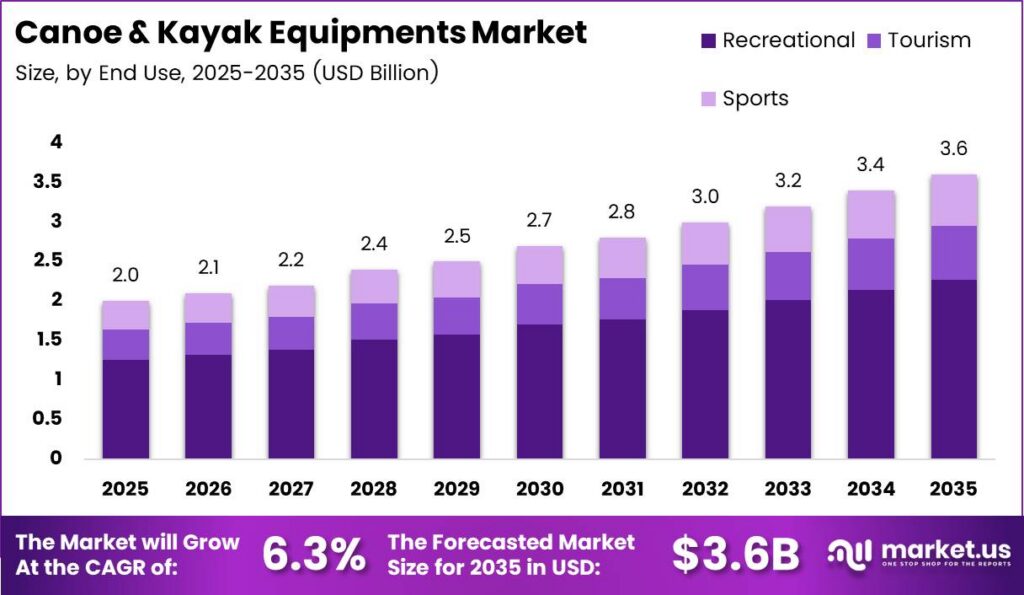
The global canoe and kayak equipments market reached USD 2.0 Billion in 2025 and will hit USD 3.6 Billion by 2035. Industry revenue expands at a 6.3% CAGR from 2026 to 2035. Rising freshwater angling and coastal eco-tourism fuel hardware demand. Consequently, manufacturers bundle paddles and vests with new watercraft.
Moreover, paddlesports hardware includes propulsion paddles, personal flotation devices, protective helmets, spray decks, and waterproof apparel. Recreational paddlers, river guides, and competitive athletes use these items for safe navigation across inland and coastal waterways. Specialized gear converts physical strokes into forward momentum. Therefore, paddlers avoid cold-water immersion and impact hazards.
Data-Driven Insights for Smarter Business Decisions:
Explore the Full Report
Key Takeaways
- The global Canoe and Kayak Equipments Market was valued at USD 2.0 Billion in 2025.
- Market revenue is projected to reach USD 3.6 Billion by 2035.
- The market will expand at a CAGR of 6.3% during the forecast period from 2026 to 2035.
- By Product Type, Paddles led the market in 2025 with a 31.89% share, while Clothing and Accessories represents the fastest growing segment.
- By End Use, the Recreational segment dominated with a 62.11% share in 2025 and also stands as the fastest growing end-use category.
- By Distribution Channel, the Offline channel captured a 75.34% share in 2025, whereas the Online channel is the fastest growing segment.
- North America dominated the regional landscape in 2025 with a 34.21% share valued at USD 0.68 Billion, while Asia-Pacific is the fastest growing region.
Additionally, leisure kayaking, commercial tour outfitters, and Olympic racing clubs drive global equipment procurement. International Olympic Committee data shows Olympic canoeing features 16 medal events and 318 athlete quotas across sprint and slalom races. Guided river tours also require durable rental vests. Consequently, outfitters replace abraded gear on annual cycles.
Furthermore, engineers integrate carbon prepreg shafts, aramid blade edges, foldable polymers, and battery-assisted pedal drives into modern gear. In November 2025, paddle makers added 16.5 feet of aramid edge thread across 4 models weighing 26 to 29 ounces for 5 times longer blade life. Therefore, composite upgrades generate repeat sales.
Meanwhile, coast guard rules and municipal water authorities enforce strict life-jacket and helmet safety standards. Eurostat data shows European Union sport employment rose 8.1% by adding 150,000 workers to reach 1.8 Million workers in 2025. Expanding trainer rosters require certified rescue gear. Consequently, municipal paddling centers increase institutional equipment orders.
Finally, Eurostat figures indicate European extra-EU exports of boats and water gear reached EUR 1.8 Billion in 2025, forming 25.5% of sporting goods exports. UN Comtrade data shows U.S. pleasure craft exports hit USD 885,132.71 Thousand across 61,926 units in 2024. Strong hull production directly pulls aftermarket accessory sales worldwide.
Market Segmentation Overview
Paddles captured a leading 31.89% product share in 2025 ahead of personal flotation devices, helmets, and spray decks. Over 75 Tennessee craftspeople build carbon paddles priced from USD 470 to USD 560 to reduce shoulder fatigue. Meanwhile, clothing and accessories grow fastest as dry suits extend winter paddling seasons.
Moreover, recreational buyers held a dominant 62.11% end-use share in 2025 over tourism and competitive sports. Additionally, offline stores led distribution with a 75.34% share as U.S. sporting goods store sales hit USD 61.70 Billion in 2024. Meanwhile, online channels grow fastest as breakdown paddles fit standard courier parcels.
Drivers
Expanding outdoor recreation recruitment widens the beginner customer funnel for paddlesports accessories. Outdoor Industry Association data shows U.S. outdoor participation grew 3% in 2024 and surpassed 34 Million American paddlers in 2025, including 15.3 Million kayakers and 10.2 Million canoeists. This recruitment adds +0.55% to the CAGR through starter bundles.
Moreover, kayak angling rigging, foldable craft convenience, and water-trail construction accelerate accessory upgrades. Angling demand adds +0.35% to the CAGR forecast, while packable craft add +0.25% and designated water trails add +0.20%. In March 2025, Old Town launched power-assisted pedal kayaks at USD 5,499.99, boosting high-margin accessory track sales.
Use Cases
Urban apartment dwellers and recreational anglers use foldable kayaks, breakdown paddles, and articulated foam vests on local lakes. In March 2024, Oru Kayak launched its 23 pound Inlet Sport kayak rated for 20,000 folds at USD 1,099. Compact folding hulls eliminate roof racks. Consequently, urban buyers purchase more personal paddling gear.
Additionally, commercial eco-tourism guides use high-visibility rescue vests, helmets, and neoprene spray skirts on rocky river excursions. UNWTO data shows global international tourist arrivals rose 4% to 1.52 Billion visitors in 2025, generating USD 1.9 Trillion in receipts. Daily rock abrasion wears out gear, forcing outfitters to place annual orders.
Major Challenges
High upfront package prices deter budget-conscious beginners from buying personal paddling equipment. A United Kingdom survey covering 12,114 adults identified gear expense as a top barrier. When 20% of prospective buyers defer 8% of purchases, endpoint sales drop 1.6%. Consequently, price sensitivity imposes a -0.35% restraint on the CAGR.
However, shipping oversized rigid watercraft also creates costly logistics delays across dealer networks. Specialist delivery cycles require 5 to 14 business days with 24 hours advance notice. When freight equals 10% of revenue, a 20% rate hike cuts 2 percentage points of gross margin, causing a -0.20% growth drag.
Business Opportunities
Equipment manufacturers can sign municipal smart-lock rental fleet contracts to generate recurring B2B revenues. Standard agreements place 8 watercraft per rental station across a 5 year term, lifting gross margins by 3.5 percentage points to 38.5%. Municipal fleet contracts add +0.30% to the CAGR forecast for participating brands.
Furthermore, suppliers can build adaptive outfitting kits for rehabilitation centers and school physical education tenders. Adaptive seating packages add +0.20% CAGR upside, while school curriculum tenders and scientific survey payloads each add +0.15%. Capturing all opportunity segments adds +0.90% upside, lifting the potential category CAGR ceiling to 7.2%.
Regional Analysis
North America dominated the global market in 2025 with a 34.21% share valued at USD 0.68 Billion. UN Comtrade data shows the United States imported USD 235,224.59 Thousand of European pleasure craft in 2024 and USD 137,573.36 Thousand of life-jackets in 2023. Strict coast guard laws mandate certified vest attachments.
Meanwhile, Asia-Pacific represents the fastest-growing regional market through 2035 due to booming coastal tourism and water park construction. UNWTO figures show Asia-Pacific international tourist arrivals rose 6% to 331 Million visitors in 2025, led by a 13% jump in North-East Asia. Consequently, resorts across China, Japan, and Australia buy tandem fleets.
Recent Developments
- August 2026 — Old Town Canoe launched the ePDL+ RetroFit Kit across 3 hulls with a 36 volt battery delivering 13.5 hours of runtime.
- July 2026 — Old Town Canoe released the 12 foot Sportsman 120 PRO kayak at USD 1,199.99 with 140 inches of aluminum accessory tracks.
- June 2026 — Northwest River Supplies debuted the Vector PFD integrating 2 built-in RECCO rescue reflectors after a 5 year engineering program.
- June 2026 — Wave Sport marked its 40 year anniversary by re-entering the U.S. market with 3 layer TriFuse technology across 2 sea kayaks.
- May 2026 — Northwest River Supplies and Orvis launched the 12 foot Approach 120 Fishing Raft Package built with 2000 denier PVC at USD 6,495.00.
- April 2026 — Northwest River Supplies released a 5 model backcountry packraft lineup featuring modular Vertex Outfitting seats across 3 models.
- March 2026 — Pelican Intl Inc. acquired KL Outdoor, adding over 140 workers and 3 brands to expand its workforce past 550 employees.
- February 2025 — Jackson Kayak acquired Eddyline Kayaks and moved molds from Mexico to Tennessee, consolidating 3 brands inside 1 plant.
Key Players
- Pelican
- Old Town Canoe (Johnson Outdoors Inc.)
- Northwest River Supplies
- Bending Branches
- Werner Paddles
- AIRE
- Argyll Kayaks
- Celtic Paddles NA
- LOMO
- Riot Kayaks
- Wave Sport
- Oru Kayak
- Other Key Players
Conclusion
The global canoe and kayak equipments market grows steadily as more families, anglers, and eco-tourists explore inland and coastal waterways. Lightweight carbon paddles, foldable hulls, and battery-assisted drives encourage paddlers to upgrade older gear. Expanding paddler recruitment adds +0.55% to the CAGR. Consequently, brands enjoy strong bundle sales.
Moreover, paddles hold a 31.89% product share while recreational users capture 62.11% of end-use demand. Offline specialty stores lead distribution with a 75.34% share, supported by fast-growing online web stores. North America leads regional revenue at USD 0.68 Billion, while Asia-Pacific grows fastest. Therefore, specialty outfitters anchor industry revenue.
Consequently, manufacturers must pursue municipal smart-lock rental fleets, adaptive seating kits, and domestic plant consolidation to protect profit margins. Reshoring rotational molding and bundling breakdown accessories also lowers bulky freight surcharges. Companies executing these strategies will capture institutional and retail demand as the market reaches USD 3.6 Billion by 2035.
Looking for data tailored to your specific market, region, or business need?
Request a custom report or consultation — write to us at
sales@market.us
Discuss your needs with our analyst
Please share your requirements with more details so our analyst can check if they can solve your problem(s)