Market Overview
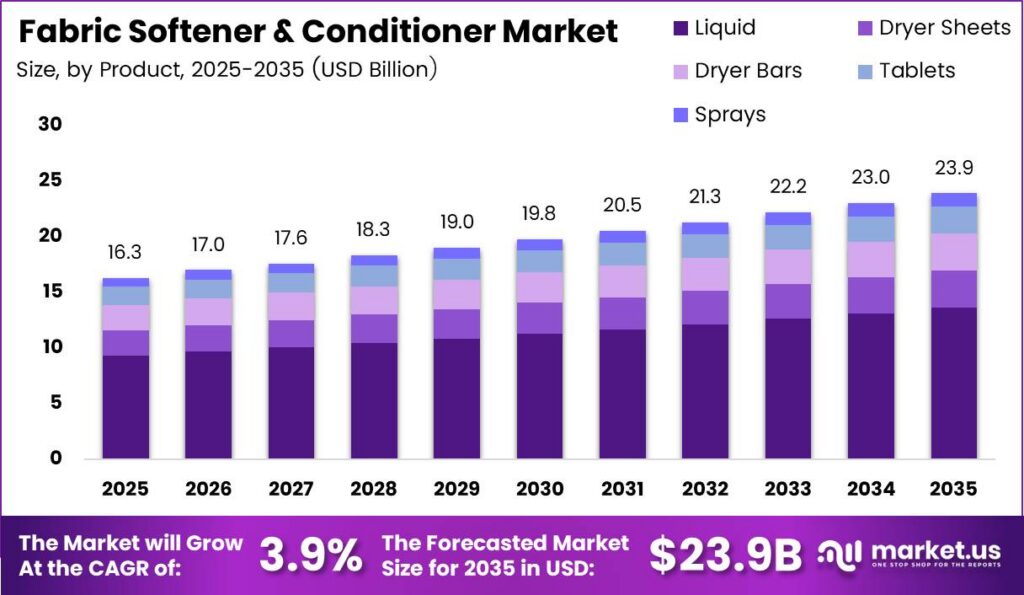
The global fabric softener and conditioner market reached USD 16.3 Billion in 2025 and will hit USD 23.9 Billion by 2035. Industry revenue expands at a 3.9% CAGR from 2026 to 2035. Rising household consumption and hotel occupancy boost textile care demand. Consequently, retailers allocate more shelf space to concentrated liquid formats.
Moreover, cationic conditioning formulas lubricate fabric fibers during rinse or drying cycles. Commercial laundries, hotels, hospitals, and households use these treatments to stop static cling, reduce wrinkles, and add lasting fragrance. Conditioning agents also prevent harsh detergent wear. Therefore, users extend garment lifespans and speed up rotary ironing.
Data-Driven Insights for Smarter Business Decisions:
Explore the Full Report
Key Takeaways
- The global Fabric Softener and Conditioner Market was valued at USD 16.3 Billion in 2025.
- Global market revenue will reach USD 23.9 Billion by 2035.
- The industry will expand at a compound annual growth rate of 3.9% during the forecast period from 2026 to 2035.
- In the Product segment, Liquid held the leading share of 55.67% in 2025, while Sprays represent the fastest-growing product format.
- Under the Type segment, Conventional products accounted for a 68.90% share in 2025, whereas Organic formulations mark the fastest-growing type.
- Within the Application segment, Commercial users captured a 74.34% share in 2025, while the Household segment registers the fastest expansion.
- Across the Distribution Channel segment, Hypermarkets & Supermarkets generated a 43.55% share in 2025, and Online channels record the fastest trajectory.
- Asia-Pacific led all regional markets with a 36.02% share worth USD 5.86 Billion in 2025, while Middle East & Africa is the fastest-growing region.
Additionally, hospitality linen services, healthcare facilities, and urban homes drive global bulk and retail sales. UNWTO data shows international tourist arrivals rose 4% to 1.52 Billion visitors in 2025, generating USD 1.9 Trillion in receipts. High hotel occupancy increases daily towel washing. Consequently, commercial laundries sign recurring chemical drum contracts.
Furthermore, chemical engineers develop micro-encapsulated fragrances, cold-water polymers, and fast-acting express formulas. In May 2026, rapid-cycle innovation Wonder Wash scaled across 41 countries to generate EUR 200 Million in annualized turnover for 15 minute wash cycles. Stand-up pouch refills also cut plastic resin use by 70%.
Meanwhile, federal appliance efficiency rules and European chemical bans reshape product engineering. U.S. Department of Energy washer standards save households USD 2.2 Billion annually and cut 71 Million metric tons of carbon emissions. Additionally, European Union rules restrict cyclic siloxanes below 0.1% starting June 6, 2026.
Finally, Eurostat data shows European household consumption rose 1.5% in 2024. U.S. Environmental Protection Agency figures indicate Safer Choice certified laundry production hit 2.4 Billion pounds across 1,724 products in fiscal 2024, up 150% since 2021. Rising eco-certified output and stable household budgets support premium conditioner upgrades.
Market Segmentation Overview
Liquid conditioners captured a leading 55.67% product share in 2025 ahead of dryer sheets, bars, and tablets, while sprays grow fastest. Flexible Packaging Association data shows U.S. flexible packaging sales hit USD 42.6 Billion in 2024, supporting liquid refill pouches. Meanwhile, conventional formulas led types at 68.90%, whereas organic plant-based products grow fastest.
Moreover, commercial users held a dominant 74.34% application share in 2025, while household demand grows fastest as American families wash 300 loads yearly. Additionally, hypermarkets and supermarkets led distribution at 43.55% as U.S. grocery sales hit USD 221.79 Billion in first-quarter 2026, whereas online channels grow fastest.
Drivers
Consumers willingly pay premium prices for encapsulated fragrances and garment fiber protection. Shifting 10% of product volume into premium tiers at a 20% price premium lifts cumulative revenue by 2% over 5 years. This fragrance upgrade adds +0.40% to the baseline CAGR. Consequently, brands prioritize botanical scent lines.
Moreover, automatic washing machine adoption and urban household formation across developing nations accelerate category growth. Automatic washer conversion adds +0.25% to the CAGR forecast, while urban household growth adds +0.18% and repeat user retention adds +0.12%. Therefore, manufacturers expand single-dose sachet distribution across secondary emerging cities.
Use Cases
Commercial hotels and hospital laundries use industrial liquid conditioners to soften cotton sheets and towels after alkaline washing. High-volume conditioning prevents fiber damage and cuts rotary ironing time across hospitality fleets. Consequently, commercial operators sign multi-year bulk supply contracts with chemical blenders.
Additionally, residential households use ultra-concentrated rinse liquids and heat-activated dryer sheets in front-load washers and tumble dryers. U.S. Department of Energy data shows 80% of American homes own a dryer and run 213 cycles annually. Fatty acid sheets neutralize static cling on synthetic clothes. Therefore, retailers enjoy steady dryer sheet reorders.
Major Challenges
Household budget stress causes financially constrained shoppers to drop rinse conditioners from grocery baskets. Eurostat data shows 17.4% of European households faced great financial difficulty in 2024. When 20% of buyers cut conditioner spending by 8%, revenue drops 1.6%, creating a -0.35% CAGR restraint.
However, Red Sea shipping delays also inflate import costs for palm-based esterquats and fragrance oils. UNCTAD data shows Suez Canal tonnage stayed 70% below 2023 levels by May 2025. A 25% freight hike absorbs 0.75% of operating margin and imposes a -0.22% growth drag.
Business Opportunities
Conditioner manufacturers can launch pooled returnable bottle networks across dense European and Asian cities. Ellen MacArthur Foundation data shows returnable bottle systems reach cost parity at 75% to 80% return rates. Cutting packaging costs by 30% expands contribution margins by 1.6% and adds +0.22% CAGR upside.
Furthermore, suppliers can sign metered commercial laundry contracts and develop waterless tablet or pouch formats for e-commerce. Metered commercial dosing adds +0.18% to the CAGR forecast, while waterless formats add +0.14% and smart-washer auto-replenishment adds +0.10%. These innovations lift the potential CAGR ceiling to 4.62%.
Regional Analysis
Asia-Pacific dominated the global market in 2025 with a 36.02% share valued at USD 5.86 Billion. World Bank data shows East Asia and Pacific GDP reached USD 33.66 Trillion in 2025 on 5.0% real growth. Humid indoor drying across China, India, and Southeast Asia drives strong fragrance sachet and liquid demand.
Meanwhile, Middle East & Africa represents the fastest-growing region through 2035 due to urbanization and Gulf hotel construction. International Monetary Fund data shows Middle East and Central Asia GDP growing 3.5% in 2026 alongside 4.3% in Sub-Saharan Africa. Consumers buy perfumed conditioners to protect garments from hard water.
Recent Developments
- October 2026 — Henkel AG & Co. KGaA acquired specialty coatings leader Stahl Group for EUR 2.1 Billion, adding EUR 725 Million in annual sales.
- September 2026 — Reckitt announced a USD 600 Million U.S. investment, allocating USD 400 Million to North Carolina and USD 200 Million to 2 plants.
- May 2026 — Church & Dwight Co., Inc. acquired stain remover brand Miss Mouth’s Messy Eater for USD 325 Million, adding USD 80 Million in sales.
- May 2026 — LG H&H Co., Ltd. divested Haitai htb for KRW 300 Billion to focus on Home Care and beauty after KRW 771.1 Billion Q1 beauty revenue.
- March 2026 — Henkel AG & Co. KGaA signed a deal to buy consumer brand Not Your Mother’s, adding EUR 190 Million in annual sales.
- February 2026 — Hindustan Unilever Limited approved an INR 2,000 Crore CapEx program over 2 years to expand automated Home Care liquid plants in India.
- December 2025 — Reckitt sold a 70% stake in its Essential Home portfolio including Woolite and 6 plants to Advent International for up to USD 4.8 Billion.
- May 2025 — Unilever committed GBP 80 Million to build an AI-powered fragrance facility at Port Sunlight in the UK for Comfort brands.
- May 2025 — Church & Dwight Co., Inc. agreed to buy hygiene brand Touchland for up to USD 880 Million, adding USD 130 Million in trailing sales.
- April 2025 — Henkel AG & Co. KGaA sold its North American private-label detergent business generating EUR 500 Million in sales to First Quality Enterprises.
- March 2025 — Kao Corporation signed an off-take deal with Future Origins for bio-based fatty alcohols supporting its JPY 1,630 Billion business.
- August 2024 — Procter & Gamble started a USD 180 Million St. Louis plant expansion and a USD 110 Million Greensboro upgrade inside a USD 2 Billion pipeline.
- April 2024 — Henkel AG & Co. KGaA partnered with Samsung Electronics in South Korea on smart wash cycles that cut energy use by 60%.
Key Players
- Procter & Gamble
- Unilever
- Reckitt
- Henkel AG & Co. KGaA
- Colgate-Palmolive Company
- Kao Industrial (Thailand) Co.
- LG H&H Co., Ltd.
- Pigeon Singapore Pte Ltd.
- Church & Dwight Co., Inc.
- Melaleuca Inc.
- Other Key Players
Conclusion
The global fabric softener and conditioner market grows steadily as urban households adopt automatic washers and hotels expand linen operations. Consumers increasingly choose encapsulated botanical scents and cold-water-soluble concentrates. Fragrance premiumization adds +0.40% to the CAGR. Consequently, leading brands expand revenue without relying on broad price hikes.
Moreover, liquid conditioners hold a 55.67% product share while conventional formulas capture 68.90% of type volume ahead of fast-growing organic lines. Commercial users lead applications at 74.34%, and supermarkets top distribution with a 43.55% share. Asia-Pacific commands 36.02% of global revenue at USD 5.86 Billion, while Middle East & Africa grows fastest.
Consequently, chemical producers must invest in silicone-free spray formulas, returnable urban bottle networks, and waterless refill pouches to protect margins. Qualifying dual regional surfactant suppliers also shields blenders from Red Sea shipping delays and tariff costs. Companies executing these strategies will capture retail and commercial share as revenue reaches USD 23.9 Billion by 2035.
Looking for data tailored to your specific market, region, or business need?
Request a custom report or consultation — write to us at
sales@market.us
Discuss your needs with our analyst
Please share your requirements with more details so our analyst can check if they can solve your problem(s)