Market Overview
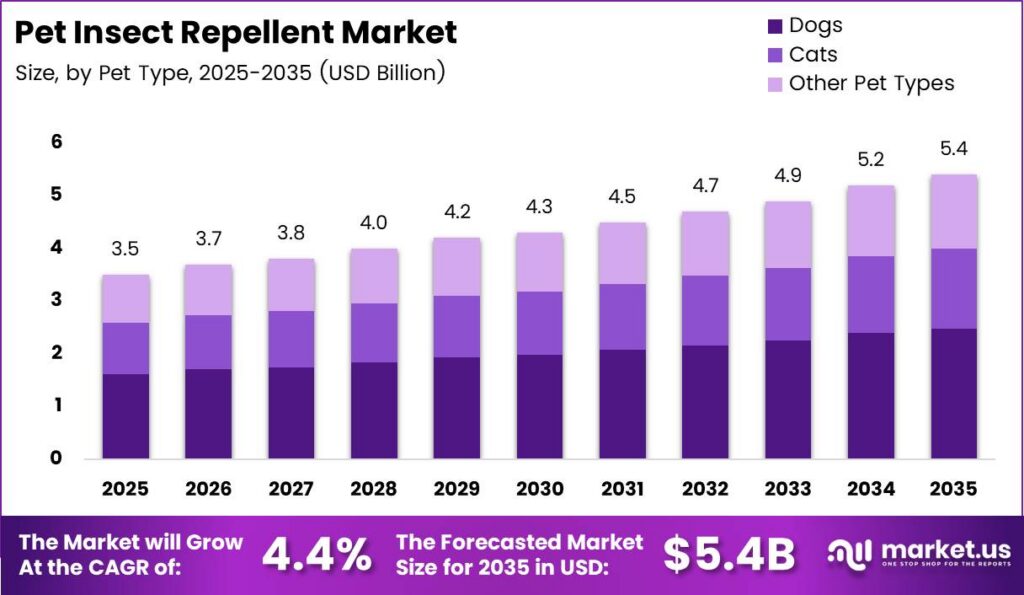
The global pet insect repellent market reached USD 3.5 Billion in 2025 and will hit USD 5.4 Billion by 2035. Industry revenue expands at a 4.4% CAGR from 2026 to 2035. Rising companion animal ownership and expanding tick ranges drive preventive demand. Consequently, manufacturers secure shelf space across veterinary clinics and retail chains.
Moreover, companion animal repellents use chemical and botanical formulas to deter fleas, ticks, mosquitoes, and biting flies. Pet owners, veterinarians, and professional groomers apply these treatments to dogs, cats, and small mammals. Active barriers stop blood-feeding parasites from attaching. Therefore, households prevent vector-borne diseases and lower veterinary treatment costs.
Data-Driven Insights for Smarter Business Decisions:
Explore the Full Report
Key Takeaways
- The global Pet Insect Repellent Market was valued at USD 3.5 Billion in 2025.
- The market is forecast to reach USD 5.4 Billion by 2035.
- The global market is expanding at a CAGR of 4.4% during the forecast period from 2026 to 2035.
- By Product, sprays led the market in 2025 with a 38.78% share, while shampoo represents the fastest-growing product category.
- By Pet Type, dogs captured the largest share at 45.78% in 2025 and also register the fastest growth rate.
- By Application, external applications dominated with a 65.78% market share in 2025, whereas internal applications are the fastest-growing segment.
- By Distribution Channel, veterinary clinics accounted for the leading share of 66.89% in 2025, while online pharmacies are the fastest-growing channel.
- North America dominated the global landscape with a 36.56% share valued at USD 1.2 Billion in 2025, while Asia-Pacific is the fastest-growing region.
Additionally, veterinary hospitals, online pharmacies, pet superstores, and grooming salons drive commercial distribution. U.S. Securities and Exchange Commission filings show PetIQ generated USD 1,101.96 Million in fiscal 2023 net sales across products and clinic services. Meanwhile, grooming salons use wash-off insecticidal shampoos. Consequently, multi-channel distribution stabilizes recurring annual sales.
Furthermore, pharmaceutical formulators develop multi-parasite oral chewables, weight-calibrated spot-on pipettes, and feline-safe botanical sprays. In January 2025, U.S. manufacturers launched 6 parasite chewables that reached USD 100 Million in net sales and 14% clinic share by June 2025. Systemic tablets prevent rain wash-off. Therefore, patented chewables command premium pricing.
Meanwhile, strict European biocide rules and U.S. drug approvals govern active ingredient marketing. European Medicines Agency data shows its veterinary committee recommended a record 30 medicines for authorization in 2025. Additionally, the U.S. Food and Drug Administration met review targets for 434 of 445 animal drug submissions in fiscal 2025.
Finally, American Pet Products Association data shows U.S. pet spending hit USD 158 Billion in 2024 across 94 million households, or 71% of homes. European Pet Food Industry Federation figures indicate 139 million European households own 299 million pets, generating EUR 29.3 Billion annually. High pet density guarantees steady replenishment demand.
Market Segmentation Overview
Sprays captured a leading 38.78% product share in 2025 ahead of spot-on treatments and tablets, while shampoos grow fastest. Consumer biocides represented 88% of registered European invertebrate repellents as pump sprays coat fur instantly. Meanwhile, dogs led pet types at 45.78% and grow fastest as U.S. dog ownership hit 53%, or 71 million homes, in 2025.
Moreover, external applications held a dominant 65.78% share in 2025, while internal oral chewables grow fastest. Centers for Disease Control and Prevention data shows 476,000 Americans receive Lyme disease treatment annually, driving external barrier sales. Additionally, veterinary clinics led distribution at 66.89%, whereas online pharmacies grow fastest through auto-ship subscriptions.
Drivers
Veterinary clinics increasingly recommend continuous year-round parasite protection rather than seasonal summer dosing. A 2025 survey across 15 countries showed 47% of veterinarians view flea-and-tick season as year-round versus 10% of owners. Extending protection from 6 to 7 months lifts buying intensity by 16.7% and adds +0.40% to the CAGR.
Moreover, rising urban pet adoption, warmer tick habitats, and online subscription pharmacies accelerate category growth. Expanding pet ownership adds +0.25% to the CAGR forecast, while widening parasite geography adds +0.20% and online retail adds +0.15%. World Health Organization data shows vector-borne diseases cause over 700,000 human deaths annually, spurring preventive pet care.
Use Cases
Suburban dog owners apply topical sprays and dorsal spot-on pipettes before daily woodland and park walks. Centers for Disease Control and Prevention surveillance through August 2025 showed blacklegged ticks formed 76.9% of collected specimens, with 39.6% carrying Lyme bacteria. Consequently, owners use external repellents to block tick attachment.
Additionally, grooming salons and cat owners use dilute insecticidal shampoos and pyrethroid-free topicals for safe ectoparasite removal. National Institutes of Health data across 708 pesticide incidents affecting 821 animals showed over 75% of reactions involved concentrated spot-ons. Therefore, safety-conscious owners choose mild wash-off shampoos and systemic prescription chewables.
Major Challenges
Species-specific toxicity rules restrict single-formula sales across multi-pet households. Cats lack liver enzymes to metabolize permethrin across Europe’s 108 million feline population. Environmental Protection Agency canine labels exclude cats and puppies under 8 weeks, locking single formulas out of 20% of pet demand and creating a -0.30% CAGR restraint.
However, improper owner dosing after purchase also triggers breakthrough tick attachment and brand complaints. Splitting single applicators across multiple pets or retreating within 30 days reduces efficacy. Cutting misapplication from 10% to 7% lifts treatment reliability to 93%, whereas ongoing owner errors impose a -0.25% growth drag.
Business Opportunities
Repellent manufacturers can sign bulk B2B supply contracts with commercial boarding kennels, shelters, and grooming chains. Bulk institutional shipments cut unit fulfillment costs by 8% to 12% and lower customer acquisition costs by 10% to 15%. These efficiencies expand margins by 1.8 percentage points and add +0.25% CAGR upside.
Furthermore, brands can expand into secondary cities across India, Southeast Asia, and Latin America while launching refillable dispensers. Secondary-city partnerships add +0.20% to the CAGR forecast, while refillable systems add +0.15% and pet-travel kits add +0.10%. Capturing all opportunity segments adds +0.80% upside, lifting the potential CAGR ceiling to 5.2%.
Regional Analysis
North America dominated the global market in 2025 with a 36.56% share valued at USD 1.2 Billion. Severe backyard tick pressure across the United States and Canada compels owners to buy year-round multi-parasite protection. Consequently, veterinary pharmaceutical brands generate their highest revenue per companion animal across North American clinics.
Meanwhile, Asia-Pacific represents the fastest-growing regional market due to rising urban apartment pet ownership across India, China, and Japan. UNCTAD data shows developing Asia and Oceania merchandise exports rose 8.7% in 2025, generating a USD 956 Billion trade surplus. Lower active ingredient import costs support local Asian packaging plants.
Recent Developments
- August 2026 — Elanco Animal Health completed a 25,000 square foot Kansas biologics expansion backed by USD 120 Million to quadruple output by 2028.
- July 2026 — Central Garden & Pet agreed to acquire an 80% stake in European leader TRIXIE for up to EUR 400 Million including earn-outs.
- March 2026 — Boehringer Ingelheim received FDA approval for NexGard chewables to control Gulf Coast ticks for 1 month in dogs weighing 4 pounds or more.
- February 2026 — Boehringer Ingelheim secured 2 FDA Emergency Use Authorizations for NexGard in dogs and cats to treat New World screwworm infestations.
- January 2026 — Elanco Animal Health launched its USD 25 Million Elanco Ventures fund and secured USDA approval for its TruCan Ultra Lyme-L4 vaccine.
- December 2025 — Elanco Animal Health obtained FDA conditional approval for Credelio Quattro-CA1 tablets to treat screwworm in dogs weighing at least 3.3 pounds.
- December 2025 — Heads Up for Tails raised USD 25 Million in Series B funding after hitting INR 400 Crore revenue across 115 stores.
- October 2025 — Elanco Animal Health received FDA approval for Credelio lotilaner tablets to control longhorned ticks and prevent Lyme disease for 1 month.
- October 2025 — Boehringer Ingelheim committed EUR 300 Million through 2028 to expand its Yamagata plant in Japan after supplying 65 million rabies vaccines.
- November 2024 — Morgan Stanley Capital Partners acquired Pet Naturals parent FoodScience LLC as its 3rd pet health platform investment.
- October 2024 — Boehringer Ingelheim secured FDA approval for NexGard PLUS chewables to treat longhorned ticks in dogs weighing at least 4 pounds.
- September 2024 — Heads Up for Tails opened its 100th India store at New Delhi Airport Terminal 3 after opening in Singapore in May 2024.
- August 2024 — Bansk Group agreed to acquire PetIQ in a USD 1.5 Billion cash buyout at USD 31.00 per share for a 51% premium.
Key Players
- Adams Pet Care
- Boehringer Ingelheim
- Central Garden & Pet
- Durvet Animal Health Products
- Elanco Animal Health
- Gurez
- Heads Up for Tails
- Mad About Organics
- Pet Naturals
- PetIQ
- The Hartz Mountain
- Other Key Players
Conclusion
The global pet insect repellent market expands steadily as warming climates widen tick habitats and veterinarians promote year-round parasite care. Pet owners increasingly adopt systemic oral chewables and mild insecticidal shampoos to protect companion animals. Year-round clinical protocols add +0.40% to the CAGR. Consequently, brands enjoy predictable recurring demand.
Moreover, sprays hold a 38.78% product share while dogs capture 45.78% of pet type demand. External treatments lead applications at 65.78%, and veterinary clinics top distribution with a 66.89% share ahead of fast-growing online pharmacies. North America commands 36.56% of global revenue at USD 1.2 Billion, while Asia-Pacific grows fastest.
Consequently, manufacturers must develop feline-safe botanical formulas, color-coded single-dose applicators, and B2B kennel supply contracts to expand margins. Dual-sourcing active ingredients and nearshoring blister packaging also shield formulators from Red Sea shipping delays. Companies executing these strategies will capture clinical and retail share as revenue reaches USD 5.4 Billion by 2035.
Looking for data tailored to your specific market, region, or business need?
Request a custom report or consultation — write to us at
sales@market.us
Discuss your needs with our analyst
Please share your requirements with more details so our analyst can check if they can solve your problem(s)