Market Overview
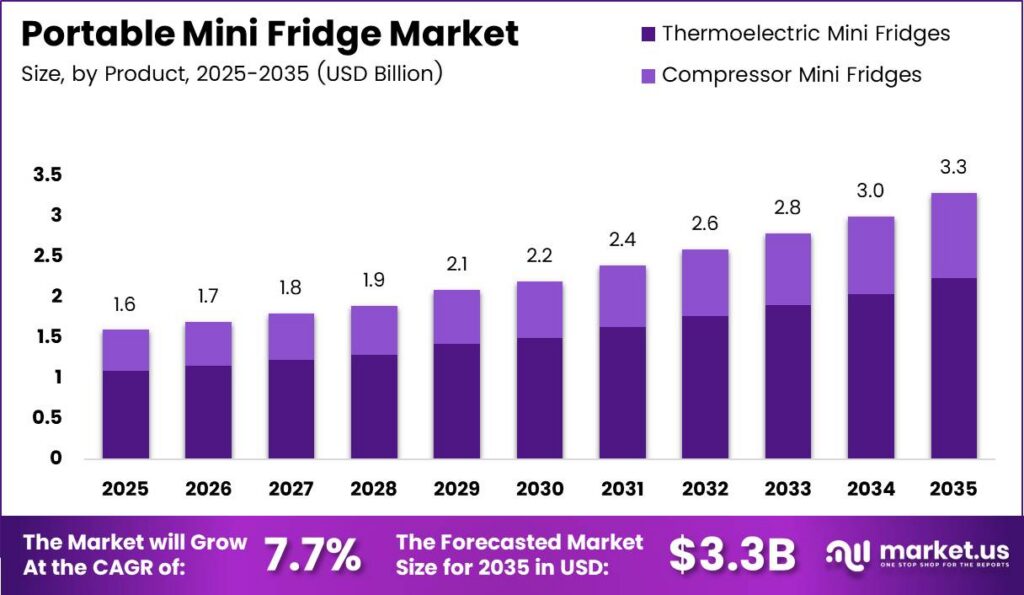
The global portable mini fridge market reached USD 1.6 Billion in 2025 and will hit USD 3.3 Billion by 2035. Industry revenue expands at a 7.7% CAGR from 2026 to 2035. Rising road travel and hotel construction boost compact cooling demand. Consequently, appliance brands target automotive and hospitality distributors.
Moreover, compact cooling appliances operate on alternating current wall outlets or direct current vehicle sockets. Travelers, truck drivers, hotel guests, and medical workers use these lightweight units to chill drinks, food, medicines, and cosmetics. Dual-power adapters support seamless switching. Therefore, users preserve perishables in small rooms and moving vehicles.
Key Takeaways
- The global Portable Mini Fridge Market was valued at USD 1.6 Billion in 2025.
- The market is projected to reach USD 3.3 Billion by 2035.
- The industry will expand at a CAGR of 7.7% during the forecast period from 2026 to 2035.
- Thermoelectric Mini Fridges led the Product segment in 2025 with a 67.23% market share and represent the fastest growing product category.
- The Below 10 L segment dominated the Capacity category in 2025 with a 61.34% share, while the Above 10 L segment is the fastest growing capacity tier.
- The Commercial segment held the largest share of 72.45% in the Application category in 2025 and is the fastest growing application segment.
- The Offline channel captured a dominant 84.56% share in the Distribution Channel category in 2025, whereas the Online channel is the fastest growing route to market.
- Asia-Pacific dominated the global regional landscape in 2025 with a 37.54% market share valued at USD 0.59 Billion, while Middle East & Africa is the fastest growing region.
Additionally, commercial hospitality, automotive touring, healthcare logistics, and urban apartments drive global equipment sales. National Restaurant Association data shows U.S. foodservice sales hit USD 1.5 trillion in 2025. Meanwhile, Cosmetics Europe reported European skincare sales reached EUR 32.3 billion in 2025. Consequently, restaurants and beauty buyers expand unit orders.
Furthermore, engineers integrate vacuum insulated panels, solid-state Peltier modules, dual-zone evaporator coils, and Bluetooth apps into modern coolers. In October 2024, Dometic Group launched its CFX5 Series across 7 models from 25L to 94L reaching -21.6°C. Vacuum panels cut heat gain. Therefore, brands defend premium retail prices.
Meanwhile, strict federal energy rules compel manufacturers to upgrade cabinet insulation and variable compressors. U.S. Department of Energy rule 88 FR 12452 impacts 49 manufacturers and requires USD 1,323.6 million in conversion spending. Commercial rule 90 FR 7464 starts in January 2029. Consequently, certified low-wattage models win retail shelf space.
Finally, World Travel & Tourism Council data shows global tourism contributed USD 11.6 trillion to GDP in 2025, including USD 5.63 trillion in domestic spending. International Energy Agency figures indicate energy efficiency progress improved 1.8% in 2025. Expanding travel and efficiency mandates sustain steady replacement demand worldwide.
Data-Driven Insights for Smarter Business Decisions:
Explore the Full Report
Market Segmentation Overview
Thermoelectric mini fridges captured a dominant 67.23% product share in 2025 and grow fastest ahead of compressor models. Vibration-free Peltier modules hold 10°C to 15°C temperatures to protect retinol skincare serums. Meanwhile, below-10L units led capacity with a 61.34% share, while above-10L models grow fastest for overlanding and clinics.
Moreover, commercial applications held a leading 72.45% share in 2025 and grow fastest ahead of residential rooms. Hotels and ghost kitchens deploy staging coolers for cold deliveries. Additionally, offline stores led distribution at 84.56% as U.S. appliance store sales hit USD 64,939 million in nine-month 2025, while online channels grow fastest.
Drivers
Rising recreational vehicle shipments and road touring boost portable cooler sales through dealer bundles. RV Industry Association data shows shipments rose 2.5% to 342,220 units in 2025, generating up to 34,000 accessory units at a 10% attachment rate. This touring demand adds +0.55% to the baseline CAGR.
Moreover, compact compressor availability and dual-voltage vehicle and mains power systems accelerate buyer adoption. Compact compressors add +0.40% to the CAGR forecast, while cross-compatible power cords add +0.30% and online specialty retail adds +0.25%. Consequently, drivers move coolers seamlessly between trucks and cabins.
Use Cases
Off-grid healthcare clinics and overland travelers use above-10L solar and battery compressor coolers to protect vaccines and food. World Health Organization data shows clinics with 3 hours or fewer of daily electricity require portable cold units holding +2°C to +8°C. Consequently, medical agencies buy insulated 28L to 60L coolers.
Additionally, urban consumers and hotel operators use quiet sub-10L thermoelectric coolers for bedrooms, desks, and skincare storage. International Energy Agency data shows efficient cold appliances cut energy use by up to 64% and save 40% in lifecycle costs. Therefore, households buy low-wattage personal coolers without raising electricity bills.
Major Challenges
Low-cost passive ice chests satisfy occasional day-trippers and reduce powered cooler purchases. Buyers taking 6 annual trips over 3 years spread hardware costs across only 18 uses. Upfront price barriers subtract -0.30% while passive cooler substitution cuts -0.35% from the CAGR. Consequently, brands target frequent travelers.
However, thermoelectric cooling limits in hot climates also increase customer product returns. Standard Peltier modules cool 20°C below ambient air, leaving a 35°C room at 15°C and missing a 5°C food-safety target by 10°C. This thermal gap creates a -0.30% CAGR drag, requiring clearer climate labels.
Business Opportunities
Appliance makers can lease managed workplace refrigeration fleets to construction and field-service crews. Dual-voltage 12/24V and 240V compressor units run 180 to 220 days annually across a 36 month recovery cycle. Fleet contracts cut customer acquisition costs by 20%, boost margins by 5 percentage points, and add +0.35% CAGR upside.
Furthermore, manufacturers can supply validated food-sampling kits, certified refurbished units, and modular office furniture fridges. Specialty food-sampling kits add +0.30% to the CAGR forecast, while certified resale adds +0.25% and co-living furniture integration adds +0.20%. Capturing all opportunities adds +1.20% upside, lifting the CAGR ceiling to 8.9%.
Regional Analysis
Asia-Pacific dominated the global market in 2025 with a 37.54% share valued at USD 0.59 Billion. World Travel & Tourism Council data shows Asia-Pacific tourism GDP grew 8.1% to USD 3.29 trillion in 2025, led by China at USD 1,904.5 billion. Consequently, manufacturers concentrate assembly plants across China, Thailand, and India.
Meanwhile, Middle East & Africa represents the fastest-growing region due to desert tourism and extreme heat. UNWTO data shows Middle East tourist arrivals rose 3% to nearly 100 million visitors in 2025, standing 39% above 2019 levels. Desert safari fleets and glamping resorts buy tropical-rated compressor coolers.
Recent Developments
- November 2026 — Electrolux AB signed an agreement committing over EUR 100 million across its Italian plants to sustain 3.2 million annual appliance units.
- September 2026 — Midea Group invested RMB 8.5 billion in first-half 2026 R&D and deployed 20,000 AI agents to raise factory efficiency by 30%.
- June 2026 — Whirlpool Corporation agreed to sell its remaining 25% stake in Beko Europe to Arcelik for cash and a 2.9% Arcelik equity stake.
- April 2026 — Whirlpool Corporation announced a USD 60 million investment to convert its Perrysburg, Ohio plant and create up to 150 jobs over 2 years.
- November 2025 — Whirlpool Corporation announced a USD 300 million Ohio plant investment creating up to 600 jobs and sold an 11% Whirlpool of India stake for USD 166 million.
- November 2025 — Midea Group merged Clivet with Arbonia Climate to form MBT Climate and added 18 overseas plants to reach 63 overseas bases.
- September 2025 — Haier Group opened a 324,000 square meter Thailand industrial park backed by USD 270 million to scale output to 6 million units by 2027.
- September 2024 — Godrej Enterprises Group opened a 100,000 square foot automated line in Maharashtra with INR 100 crore CapEx targeting INR 10,000 crore revenue by FY2026.
Key Players
- Midea Group
- ARB
- Danby
- DOMETIC GROUP AB (PUBL)
- Living Direct, Inc.
- Engel Australia Pty Ltd.
- Haier Inc.
- Whirlpool Corporation
- Godrej Group
- Electrolux AB
- Other Key Players
Conclusion
The global portable mini fridge market grows rapidly as road tourism, hotel construction, and off-grid solar demand expand worldwide. Consumers and commercial operators demand dual-voltage coolers that work in vehicles and buildings. Recreational vehicle touring adds +0.55% to the CAGR. Consequently, manufacturers enjoy strong dealer and online sales.
Moreover, thermoelectric units hold a 67.23% product share while sub-10L models capture 61.34% of capacity volume. Commercial users lead applications at 72.45%, and offline stores top distribution with an 84.56% share. Asia-Pacific commands 37.54% of global revenue at USD 0.59 Billion, while Middle East & Africa grows fastest.
Consequently, appliance brands must invest in vacuum insulation panels, workplace fleet leasing, and nearshored assembly plants in Mexico and Egypt.Holding 30 to 45 days of component buffer stock also shields distributors from Red Sea freight delays. Companies executing these strategies will capture commercial contracts as revenue reaches USD 3.3 Billion by 2035.
Looking for data tailored to your specific market, region, or business need?
Request a custom report or consultation — write to us at
sales@market.us
Discuss your needs with our analyst
Please share your requirements with more details so our analyst can check if they can solve your problem(s)