Market Overview
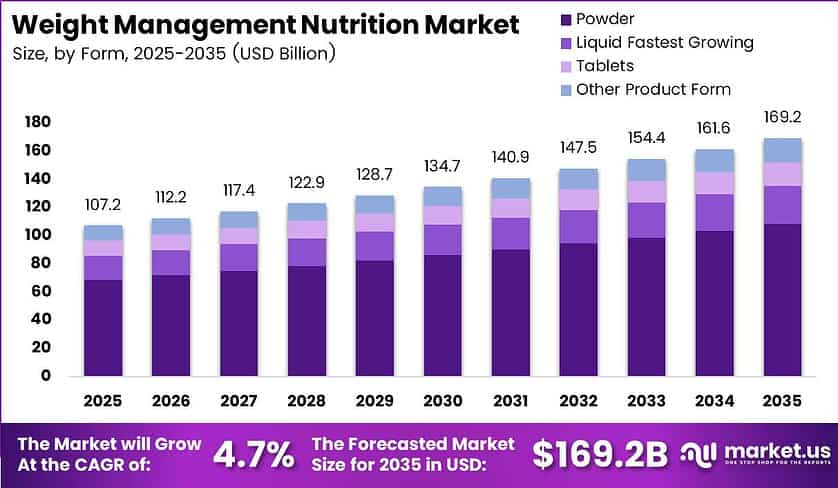
The global weight management nutrition market reaches USD 169.2 billion by 2035, up from USD 107.2 billion in 2025. Analysts project a 4.7% CAGR during the 2026 to 2035 forecast period. This growth reflects rising demand for structured nutrition products.
Weight management nutrition products include shakes, powders, bars, and clinical dietary supplements. These products regulate calorie intake, preserve lean muscle, and support metabolic function. The industry links dairy processors, botanical extractors, and contract manufacturers with bariatric clinics, telehealth weight platforms, and retail pharmacies.
Moreover, pharmacies, supermarkets, specialty stores, and online retailers sell these products to distinct buyers. Pharmacy shoppers collect prescriptions and add protein shakes to prevent muscle loss. Fitness consumers visit specialty stores for potent thermogenic formulas, while grocery shoppers add high-protein items to weekly food budgets.
Data-Driven Insights for Smarter Business Decisions: Explore the Full Report
Key Takeaways
- The market was valued at USD 107.2 billion in 2025 and will reach USD 169.2 billion by 2035.
- The market expands at a 4.7% CAGR from 2026 to 2035.
- Weight Loss / Fat Reduction leads types with 41.23%, while Metabolic Health & Blood Sugar Support grows fastest.
- Powder holds 63.56% of the form segment, while Liquid grows fastest.
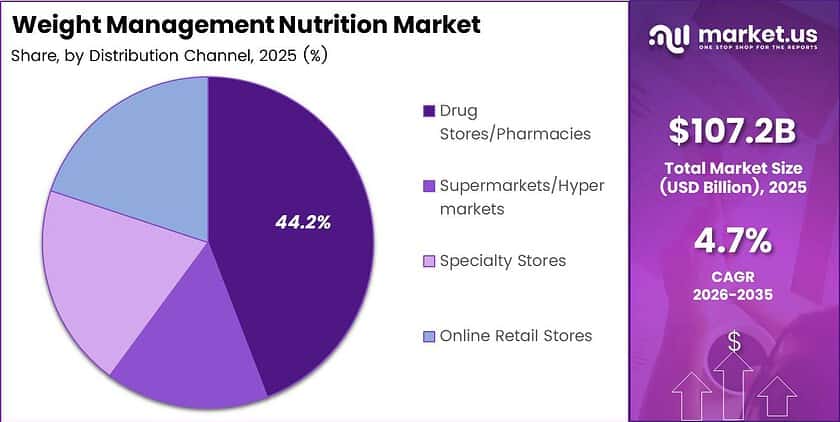
- Drug Stores/Pharmacies capture 44.23%, while Supermarkets/Hypermarkets grow fastest.
- North America leads with 34.21%, worth USD 36.6 billion, while Europe grows fastest.
Market Segmentation Overview
Weight Loss / Fat Reduction leads the type segment with 41.23% share in 2025. The NIH reports that 15% of U.S. adults have used a weight-loss supplement. Consequently, fat-burner sales fund clinical metabolic research, while Metabolic Health & Blood Sugar Support grows fastest as shoppers target insulin sensitivity.
Moreover, Appetite Control & Satiety Management, Meal Replacement & Structured Nutrition, GLP-1 Companion Nutrition, and Gut Health & Microbiome Support complete the type mix. Viscous fibers expand in the stomach and trigger fullness, so satiety suppliers earn premium licensing fees.
Powder dominates the form segment with 63.56% share in 2025 because of low per-serving cost and versatility. Spray-dried powders cut shipping weight and last 24 months without preservatives. Meanwhile, Liquid grows fastest, and Tablets deliver precise doses of botanical extracts.
Drug Stores/Pharmacies capture 44.23% share in 2025 because of clinical trust and pharmacist guidance. Patients add companion shakes during prescription pickups. However, Supermarkets/Hypermarkets grow fastest as grocery shoppers add protein products, while Specialty Stores and Online Retail Stores serve fitness buyers and digital shoppers.
Drivers
Incretin therapy companion nutrition leads growth, adding 1.9 percentage points to the CAGR. Appetite-suppressing drugs cause muscle to make up 25% to 40% of weight lost. Therefore, medical societies recommend 1.2 to 1.5 grams of protein per kilogram daily.
Ready-to-drink high-density formats add 1.0 percentage point to growth across North America and Europe. Retail sales of shakes with 30 to 42 grams of protein rose 28% year over year. Moreover, telehealth subscription bundles extended customer retention from 3.5 months to 9.2 months.
Data-Driven Insights for Smarter Business Decisions: Explore the Full Report
Use Cases
Patients on weight-loss medication use companion protein shakes to prevent muscle loss. They buy these shakes at pharmacy counters during prescription pickups. Consequently, nutrition brands fund pharmacy endcaps to reach clinical buyers, and telehealth platforms bundle shakes into recurring subscriptions.
Fitness consumers use thermogenic and metabolic formulas to support body-composition goals. In November 2025, Iovate launched MuscleTech EFF’N beadlets exclusively across GNC specialty stores. Additionally, exclusive launches let brands test premium prices before moving into mass grocery chains, which raises gross margins for ingredient innovators.
Major Challenges
Whey isolate supply deficit creates the largest challenge, dragging growth by 1.3 percentage points. Cheese plants need 100 kilograms of milk for 1 kilogram of whey isolate, so supply cannot expand independently. Consequently, wholesale 80% concentrate prices surged 250% year over year, squeezing formulators’ margins.
However, statutory age bans and claim enforcement restrain growth by 1.1 percentage points. California banned weight-loss supplement sales to minors under 18 on September 28, 2026. Consequently, retailers moved over 1,400 thermogenic products behind pharmacy counters or delisted them, cutting impulse unit sales by 14% to 19%.
Business Opportunities
Post-pharmacotherapy weight maintenance regimens offer the top opportunity, with 1.6 points of potential CAGR upside. Many patients stop incretin therapy within 12 to 24 months and regain 60% to 67% of lost weight. Therefore, off-ramp maintenance kits can fill a clear gap that legacy meal replacements miss.
Moreover, early movers that validate maintenance protocols can shift consumers into 12-month to 18-month subscriptions. These plans cut raw ingredient costs by 22% to 28% versus dairy isolate shakes. As a result, customer lifetime value rises 45%, and continuous glucose monitor subscriptions add another 1.0 point of upside.
Data-Driven Insights for Smarter Business Decisions: Explore the Full Report
Regional Analysis
North America leads with 34.21% share, valued at USD 36.6 billion in 2025. The CDC reports that 72.4% of U.S. adults aged 20 and older are overweight or obese, including 40.3% with obesity. This disease burden drives medical referrals for low-glycemic shakes.
However, Europe grows fastest as health authorities enforce front-of-pack labeling and shoppers choose clean-label meal replacements. Eurostat shows 51.7% of EU adults were overweight in 2025, including 35.4% pre-obese. Therefore, manufacturers with EFSA-compliant fiber and protein claims will win supermarket shelf space.
Recent Developments
- September 2026 — Nestlé agreed to sell its 7-brand vitamins unit to Yellow Wood Partners for USD 1.0 billion cash.
- March 2026 — Herbalife agreed to buy Bioniq’s personalized supplement assets for up to USD 150 million.
- February 2026 — Herbalife secured USD 7.5 million from Cristiano Ronaldo for a 10% Pro2col Software stake.
- October 2025 — Glanbia completed its SlimFast divestiture for USD 27 million after a USD 91.4 million impairment.
- September 2025 — Nutrabolt invested USD 160 million more in Bloom Nutrition, exceeding USD 210 million and 50% ownership.
- September 2025 — Ferrero completed its USD 3.1 billion WK Kellogg Co acquisition at USD 23.00 per share.
- August 2025 — Glanbia acquired Brazil’s Sweetmix for USD 41 million plus contingent earnout payments.
- April 2025 — Herbalife completed the Pro2col Health and Pruvit purchases for USD 19 million, plus 51% of Link BioSciences.
- March 2025 — Simply Good Foods launched Quest Protein Milkshakes with 45 grams of protein across 3 flavors.
- June 2024 — Simply Good Foods acquired OWYN for a USD 280 million enterprise value.
Conclusion
The weight management nutrition market grows from USD 107.2 billion in 2025 at a 4.7% CAGR. Incretin therapy companion nutrition and ready-to-drink formats power this momentum. Consequently, brands now shift from simple calorie-cutting products toward muscle-preserving, clinically supported nutrition regimens.
Weight Loss / Fat Reduction, Powder, and Drug Stores/Pharmacies lead their segments with 41.23%, 63.56%, and 44.23% shares. Moreover, North America commands 34.21% of revenue, while Europe grows fastest. Metabolic Health, Liquid, and Supermarkets/Hypermarkets also grow fastest in their respective segments.
Companies must act on two priorities. First, brands should secure whey and plant-protein supply through forward contracts. Additionally, they should develop clinically validated maintenance products for patients leaving incretin therapy. Therefore, early movers can capture growth as the market reaches USD 169.2 billion by 2035.
Looking for data tailored to your specific market, region, or business need? Request a custom report or consultation — write to us at sales@market.us
Discuss your needs with our analyst
Please share your requirements with more details so our analyst can check if they can solve your problem(s)