Market Overview
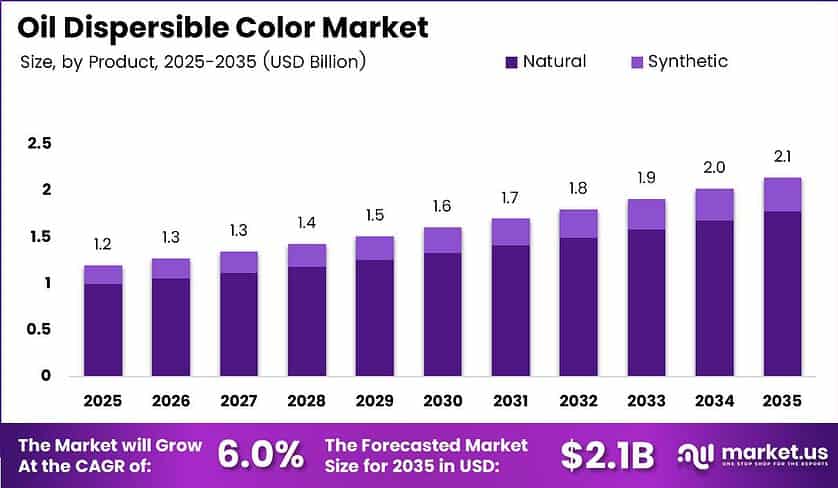
The global oil dispersible color market reaches USD 2.1 billion by 2035, up from USD 1.2 billion in 2025. Analysts project a 6.0% CAGR during the 2026 to 2035 forecast period. This growth reflects rising demand for fat-friendly colorants in food, drug, and cosmetic products.
Oil dispersible colors are micronized pigments and lipophilic dye suspensions that spread evenly in fat and oil phases without water. Manufacturers use them to tint chocolate coatings, bakery shortenings, softgels, and lip cosmetics. These colorants prevent phase separation in anhydrous products.
Data-Driven Insights for Smarter Business Decisions: Explore the Full Report
Key Takeaways
- The market was valued at USD 1.2 billion in 2025 and will reach USD 2.1 billion by 2035.
- The market expands at a 6.0% CAGR from 2026 to 2035.
- Natural colors lead the product segment with 82.34% and grow fastest.
- Powdered Oil-Soluble Colors lead types with 46.89%, while Gel or Emulsion colors grow fastest.
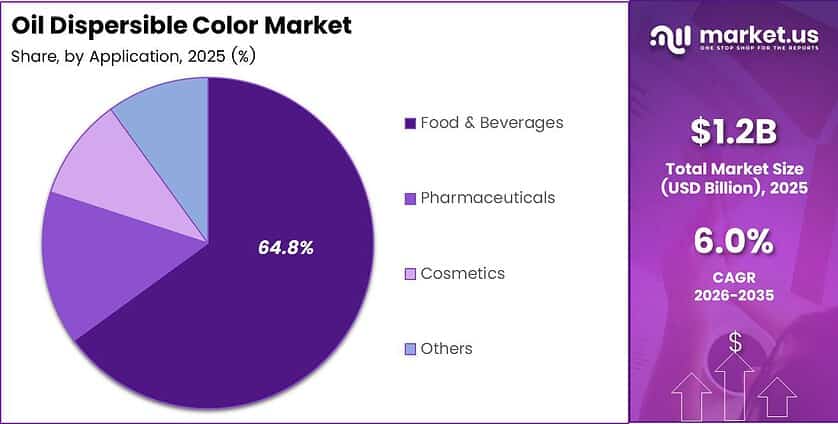
- Food & Beverages dominates applications with 64.89% and grows fastest.
- Distributors hold 71.34% of sales, while E-commerce grows fastest.
- Asia-Pacific leads with 41.23%, worth USD 0.49 billion, while Middle East & Africa grows fastest.
Market Segmentation Overview
Natural dominates the product segment with 82.34% share in 2025 and also grows fastest. Clean-label confectionery reformulations drive this lead, and carrier oils protect carotenoids from oxidation. Meanwhile, Synthetic colors serve buyers needing heat stability and high tinting strength at low dosage cost.
Powdered Oil-Soluble Colors lead the type segment with 46.89% share in 2025 because of long ambient shelf stability. Dry powders cut rancidity risk and shipping weight. However, Gel or Emulsion colors grow fastest, while Liquid Oil-Soluble Dyes dissolve directly into waxes, oils, and softgel fills.
Food & Beverages dominates the application segment with 64.89% share in 2025 and grows fastest. Chocolate coatings and bakery fillings need water-free dispersions to avoid sugar bloom. Moreover, Pharmaceuticals tint softgels and tablet coatings, while Cosmetics color lipsticks, balms, and foundations.
Distributor dominates the sales channel segment with 71.34% share in 2025 because regional formulation accounts stay fragmented. Mid-sized bakeries and cosmetic labs need local warehousing and split-pallet deliveries. Additionally, E-commerce grows fastest, while Direct Sales serve multinationals needing custom shade matching.
Drivers
Mandatory migration from synthetic lake dyes leads growth, adding 2.2 percentage points to the CAGR. State and federal dye bans pushed reformulation pipelines up 35% to 45%. Consequently, confectionery and bakery brands replace spot-bought synthetic lakes with long-term natural oil dispersion contracts.
Plant-based dairy and confectionery matrices add 1.6 percentage points to growth worldwide. Moreover, anhydrous color cosmetics and lip care add 1.3 points across Asia-Pacific and North America. Therefore, suppliers shift from commodity pricing to value-based formulation contracts, cutting customer payback from 18 months to 11 months.
Use Cases
Confectioners and bakers use oil dispersible colors in compound chocolate coatings, fat-based fillings, and snack seasonings. Water-free dispersions prevent sugar bloom and stop melted cocoa butter from seizing. Consequently, EU food manufacturing, worth EUR 1,081 billion in 2024, supports steady volume contracts for natural color formulators.
Moreover, pharmaceutical makers tint lipid-based softgel capsules, suppositories, and tablet film coatings for accurate pill identification. Photostable iron oxides, lakes, and carotenoid suspensions also shield light-sensitive active ingredients from degradation. As a result, excipient suppliers with drug master files command high switching costs.
Major Challenges
Botanical raw material yield volatility drags growth by 1.2 percentage points. Erratic monsoons and frost disrupted paprika, turmeric, and annatto harvests, swinging pigment concentration by 20% to 35%. Consequently, spot prices for bixin extracts spiked 45%, and tier-one formulators hold 120 to 150 days of buffer inventory.
However, the EU titanium dioxide ban restrains growth by 1.4 percentage points. Replacement opacifiers need 3.5% to 6.0% solid loading, which raises viscosity by 40% to 65% and clogs depositor nozzles. Therefore, European coaters froze launches for 22% of planned multi-color products.
Business Opportunities
Precision-fermented and algal lipid-soluble pigments offer the top opportunity, with 1.9 points of potential CAGR upside. Yeast and microalgae produce fat-soluble pigments at purities above 92%, avoiding agricultural land limits. Consequently, bioreactor scale above 50,000 liters can cut unit costs by 28% to 36%.
Moreover, nano-encapsulated lipid color microparticles add 1.4 points of potential upside globally. Therefore, early movers in fermented pigments that secure patent licenses and joint ventures between 2027 and 2030 can capture 550 to 800 basis points of gross margin expansion.
Regional Analysis
Asia-Pacific leads with 41.23% share, valued at USD 0.49 billion in 2025. India and China anchor botanical extraction, and developing East Asia and Pacific GDP grew 5.0% in 2025. Rising incomes lift consumption of coated confectionery and color cosmetics, so pigment houses open local application labs.
However, Middle East & Africa grows fastest as Gulf and African urban centers invest in domestic confectionery, bakery, and pharmaceutical manufacturing. Industrial diversification into halal-certified food coatings and softgel encapsulation spans Dubai, Saudi Arabia, and South Africa. Therefore, ingredient suppliers build regional technical hubs to capture import-substitution demand.
Recent Developments
- October 2026 — Vidhi Specialty committed INR 25 crore to INR 35 crore for a CoatIcon tablet-coating color facility.
- August 2026 — Sudarshan agreed to buy Clariant’s Muttenz aluminium dyes plant for CHF 7 million.
- July 2026 — Kalsec opened its Kalamazoo Spice Processing Center with 0 recordable injuries.
- May 2026 — Phytolon closed a USD 23.6 million Series B, bringing total funding to USD 43.6 million.
- May 2026 — Oterra and Debut Biotechnology partnered on a precision-fermentation Red 40 alternative across 3 shade families.
- February 2026 — The FDA approved Phytolon’s fermentation-derived Beetroot Red, totaling 4 natural approvals in 2 months.
- January 2026 — ADM committed USD 26 million to expand its Erlanger campus, raising handling capacity 40%.
- October 2025 — Lycored debuted microencapsulated Lycobeads in 4 delivery formats at SupplySide Global.
- August 2025 — Nactarome agreed to buy Claremont Ingredients for about GBP 100 million.
- May 2025 — Oterra opened a 155,000 square foot Wisconsin hub as revenue rose 7.2%.
- March 2025 — Sudarshan bought Heubach’s pigment business for EUR 127.5 million across 19 sites.
- August 2024 — Kalsec opened an 8,000 square foot Mildenhall distribution center.
- July 2024 — Givaudan bought the remaining 75% of b.kolormakeup & skincare for CHF 310 million.
Conclusion
The oil dispersible color market grows from USD 1.2 billion in 2025 at a 6.0% CAGR. Dye bans and clean-label reformulation power this momentum. Consequently, formulators shift from synthetic lakes toward natural oil dispersions across confectionery, pharmaceutical, and cosmetic products.
Natural colors, Powdered Oil-Soluble Colors, Food & Beverages, and Distributors lead their segments with 82.34%, 46.89%, 64.89%, and 71.34% shares. Moreover, Asia-Pacific commands 41.23% of revenue, while Middle East & Africa grows fastest. E-commerce and Gel or Emulsion colors also grow fastest.
Companies must act on two priorities. First, suppliers should secure botanical supply through dual-hemisphere contracts and invest in fermented pigments. Additionally, they should develop titanium dioxide alternatives with low viscosity. Therefore, early movers can capture growth as the market reaches USD 2.1 billion by 2035.
Looking for data tailored to your specific market, region, or business need? Request a custom report or consultation — write to us at sales@market.us
Discuss your needs with our analyst
Please share your requirements with more details so our analyst can check if they can solve your problem(s)