Market Overview
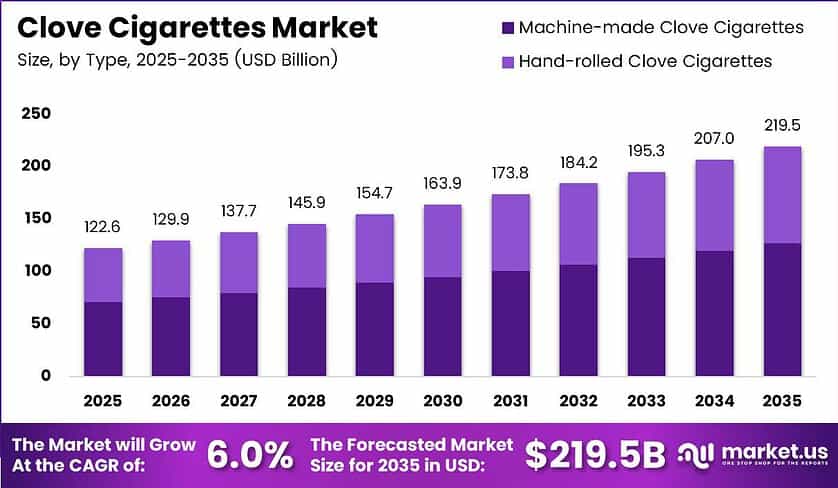
The global clove cigarettes market reaches USD 219.5 billion by 2035, up from USD 122.6 billion in 2025. Analysts project a 6.0% CAGR during the 2026 to 2035 forecast period. This growth reflects steady adult demand for spiced kretek products despite tightening regulation.
Clove cigarettes, known as kretek, are tobacco products blended with minced dried clove buds and eugenol-rich spice sauces. They deliver a numbing aromatic draw for adult smokers. Manufacturers sell machine-made and hand-rolled formats through convenience stores, supermarkets, and online retailers.
Moreover, the industry links spice plantations, leaf curing processors, and tax stamp distribution networks with adult hospitality and retail buyers. Indonesia produces 120,000 to 135,000 metric tons of cloves annually, or 70% to 75% of global output, giving blenders a procurement edge.
Data-Driven Insights for Smarter Business Decisions: Explore the Full Report
Key Takeaways
- The market was valued at USD 122.6 billion in 2025 and will reach USD 219.5 billion by 2035.
- The market expands at a 6.0% CAGR from 2026 to 2035.
- Machine-made cigarettes lead types with 57.89% and grow fastest alongside Hand-rolled.
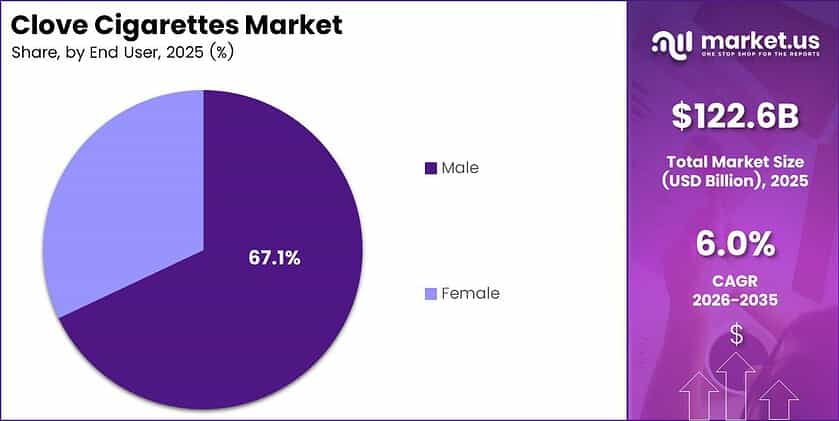
- Male consumers dominate end users with 67.11%.
- Convenience Stores lead with 67.45%, while Online Retail Stores grow fastest.
- Asia Pacific leads with 63.56%, worth USD 82.1 billion, while Latin America grows fastest.
Market Segmentation Overview
Machine-made Clove Cigarettes dominate the type segment with 57.89% share in 2025 due to high-speed automated filter production. Sampoerna generated IDR 61.4 trillion in machine-made kretek revenue in 2025. Consequently, automated producers capture operating leverage across urban retail chains, and Hand-rolled formats also grow fastest.
Hand-rolled Clove Cigarettes serve value-conscious and traditional smokers who prefer unfiltered full-flavor blends. Sampoerna’s hand-rolled lines generated IDR 38.2 trillion in 2025 net revenue across 6 internal plants and 43 third-party operators. Lower excise tiers protect affordability, so manufacturers expand contract rolling networks with minimal fixed capital risk.
Male consumers dominate the end user segment with 67.11% share in 2025 due to entrenched adult male smoking habits. WHO data show adult male tobacco use stood at 32.5% in 2024, down from 41.4% in 2010. Meanwhile, Female smokers prefer slimmer formats and milder variants, so developers engineer ultra-mild clove products for urban markets.
Convenience Stores dominate distribution with 67.45% share in 2025 because daily commuter foot traffic drives single-pack cash purchases. Therefore, manufacturers lock in shelf space contracts at neighborhood stores. Meanwhile, Online Retail Stores grow fastest, and Supermarkets/Hypermarkets use carton promotions to stabilize working capital.
Drivers
Affordable hand-rolled kretek substitution leads growth, adding 0.45 percentage points to the CAGR. Price-sensitive adult smokers downtrade to lower-priced products, and a manufacturer added 2 hand-rolled facilities and 5 third-party operators in 2024. Consequently, legal category volume holds up even when total cigarette consumption stays flat.
Existing-brand retail price realization adds 0.30 percentage points across Indonesia and permitted export markets. Moreover, household consumption resilience adds 0.20 points. Therefore, brands that raise prices selectively protect margins. Gudang Garam’s net income recovered 59% in 2025 through cost control and selective pack price increases.
Use Cases
Convenience-store shoppers buy single packs of machine-made and hand-rolled kretek during daily trips. Daily commuter foot traffic and cash transactions require dense counter displays. Consequently, manufacturers secure shelf-space agreements, and Bentoel invested IDR 11.12 billion in machinery in August 2024 to supply 23 export markets.
Moreover, specialty importers and online retailers connect adult consumers with niche clove blends and multipack cartons. Therefore, distributors invest in compliant digital storefronts, as U.S. retail e-commerce sales rose 12.2% to USD 340.2 billion in the second quarter of 2026.
Data-Driven Insights for Smarter Business Decisions: Explore the Full Report
Major Challenges
Clove harvest supply volatility creates the largest challenge, dragging growth by 0.25 percentage points. Indonesia’s 2023 yield fell almost 25% below its 2010 peak. Consequently, a 20% clove price jump raises production cost by 2% to 3%, so blenders sign multi-year forward supplier contracts.
However, domestic age and outlet restrictions restrain growth by 0.35 percentage points. Indonesia also bans most single-stick sales, and the United States bans cigarettes with a characterizing clove flavor. Consequently, distributors absorb lower outlet throughput and redirect inventory toward compliant stores.
Business Opportunities
Subscale manufacturer consolidation offers the top opportunity, with 0.30 points of potential CAGR upside. Cutting duplicated overhead by 8% to 12% lowers combined costs by 0.8% to 1.8%. Therefore, early consolidators can lift operating margins by 0.3 to 0.7 percentage points while navigating excise tier thresholds.
Moreover, production-scrap recovery investment adds 0.18 points, and factory energy-efficiency retrofits add 0.14 points across Indonesian plants. Lawful export contract manufacturing adds 0.10 points in permitted markets. Consequently, producers that cut waste and energy costs strengthen margins under tight excise and price floors.
Regional Analysis
Asia Pacific leads with 63.56% share, valued at USD 82.1 billion in 2025. East Asia and Pacific GDP grew 4.8% in 2025, and rising wage employment in Southeast Asian cities sustains daily spending on kretek packs. Consequently, manufacturers concentrate blending and rolling capacity in Indonesia to serve regional demand.
However, Latin America grows fastest as specialty distributors expand duty-paid clove cigarette imports across urban retail chains. The World Bank expects regional GDP growth of 2.2% in 2026, matching 2025. Therefore, exporters target South American metropolitan convenience chains, helped by ties between Brazilian leaf suppliers and Indonesian blenders.
Recent Developments
- October 2026 — JTI announced a JPY 800 billion investment program across 30 markets through 2028.
- August 2026 — Gudang Garam injected IDR 200 billion into the entity managing Dhoho Kediri Airport.
- July 2026 — Wismilak’s first-half net profit rose 104.7% to IDR 303.56 billion.
- May 2026 — Wismilak paid an IDR 217.8 billion dividend after revenue rose 34.33% to IDR 6.38 trillion.
- February 2026 — Philip Morris reported 6.5% organic revenue growth and 187,824 million fourth-quarter shipment units.
- November 2025 — Djarum introduced 2 kretek variants, L.A. Ice Mango Boost and L.A. Lights, in Japan.
- July 2025 — Djarum raised its direct stake in Surya Semesta Internusa to 6.74%.
- March 2025 — Sampoerna expanded its USD 330 million Karawang export facility after reaching USD 250 million in exports.
- March 2025 — JTI allocated JPY 176.0 billion to fiscal 2025 capital spending, including JPY 152.0 billion for tobacco manufacturing.
- October 2024 — JTI completed its 100% acquisition of Vector Group at USD 15.00 per share, about USD 2.4 billion.
- October 2024 — Kretek International signed an exclusive U.S. distribution partnership with Clipper 1959, effective January 1, 2025.
Conclusion
The clove cigarettes market grows from USD 122.6 billion in 2025 at a 6.0% CAGR. Hand-rolled downtrading and selective price increases power this momentum. Consequently, manufacturers defend volume among adult smokers through tiered pricing, spice blend differentiation, and cost discipline.
Machine-made cigarettes, Male consumers, and Convenience Stores lead their segments with 57.89%, 67.11%, and 67.45% shares. Moreover, Asia Pacific commands 63.56% of revenue, while Latin America grows fastest. Online Retail Stores also grow fastest among channels. Hand-rolled cigarettes grow fastest alongside machine-made ones.
Companies must act on two priorities. First, manufacturers should secure clove supply through forward contracts and comply with age and outlet rules. Additionally, they should pursue consolidation, cost recovery, and compliant digital channels. Therefore, early movers can capture growth as the market reaches USD 219.5 billion by 2035.
Looking for data tailored to your specific market, region, or business need? Request a custom report or consultation — write to us at sales@market.us
Discuss your needs with our analyst
Please share your requirements with more details so our analyst can check if they can solve your problem(s)