
Market Overview
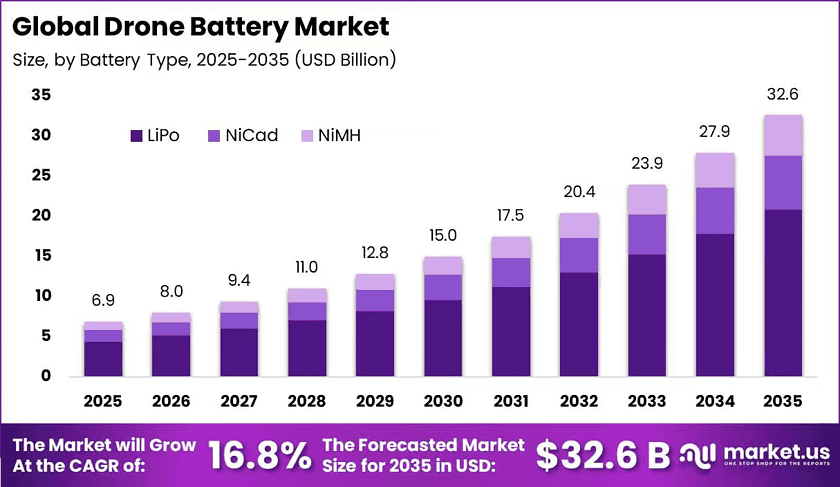
New York, NY – November 13, 2026 – The Global Drone Battery Market reached a value of USD 6.9 billion in 2025. Analysts project the market to reach about USD 32.6 billion by 2035. Moreover, the sector should grow at a CAGR of 16.8% during 2026–2035. North America led the global drone power systems market in 2025. The region held more than 34.7% of the total share and earned about USD 2.4 billion in revenue.
According to the FAA, the U.S. small drone fleet should grow from around 1.9 million units in 2025 through 2029. Additionally, the FAA expects the commercial fleet to pass 1 million units by 2029, a 22 percent rise from 2024. Every drone needs a battery system. Therefore, fleet growth directly lifts battery demand.
Defense spending also creates strong growth for drone power packs. According to SIPRI, global military spending reached USD 2,887 billion in 2025, rising 2.9 percent in real terms. Moreover, Europe raised military spending by 14 percent to USD 864 billion. Armed forces now buy more drones, which increases demand for long-life, fast-charging batteries.
Commercial activity also boosts replacement demand. According to FAA data, commercial UAS registrations grew 12.5 percent a year to 453,635 units in late 2025. Meanwhile, certificated remote pilots increased 13.9 percent. More active pilots fly more missions, so operators replace battery packs more often and buy extra spares.
Key Takeaways
- The Drone Battery Market was worth USD 6.9 billion in 2025 and should reach USD 32.6 billion by 2035 at a 16.8% CAGR.
- LiPo Batteries lead by battery type with a 63.8% share.
- The 3,000–5,000 mAh capacity segment leads with a 42.7% share.
- Rotary-wing drones lead with a 53.3% share, and commercial drones lead in applications with 57.1%.
- North America led with a 34.7% share and USD 2.4 billion in 2025 revenue.
➤ Get Instant Access to the Premium Report Sample Before Purchase – https://market.us/report/drone-battery-market/request-sample/
Market Segmentation
By Battery Type
LiPo batteries lead the drone battery market by battery type with a 63.8% share. Drone makers choose them for their lightweight, flexible shape, and strong power output. As a result, LiPo packs suit small and medium drones, where weight directly affects payload, flight time, and motor efficiency.
According to NASA, LiPo batteries offer an energy density of 150–200 Wh/kg. This high density lets drones carry more power without extra weight. Moreover, NASA testing recorded 182.7 Wh/kg for 10C cells. Meanwhile, older NiCad and NiMH batteries play smaller roles because they are heavier and store less energy.
By Battery Capacity
The 3,000–5,000 mAh segment leads by capacity with a 42.7% share. Operators like its balance of flight time, weight, payload, and cost. According to the FAA formula, a 5,000 mAh battery at 22.8 V stores about 114 Wh. Additionally, packs below 3,000 mAh serve small drones, while larger packs power heavy-lift aircraft.
By Drone Type
Rotary-wing drones lead by drone type with a 53.3% share. These aircraft take off straight up, hover steadily, and collect close-range data. According to the U.S. Department of the Interior, its 581 small UAS completed 7,833 flights in fiscal 2024, up 27%. Furthermore, fixed-wing and hybrid-wing drones handle long-range mapping and surveillance missions.
By Application
Commercial drones lead applications with a 57.1% share because businesses fly them often for field work. According to the U.S. Forest Service, its drone flights rose 69% to 17,255 in fiscal 2024. Similarly, flight hours climbed 78% to 4,536. Moreover, consumer and military drones add steady demand for spare and high-performance battery packs.
Regional Analysis
North America holds the largest regional share at 34.7%, worth about USD 2.4 billion in 2025. According to the FAA, the United States had 481,760 registered drones as of September 2026. Additionally, Transport Canada reported 116,304 registered drones in December 2025. These large fleets keep battery demand in the region strong and steady.
Asia Pacific should grow fastest among all regions during the forecast period. Farms, factories, logistics firms, and city services across the region use more drones each year. Moreover, Asia Pacific has a strong electronics and battery supply chain. Therefore, local makers can quickly scale up compact, high-discharge and fast-charging battery systems.
Drivers
Commercial fleet growth drives drone battery demand because operators often use several packs per aircraft. According to the FAA, more than 126,000 new commercial aircraft joined the U.S. registry during 2025. As a result, makers see steady orders for original batteries, spare packs, and chargers. This driver could add about +3.2% to the baseline CAGR.
Wider use of drones for industrial inspection is the second key driver. Energy, utility, and construction firms now use drones to check power lines, pipelines, and bridges. However, frequent inspection flights drain packs quickly and shorten their working life. Therefore, this trend could add about +2.4% to market growth over the medium term.
Use Cases
Emergency teams use drones for search and rescue, disaster response, and firefighting support. Quadcopters lead these fleets because they hover steadily over a target area. Moreover, crews often fly several missions in one day. As a result, public safety agencies keep many charged spare batteries ready to avoid downtime during urgent operations.
Delivery companies are another major user of drone power systems. Amazon Prime Air plans frequent flights of its electric MK30 drones from local delivery centers. Additionally, these fleets need fast charging and quick battery swaps between trips. Therefore, delivery networks create steady demand for durable, long-lasting battery packs and smart charging stations.
Business Opportunities
Battery-as-a-service networks offer a strong new source of revenue. Most drone operators still buy and manage batteries on their own today. However, suppliers can offer subscriptions, managed charging, battery health tracking, and quick field swaps. As a result, operators lower upfront costs, while suppliers earn recurring income and gain useful battery health data.
Local pack assembly creates another clear opportunity in North America and Europe. Buyers want shorter supply chains and fewer tariff risks. Moreover, local assembly helps makers meet defense and government sourcing rules. Therefore, firms that build packs near their customers can win public contracts and offer faster service and support.
Major Challenges
The concentration of critical minerals in a few countries is a serious challenge for battery producers. These countries supply most of the lithium, graphite, cobalt, and processed electrode materials. As a result, makers face risks from export limits, trade disputes, and price swings. Therefore, many firms now hold extra safety stock and approve new suppliers, which ties up working capital.
Battery heat and fire safety is a second major hurdle in markets worldwide. Lithium packs can overheat or catch fire when damaged, overcharged, or stored poorly. Moreover, strict hazardous-goods rules limit how firms ship these batteries. As a result, suppliers must invest in better cells, smarter battery management software, and costly safety testing.
Top Key Players in the Market
- Amperex Technology Limited
- Autel Robotics
- DJI
- LG Chem
- MaxAmps
- Panasonic
- Parrot
- Samsung SDI
- Tadiran Batteries
- Tattu (Shenzhen Grepow Battery Co., Ltd)
- Yuneec International Co. Ltd.
Conclusion
The drone battery market shows strong long-term growth as commercial, public safety, and defense fleets expand. LiPo batteries, mid-range capacity packs, rotary-wing aircraft and commercial uses lead current demand. Moreover, North America holds the top position, while Asia Pacific grows fastest. However, mineral concentration, tariffs, and safety rules remain key risks. Therefore, suppliers that focus on safety, fast charging, and local assembly will gain a lasting edge.
Discuss your needs with our analyst
Please share your requirements with more details so our analyst can check if they can solve your problem(s)