
Market Overview
New York, NY – November 17, 2026 – The Global Autonomous Delivery Robots Market reached USD 1.5 billion in 2025. Analysts project a CAGR of 23.4% from 2026 to 2035, which would lift its value to about USD 12.1 billion by 2035. North America led in 2025 with a 39.8% share and about USD 0.6 billion in revenue.
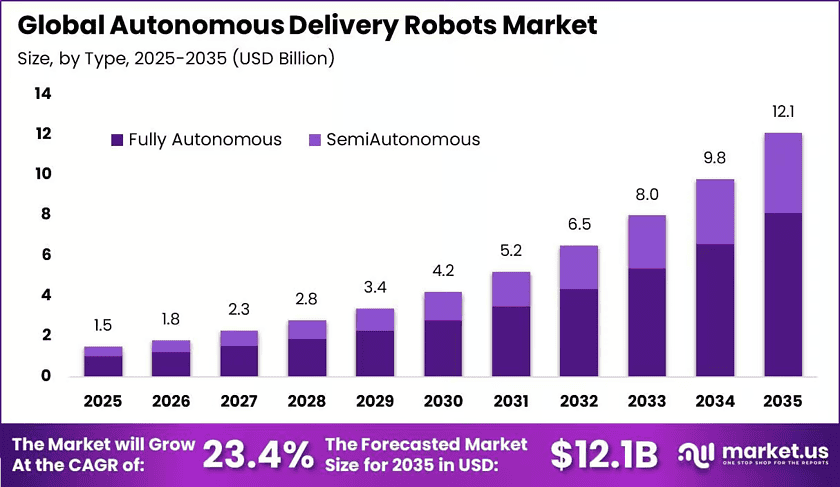
Moreover, the market should add nearly USD 10.6 billion over the forecast period. Growing grocery, food, pharmacy, and on-demand orders drive this gain. According to the U.S. Census Bureau, U.S. retail e-commerce sales reached about USD 1.23 trillion in 2025. This online volume creates steady demand for fast, low-cost local delivery.
Additionally, according to the U.S. Census Bureau, e-commerce rose from 16.2% of U.S. retail sales in Q1 2025 to 16.6% in Q4. Online sales grew 5.3% in Q3, while total retail grew 4.1%. Therefore, shoppers keep moving their spending online, and retailers need faster ways to deliver small orders.
However, labor needs remain high. According to U.S. labor projections, delivery driver jobs should grow 7% from 2025 to 2035, with about 152,700 openings each year. This steady hiring need pushes logistics firms to test robot fleets that handle short, repeat trips without a driver.
Key Takeaways
- The Autonomous Delivery Robots Market was valued at USD 1.5 billion in 2025 and is projected to reach USD 12.1 billion by 2035 at a 23.4% CAGR.
- The fully autonomous segment held a dominant 67.1% share by type.
- The up to 10 kg carrying capacity segment led with a 44.2% share.
- The four-wheel segment held the largest share at 45.6%.
- The food and beverages vertical dominated with a 42.1% share.
- North America led the market in 2025 with a 39.8% share and about USD 0.6 billion in revenue.
➤ Preview Key Insights with an Exclusive Sample Report Download – https://market.us/report/global-autonomous-delivery-robots-market/request-sample/
Autonomous Delivery Robots Market Segmentation
By Type
Fully autonomous robots held a dominant 67.1% share by type. These machines complete trips inside approved service zones without a remote operator. Moreover, retailers, restaurants, and pharmacies cut labor per delivery and run routes for longer hours. Meanwhile, semi-autonomous models still serve complex sites that need human support.
Additionally, autonomous driving systems logged more than 127 million rider-only miles in U.S. robotaxi operations through September 2025. This record builds public trust in self-driving technology. Therefore, delivery robots now rely on cameras, radar, maps, and obstacle detection to handle short trips safely.
By Carrying Capacity
The up to 10 kg segment led with a 44.2% share. Light payloads suit meals, medicines, and small grocery orders. Moreover, according to the U.S. Postal Service, its Ground Advantage service moved 2.3 billion pieces averaging about 1.18 pounds each. This shows how many light parcels compact robots can serve.
Additionally, according to the USDA, U.S. household spending on food at home reached USD 961.3 billion in 2024. This spending creates a large base of small grocery trips. However, the 10.01 to 50 kg and above 50 kg classes serve bulkier retail and industrial loads that need stronger chassis.
By Number of Wheels
Four-wheel robots held the largest share at 45.6%. These designs balance stability, payload, battery space, and turning ability. Moreover, according to NHTSA, the U.S. recorded 7,080 pedestrian deaths in 2024. This safety concern drives demand for stable platforms with reliable braking. Meanwhile, three-wheel and six-wheel models target niche routes.
By Vertical
Food and Beverages dominated with a 42.1% share. Meal orders come often, need fast handling, and travel short distances. Moreover, according to the USDA, U.S. food delivery spending grew from USD 9.8 billion in 1997 to USD 100.5 billion in 2024. This rise gives robot operators a large, steady order base.
Additionally, enclosed cargo boxes protect food quality during trips. Meanwhile, healthcare, retail, logistics, and hospitality buyers also adopt robots for medicines, parcels, and room service. Consequently, operators earn revenue beyond restaurants and keep their fleets busy for more hours of the day.
Regional Analysis
North America led with a 39.8% share in 2025, generating about USD 0.6 billion. Strong e-commerce, high foodservice spending, and early robotics use drive this lead. Moreover, according to Statistics Canada, Canadian retail sales reached CAD 837.2 billion in 2025, up 4.0%. This healthy retail base supports more robot delivery pilots.
Asia Pacific should grow fastest, thanks to dense cities and large online volumes. According to China’s official statistics, online retail sales reached CNY 15.97 trillion in 2025, up 8.6%. Additionally, China installed 295,000 industrial robots in 2024. Therefore, local makers can easily source batteries, sensors, and navigation parts.
Market Drivers
High-frequency local commerce adds an estimated 3.2% to the baseline CAGR. Meal, grocery, and pharmacy orders create short, repeat routes. Moreover, JD Logistics reported that its unmanned vehicles extended active delivery time by 3 to 4 hours. Consequently, busy routes spread software and charging costs across more trips.
Additionally, the logistics labor gap adds an estimated 2.4% to growth across North America, Western Europe, and Japan. Delivery firms struggle to hire enough drivers as order volumes rise. Therefore, operators assign robots to simple short trips and move human staff to longer or more complex deliveries.
Use Cases
Restaurants use delivery robots to carry meals to nearby homes, offices, and campuses. Food platforms send orders straight to robot fleets through their apps. Moreover, sealed cargo boxes keep meals warm and secure. Consequently, restaurants serve more customers during rush hours without hiring extra drivers for every short trip.
Hospitals use indoor robots to move medicines, lab samples, and supplies between departments. For example, Diligent Robotics deploys Moxi robots for hospital pharmacy deliveries. Additionally, nurses spend less time walking the hallways. Therefore, care teams can focus more on patients while robots handle routine transport tasks.
Business Opportunities
Robot-as-a-service contracts offer a strong opportunity for vendors. Many small retailers and restaurants cannot afford to buy robot fleets upfront. However, usage-based pricing turns large purchases into simple monthly costs. Consequently, vendors gain recurring revenue, while customers adopt automation with lower financial risk and bundled maintenance support.
Pharmacy cold-chain delivery creates another growth path in North America, Japan, and Europe. Pharmacies need to move temperature-sensitive medicines quickly and safely. Moreover, robots with temperature-controlled boxes can protect drug quality. Therefore, vendors that add temperature tracking and secure access features can win more healthcare contracts.
Major Challenges
Component sourcing concentration poses a serious challenge. Robot makers depend on a few supply regions for battery cells, rare-earth magnets, processors, lidar, and cameras. However, export controls and shipping delays can disrupt these supplies. Consequently, manufacturers hold larger inventories and look for other suppliers, which raises production costs.
Bad weather also makes navigation less reliable in North America, Europe, and Japan. Snow, heavy rain, and ice can confuse sensors and block sidewalks. Moreover, robots may pause or fail trips in harsh conditions. Therefore, developers invest in better sensors, stronger wheels, and remote support to keep service steady.
Top Key Players in the Market
- Marble Robot Inc.
- Aethon Inc.
- Aitonomi AG
- Boston Dynamics Inc.
- JD.com, Inc.
- Kiwi Campus SAS
- Nuro Inc.
- Piaggio and C. Spa
- Postmates Inc.
- Caterpillar Inc.
Conclusion
The autonomous delivery robots market is set for rapid growth as online shopping and food delivery expand. Fully autonomous, lightweight, four-wheel robots lead adoption, and food and beverages remain the top vertical. Moreover, North America leads today, while Asia Pacific grows fastest. However, supply risks, bad weather, and permit rules remain hurdles. Therefore, vendors with flexible service models and reliable fleets stand to gain the most.
Discuss your needs with our analyst
Please share your requirements with more details so our analyst can check if they can solve your problem(s)