
Market Overview
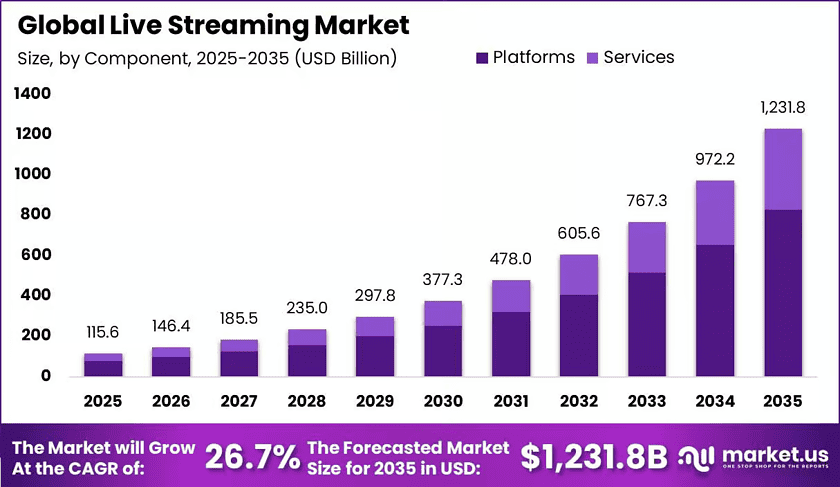
New York, NY – November 13, 2026 – The Global Live Streaming Market reached a value of USD 115.6 billion in 2025. Industry analysts expect the market to grow at a CAGR of 26.7% from 2026 to 2035. Consequently, real-time video platforms could reach about USD 1,231.8 billion by 2035, which signals strong long-term demand. North America led the global market in 2025 with a share of more than 39.7%. The region generated nearly USD 45.9 billion in revenue.
Additionally, wider internet access keeps adding new viewers. According to the International Telecommunication Union, about 6 billion people were online in 2025, up from 5.8 billion in 2024. Therefore, live video, gaming, and online shopping platforms now reach a much larger audience than before, which creates new revenue opportunities.
Furthermore, mobile networks are speeding up adoption of online broadcasting. According to GSMA Intelligence, mobile data traffic may grow more than fourfold by 2030 and pass 5,400 exabytes. As a result, users can watch and host longer streams at better quality, which helps platforms keep audiences engaged for longer.
However, about 2.2 billion people still remain offline worldwide. This gap is a large future audience for digital streaming services. Consequently, as networks expand and mobile data use rises, more people will start watching live content, which should support steady market growth through 2035.
Key Takeaways
- The Live Streaming Market was valued at USD 115.6 billion in 2025 and may reach USD 1,231.8 billion by 2035 at a 26.7% CAGR.
- The Platforms segment led the Component category with a 67.4% share.
- Video Streaming led the Type category with a 58.3% share.
- Ad-Supported was the leading Revenue Model with a 42.6% share.
- Gaming was the top End-use segment with a 38.7% share.
- North America led the market in 2025 with a 39.7% share and about USD 45.9 billion in revenue.
➤ Evaluate the Report Quality with an Exclusive Sample Download – https://market.us/report/live-streaming-market/request-sample/
Live Streaming Market Segmentation
By Component
Platforms held a leading 67.4% share of the Live Streaming Market. Broadcasters depend on software, cloud computing, video encoding, and payment tools to reach large audiences in real time. According to UNCTAD, data centres used about 460 terawatt-hours of electricity in 2022. This figure shows the heavy computing power that streaming platforms need.
Moreover, the International Energy Agency expects data centre power use to nearly double to 1,000 TWh by 2026. Video-heavy services drive much of this growth. Consequently, platform providers keep investing in cloud capacity, which helps them serve millions of viewers at the same time with steady performance.
By Type
Video Streaming led the Type segment with a 58.3% share. Viewers prefer high-definition, real-time video over audio or text formats. According to the ITU, global fixed-broadband traffic reached 6 zettabytes in 2024, up from 5.1 zettabytes a year earlier. Therefore, telecom firms keep expanding capacity to meet growing video demand.
By Revenue Model
Ad-Supported models held a 42.6% share of the market. Free live content attracts big audiences, and advertisers pay to reach them. Additionally, social media ad revenue reached USD 117.7 billion in 2025. This figure shows strong advertiser interest in video platforms, which helps free streaming services stay profitable.
By End-use
Gaming led the End-use segment with a 38.7% share. According to the Entertainment Software Association, about 205.1 million Americans played video games regularly in 2024. Consequently, esports, multiplayer matches, and game launches draw large live audiences because fans enjoy watching competitive play as it happens.
Furthermore, U.S. consumers spent USD 59.4 billion on video games, including USD 51.3 billion on game content. This spending shows a committed and growing fan base. Therefore, gaming streamers and esports organizers gain a strong commercial base for sponsorships, tips, and ad revenue.
Regional Analysis of Live Streaming
North America led the market in 2025 with a 39.7% share, worth about USD 45.9 billion. According to the Federal Communications Commission, the United States had 549 million internet connections as of June 2024. Moreover, residential fixed connections reached a median download speed of 500 Mbps, which supports smooth high-definition streaming.
However, Asia Pacific is likely to be the fastest-growing region. According to the ITU, the region recorded 97 mobile-broadband subscriptions per 100 inhabitants in 2024. Additionally, it had 4.9 billion mobile subscriptions in 2023. As a result, mobile gaming, live shopping, and creator content are growing fast across the region.
Key Growth Drivers
Live commerce is changing how platforms earn money. China’s Order No. 117, effective February 2026, set clearer rules for livestream selling. Consequently, merchants are moving budgets toward real-time selling. This shift could raise earnings per streaming hour by an estimated 15% to 20%, since buyers discover and pay within one session.
Moreover, wider 5G networks support low-delay broadcasts. According to the ITU, about 36% of mobile broadband subscriptions were 5G in 2025, around 3 billion connections. Therefore, mobile users can watch and host smoother live games and interactive shows, which boosts viewer time and platform revenue worldwide.
Live Streaming Use Cases
Gaming creators use live streams to share gameplay, host tournaments, and chat with fans in real time. Moreover, game publishers launch new titles through live events to build early excitement. Consequently, gaming communities grow stronger, and creators earn income through tips, subscriptions, and brand sponsorships across popular streaming platforms.
Additionally, retailers use live shopping streams to show products and answer buyer questions instantly. Shoppers watch demos and buy items without leaving the stream. Therefore, brands shorten the path from discovery to purchase. This format also builds trust, because buyers see real products and real hosts before they decide.
Business Opportunities in Streaming
Enterprise live events remain a largely untapped space. Companies run investor calls, hybrid conferences, staff training, and product launches online. However, most firms still use basic video-call tools. Consequently, streaming providers can offer dedicated business packages with strong analytics, security, and event tools that command higher prices than consumer services.
Moreover, rural areas in Asia Pacific, Latin America, and Africa offer new audiences as 5G coverage spreads. Many people in these regions will go online for the first time. Therefore, platforms that offer local languages, light apps, and low-cost plans can win loyal viewers early and build long-term growth.
Major Market Challenges
Telecom operators are cutting network spending in several markets. This slowdown may delay last-mile bandwidth upgrades and edge network growth. Consequently, streaming platforms could face weaker network quality in some areas. Viewers may then see buffering or lower video quality, which can reduce watch time and hurt advertising income.
Additionally, AI companies now compete with streaming firms for data centre capacity. AI training uses large numbers of GPUs and high-power servers. Therefore, cloud costs keep rising, and capacity takes longer to secure. Streaming companies may need long-term contracts or their own edge networks, which puts steady pressure on profit margins.
Top Key Players in the Market
- Dacast, Inc.
- Empire Video Productions LLC
- Flux Broadcast Ltd.
- Huya Inc.
- International Business Machines Corporation
- Meta
- Pluto Inc.
- TikTok Inc.
- Twitch Interactive, Inc.
- Vimeo, Inc.
Conclusion
The Live Streaming Market shows strong long-term growth, driven by wider internet access, faster mobile networks, and rising demand for real-time video. Moreover, platforms, video formats, ad-supported models, and gaming lead their segments. North America leads today, while Asia Pacific grows fastest. However, firms must manage rising compute costs and slower telecom spending. Consequently, companies that invest in live commerce, enterprise events, and new audiences will gain a lasting advantage.
Discuss your needs with our analyst
Please share your requirements with more details so our analyst can check if they can solve your problem(s)