
Market Overview
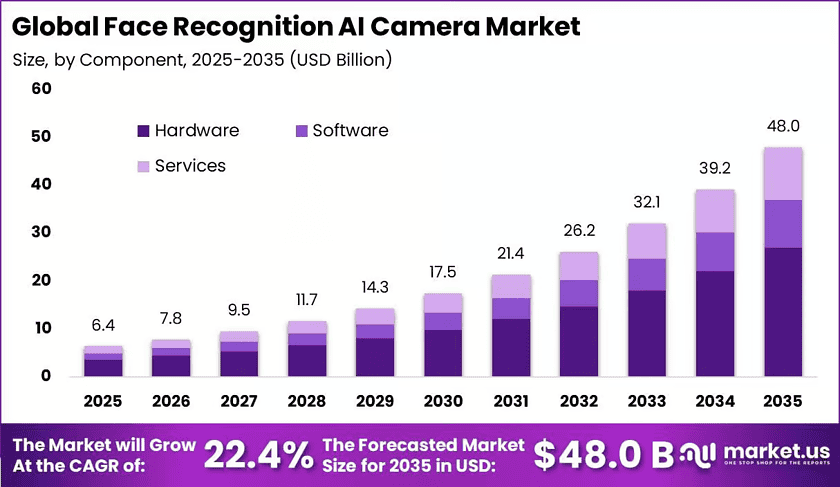
New York, NY – November 17, 2026 – The Global Face Recognition AI Camera Market reached USD 6.4 billion in 2025. Analysts expect the market to hit about USD 48.0 billion by 2035, growing at a CAGR of 22.4%. That works out to almost 7.5 times growth. Consequently, buyers will spend heavily on smart identity tools over the next ten years.
Airports, metro systems, offices, and retail stores now use automated security in their daily work. Moreover, hospitals, factories and public sites rely on real-time video monitoring. Facial recognition cameras spot approved users and flag entry into restricted areas. Therefore, these smart vision systems cut manual video review and help security teams respond faster.
Hong Kong International Airport handled 61 million passenger trips in 2025, up 15% year on year. Additionally, Singapore Changi Airport recorded 69.98 million passenger movements and 374,000 flights. These figures show that busy hubs need automated surveillance. As a result, airport operators keep investing in biometric camera networks to manage crowds safely.
East Asia and the Pacific had about 1.5 billion urban residents, or 63.7% of the region’s population. Similarly, Delhi Metro recorded 2.3 billion passenger journeys in 2025, about 6.46 million each day. Crowded cities create steady demand for identity checks. Consequently, transit agencies are adopting AI-powered security cameras to watch busy stations.
Asia-Oceania produced 59.2 million vehicles in 2025, more than 61% of global output. China alone built about 34.53 million vehicles. Moreover, this large industrial base raises the need for cameras at factories, logistics yards, and parking sites. Therefore, vehicle-access tools and plant security add another strong source of demand.
Key Takeaways
- The Face Recognition AI Camera Market was valued at USD 6.4 billion in 2025 and should reach USD 48.0 billion by 2035, growing at a CAGR of 22.4%.
- Hardware led with a 56.3% share, driven by strong demand for AI cameras, sensors, processors, storage, and access-control devices.
- Security and access control led with a 34.2% share, supported by wider use of automated identity checks and restricted-entry systems.
- Government and public sector accounted for 45.4%, driven by large biometric surveillance, border security and public-safety projects.
- North America led the market in 2025 with more than 44.5% share and about USD 2.8 billion in revenue.
➤ See the Full TOC, Market Tables & Figures in Your Sample Copy – https://market.us/report/face-recognition-ai-camera-market/request-sample/
Market Segmentation by Component, Application and End-User
By Component
Hardware held a 56.3% share of the market in 2025. Every installation needs physical parts such as AI cameras, image sensors, processors, lenses, video recorders and access terminals. Consequently, buyers spend more on hardware than on software or services. Moreover, upgrade cycles keep hardware demand steady across offices, factories and public sites.
India’s electronics production rose from INR 5.54 lakh crore in FY 2020–21 to INR 9.52 lakh crore in FY 2023–24, a CAGR of 19.78%. In addition, mobile-phone manufacturing reached INR 4.2 lakh crore. This growth gives camera makers better access to sensors and circuit boards. Therefore, suppliers can roll out AI cameras faster.
By Application
Security and access control held the largest share at 34.2%. These systems confirm a person’s identity before letting them into restricted areas. Moreover, face-based entry is replacing access cards, PINs, and manual checks in offices, data centers, and airports. Consequently, companies cut identity misuse and move visitors through entry points faster.
According to U.S. Customs and Border Protection, facial comparison processed more than 193 million travelers and caught over 1,500 people using false identities. Additionally, the FBI estimated about 5.99 million property crimes in 2024. These numbers show real security risks. Therefore, organizations are installing face-recognition cameras to protect people, assets, and sensitive data.
By End-User
The Government and Public Sector accounted for 45.4% of the market. Public agencies use these systems at borders, police sites, courts, ports and transport terminals. Moreover, the tools help authorities verify identity, catch document fraud, and control access. Consequently, governments can make security checks faster while using fewer staff.
The European Union’s Entry/Exit System runs across 29 European countries and records facial images of non-EU travelers. By March 2026, it had registered more than 45 million border crossings and over 24,000 refusals of entry. Therefore, the system shows that biometric checks can work at a large scale and stop real threats.
Regional Analysis of Face Recognition Camera Demand
North America led the market in 2025 with 44.5% of global revenue, about USD 2.8 billion. Large public-security programs and dense cities drive this lead. Moreover, according to TSA, the agency screened about 906.7 million passengers in 2025. Such huge passenger volumes push airports to adopt automated identity tools.
Asia Pacific is expected to grow the fastest during the forecast period. Airports, data centers, hospitals and logistics sites are adopting biometric security quickly. Additionally, India’s electronics production reached about INR 11.3 lakh crore in FY 2024–25, nearly six times higher than ten years earlier. Consequently, the region now has a stronger local supply base for components.
Key Growth Drivers
Biometric border upgrades are a major driver, adding an estimated +2.8% to the baseline CAGR. Border agencies are replacing passport stamps with digital face records. Moreover, these projects cover cameras, edge processors, networks, and maintenance. Consequently, vendors earn steady income from integration, software and services over many years.
Enterprise access automation adds about +2.2% to market growth around the world. Companies are replacing keycards with face-based entry at offices, factories and campuses. Additionally, automated access cuts guard costs and stops shared-credential misuse. Therefore, businesses see quick returns, and this driver is expected to have its strongest effect within two years.
Major Use Cases
Airports and border checkpoints use face-recognition cameras to confirm traveler identity at entry, exit, and boarding gates. Passengers move through without showing documents again and again. Moreover, officers can focus on high-risk cases instead of routine checks. Consequently, airports manage peak traffic better while keeping security standards high and lines shorter.
Corporate offices and factories use these cameras for access control and attendance tracking. Employees enter secure zones without cards, and managers get accurate time records automatically. Additionally, the systems alert security teams when unknown people enter restricted areas. Therefore, organizations improve workplace safety and cut down on payroll disputes and badge sharing.
Business Opportunities
Privacy-friendly video analytics offers a strong untapped opportunity. Suppliers can match faces on the device, encrypt biometric templates, and blur faces at the camera level. Moreover, these features help buyers meet strict data rules in Europe and North America. Consequently, vendors can win regulated contracts while cutting cloud storage and bandwidth costs.
Identity-as-a-service platforms create another promising revenue path for providers. Enterprises prefer subscription models that bundle cameras, software, updates, and support. Additionally, retrofit analytics let customers add face recognition to cameras they already own. Therefore, suppliers can reach budget-limited buyers and build steady recurring income without requiring full system replacement.
Major Market Challenges
Algorithm accuracy remains a key challenge for vendors. Lighting, camera angles, face masks and image quality can all reduce matching performance. Moreover, buyers expect fair results across all user groups. Consequently, suppliers must spend more on threshold tuning, audit logs, and human review, which raises costs and slows adoption in hard settings.
Regulation and supply chain pressure create further obstacles. The EU AI Act limits real-time biometric identification in public spaces, which shrinks some surveillance projects. Additionally, chip tariffs and shipping delays raise component costs and slow deliveries. Therefore, vendors need to shift toward consent-based enterprise projects and spread their sourcing across more suppliers.
Top Key Players in the Market
- AllGoVision Technologies Pvt. Ltd.
- Axis Communications AB
- Cisco Systems, Inc.
- Honeywell International, Inc.
- IBM Corporation
- IntelliVision
- Verint Systems, Inc.
- Huawei Technologies Co., Ltd.
- Gorilla Technology Group, Inc.
- i2v Systems Pvt. Ltd.
- ADT, Inc.
- Agent Video Intelligence Ltd.
- Intuvision, Inc.
- Avigilon Corporation
- Stanley Convergent Security Solutions, Inc.
- Eagle Eye Networks
- Milestone Systems A/S
Conclusion
The face recognition AI camera industry is set for fast, long-term growth. Border upgrades, enterprise access automation and smart-city projects drive this expansion. Moreover, hardware, security applications and government buyers lead current demand, while North America leads by region and Asia Pacific grows fastest. However, privacy rules, accuracy concerns and supply risks remain real. Consequently, vendors that offer privacy-friendly, accurate and flexible solutions will gain the strongest competitive position.
Discuss your needs with our analyst
Please share your requirements with more details so our analyst can check if they can solve your problem(s)