
Market Overview
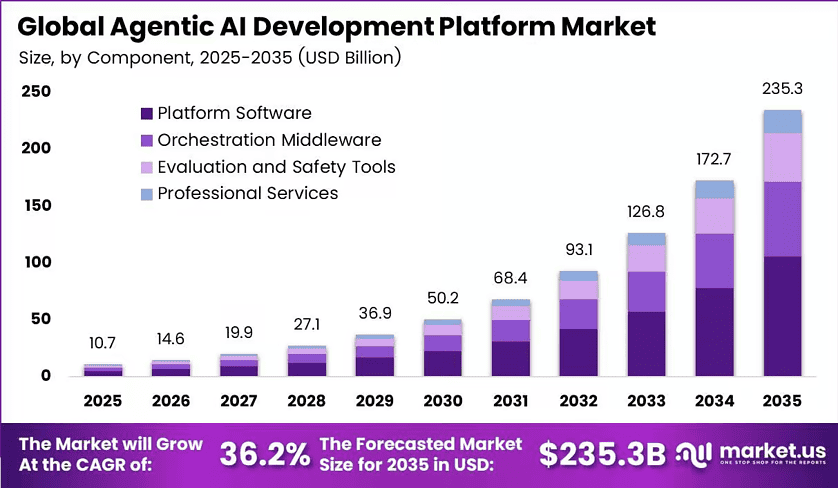
New York, NY – November 23, 2026 – The Global Agentic AI Development Platform Market reached USD 10.7 billion in 2025. Analysts expect it to hit USD 235.3 billion by 2035, growing at a 36.2% CAGR. This growth shows that companies now treat AI agents as core business tools rather than side experiments.
Business adoption of AI is driving this growth. According to the OECD, 20.2% of firms in member countries used AI in 2025, up from 8.7% in 2023. Adoption therefore more than doubled in two years. Consequently, vendors that build agent tools now sell to a much larger group of buyers.
Moreover, large companies lead this shift. According to the OECD, 40% of firms with 250 or more workers used AI in 2024. Only 11.9% of firms with 10 to 49 workers did the same. Smaller firms therefore make up the next big wave of platform buyers.
Additionally, enterprises now want AI agents that complete whole workflows, not just chat tools. This change creates strong demand for platforms that build, connect, test and govern autonomous agents. Software vendors are responding with tools for orchestration, security and performance tracking that business teams can reuse across many functions.
However, computing power shapes who leads this market. According to the IEA, the United States used about 45% of global data centre electricity in 2024. The IEA expects global data centre demand to reach about 945 TWh by 2030. This large compute base lets vendors train models and run agents at scale.
Key Takeaways
- The Global Agentic AI Development Platform Market was valued at USD 10.7 billion in 2025 and should reach USD 235.3 billion by 2035, at a 36.2% CAGR from 2026 to 2035.
- By component, Platform Software led with a 76.6% share in 2025.
- By deployment mode, Cloud led with a 58.9% share in 2025.
- By end-user industry, BFSI led with a 72.5% share in 2025.
- North America led the market with a 38.8% share and USD 4.2 billion in revenue in 2025.
➤ Evaluate the Report Quality with an Exclusive Sample Download – https://market.us/report/agentic-ai-development-platform-market/request-sample/
Agentic AI Platform Market Segmentation
By Component
Platform Software leads the component segment with a 76.6% share. Enterprises need one core environment to build, test, deploy, and improve AI agents. Moreover, a shared platform links models, company data, security controls, and workflow tools. Companies therefore avoid paying for many separate point products.
Professional Services grows fastest because firms need expert help to move from pilots to real business use. According to C3 AI, professional services made up 16% of revenue in fiscal 2025 and 9% in fiscal 2026. This swing shows that implementation demand changes sharply during active rollout phases.
By Deployment Mode
Cloud deployment leads with a 58.9% share. Cloud gives teams fast access to computing power and model services without large hardware costs. According to Manhattan Associates, its cloud revenue rose 21% to USD 408.1 million in 2025. This rise shows that buyers clearly prefer subscription access to advanced business software.
However, hybrid deployment grows fastest. Many organizations want cloud flexibility but must keep sensitive data inside their own systems. According to IBM, 86% of executives use hybrid cloud setups to deploy AI. Regulated firms therefore run models and controls across public cloud, private cloud, and on-site systems.
By End User Industry
BFSI dominates end-user demand with a 72.5% share. Banks, insurers and payment firms handle large volumes of repeatable and time-sensitive work. Moreover, fraud checks, onboarding, claims handling, and compliance reviews give clear use cases. Financial institutions therefore automate these tasks while keeping humans in the review loop.
Retail and E-Commerce grows fastest as retailers work to improve customer service and control costs. According to Salesforce, 75% of retailers believe AI agents will be essential to compete within one year. Additionally, 76% plan to raise AI spending, which signals strong buying intent across the sector.
Regional Analysis
North America leads the agentic AI platform market with a 38.8% share and USD 4.2 billion in revenue. The region hosts most major model builders and platform vendors. Consequently, local buyers get early access to new agent tools, deep partner networks, and strong support teams from US technology providers.
Asia Pacific is the fastest-growing region. According to the IEA, Chinese data centre power use should rise by about 175 TWh by 2030, a 170% increase. This growth reflects rapid compute expansion. Moreover, Japan and South Korea push agents into manufacturing, while India adds large engineering talent pools.
Key Market Drivers
Enterprise demand for workflow automation adds an estimated 4.2% to the baseline growth rate. Companies now combine scattered automation pilots into governed platform contracts. Consequently, buyers cut duplicate integration work and move budgets toward reusable agent templates. This shift turns agent platforms into recurring core business software.
Additionally, agent-enabled software development adds an estimated 3.1% to market growth. Software teams use AI agents to write, test, and review code faster. This trend matters most in software-heavy economies worldwide. Therefore, development teams adopt agent platforms quickly, often within two years of first testing them.
Agentic AI Use Cases
Banks and insurers use AI agents to handle customer onboarding, identity checks, and fraud reviews. These agents gather documents, flag risky cases, and send complex issues to human staff. Consequently, financial firms serve customers faster while keeping strong control over regulated decisions and audit records.
Moreover, retailers deploy agents to support product search, order tracking, and returns. Shoppers get quick answers at any hour without waiting for staff. Additionally, merchandising teams use agents to adjust pricing and inventory plans. Retail brands therefore improve customer experience while keeping their operating costs under control.
Business Opportunities in Agentic AI
Vertical agent operating systems offer a major untapped opportunity. Most current tools focus on general workflows rather than specific industries. However, healthcare, logistics, manufacturing, and public administration need custom data connectors and controls. Platforms that package these modules can turn one-off service work into steady recurring revenue.
Additionally, outcome-based pricing creates fresh growth potential. Buyers want to pay for finished tasks and measurable results rather than raw usage. Vendors that link fees to resolved tickets or processed claims can build stronger trust. Consequently, this model helps cautious enterprises justify larger agent investments with clearer returns.
Major Challenges in the Market
Unclear liability for autonomous actions slows enterprise sales. Agents can change records, send messages, or start transactions without clear rules on who carries responsibility. Consequently, companies delay approvals and demand stronger contract protections. Vendors must also add audit logs, human override controls, and insurance coverage.
Moreover, reliable agent evaluation remains a key operational hurdle. Companies must test agents on multi-step planning, tool choice, permissions, and recovery from failed actions. These tests take time and require larger quality teams. Therefore, many enterprises limit agent autonomy until they see consistent and proven performance.
Top Key Players in the Market
- Neurons Lab
- BotsCrew
- Winder.AI
- OpenAI, L.L.C.
- Anthropic PBC
- Cognizant
- ServiceNow, Inc.
- International Business Machines Corporation
- Oracle Corporation
- SAP SE
- UiPath, Inc.
- Accenture
Conclusion
The Agentic AI Development Platform Market is growing quickly as enterprises move from simple chat tools to agents that complete whole workflows. Platform software, cloud deployment, and BFSI lead demand today, and North America leads among regions. However, liability concerns and testing gaps still slow adoption. Vendors that offer industry-specific modules, strong governance, and outcome-based pricing will capture the next wave of buyers.
Discuss your needs with our analyst
Please share your requirements with more details so our analyst can check if they can solve your problem(s)