Market Overview
The Global Heated Clothing Market is projected to reach USD 850 Billion by 2035, up from USD 171.739 Billion in 2025. Analysts expect a CAGR of 10.10% from 2026 to 2035. Cold-weather recreation, outdoor work, and better battery technology drive this expansion.
Heated clothing includes battery-powered and electrically heated garments that regulate body temperature in cold or extreme environments. Jackets, sweaters, pants, t-shirts, and other apparel carry built-in heating systems. Recreational, occupational, military, and therapeutic users wear these products across cold regions.
Outdoor recreation and cold-exposed work drive most demand. The Outdoor Industry Association reports 175.8 million US participants in 2023. The Bureau of Labor Statistics shows 33.0% of US workers faced outdoor conditions regularly. Consequently, employers in construction, utilities, and field service equip crews with protective heated apparel.
Technology makes heated garments more practical. Better batteries, USB power formats, and lighter heating systems extend runtime and reduce bulk. Adidas unveiled its CLIMAWARM SYSTEM in February 2026, using Clim8 smart heating to keep athletes’ muscles warm before races. Consequently, sport brands now compete with specialist heated clothing makers.
Data-Driven Insights for Smarter Business Decisions: Explore the Full Report
Key Takeaways
- Market value was USD 171.739 Billion in 2025 and will reach USD 850 Billion by 2035.
- The market grows at a CAGR of 10.10% from 2026 to 2035.
- Jacket dominates product type with a 37.80% share in 2025.
- The 7–20 Volts segment leads power rating with a 44.90% share.
- Men dominate end-use with a 62.30% share.
- North America leads with a 52.60% share.
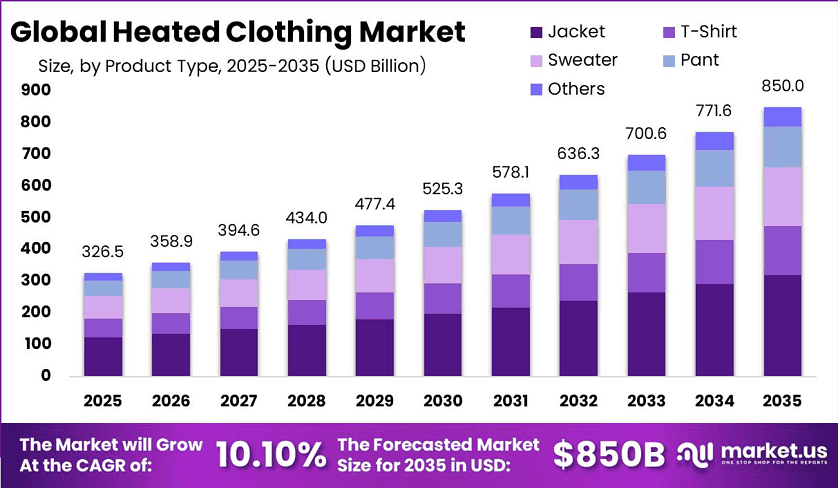
Market Segmentation Overview
Jackets dominate the product type segment with a 37.80% share in 2025. They cover the torso and core, the most critical thermal zone for sustained outdoor performance. Consequently, jackets act as the default entry point for new buyers, supporting premium pricing and repeat upgrade cycles.
Moreover, sweaters hold 22.00% as a mid-layer for buyers who already own outerwear. T-shirts hold 18.00% and target base-layer buyers in workwear and athletic contexts. Therefore, these lighter formats give first-time buyers accessible entry products and create cross-sell chances for jacket-first brands.
The 7–20 Volts segment dominates power rating with a 44.90% share because higher voltage delivers longer heating duration. This addresses the most common complaint about heated clothing. Consequently, cold-environment workers and winter sports buyers choose it, and manufacturers earn a pricing premium and stronger margins.
Additionally, the 5–7 Volts segment suits recreational day users and commuters who want moderate heat with lighter garments. As USB-C power formats spread, compatible garments will reach wider audiences. The 3–5 Volts segment drives volume among price-sensitive and gift buyers, which supports penetration in emerging regions.
Men dominate the end-use segment with a 62.30% share because they form most outdoor recreation participants and cold-environment workers. Motorcyclists form a core buyer group for heated riding jackets and gloves. Meanwhile, women hold 37.70%, so women-specific fit, power pack placement, and style open growth.
Drivers
Outdoor recreation spending leads all drivers, with a +2.1% CAGR impact. The US outdoor economy generated USD 696.7 billion in value added in 2024 and supported 5.2 million jobs. Therefore, brands that position heated garments as performance tools tap one of North America’s largest consumer spending ecosystems.
Moreover, industrial cold-exposure demand adds +1.7%. Construction, utility, and field service employers face incentives to equip workers with performance protective apparel. Meanwhile, better batteries and USB power formats add +1.5%, making garments lighter and longer-lasting. Therefore, vendors who adopt these formats widen appeal beyond dedicated buyers.
Use Cases
Construction, utility, and field service crews wear heated jackets and base layers during cold shifts. Employers equip them to protect performance and safety. As a result, occupational demand adds a steady layer of institutional orders beyond seasonal consumer sales across cold regions.
Additionally, motorcyclists and winter athletes use heated gear for long exposure. Europe’s five largest markets registered 1,155,640 new motorcycles in 2024, while Adidas offers a heated pre-race jacket and trouser platform. Therefore, riders and athletes create demand for heated riding jackets, gloves, base layers, and pre-competition warm-up apparel.
Major Challenges
Tariffs raise costs for products that combine apparel and electronics. A 12–18% rise in landed costs can lift retail prices by 8–14%. Consequently, manufacturers either absorb margin loss or pass costs to price-sensitive buyers, and uncertainty reduces inventory commitments before peak winter selling windows.
However, durability gaps hurt confidence. Many e-textile systems lose electrical performance within 10–50 wash cycles, while buyers expect 50–100. Warranty claims reach 6–9% of annual units for weaker designs. Therefore, brands face returns, negative reviews, and development timelines of about 18–24 months.
Business Opportunities
Smart industrial heated PPE offers the biggest upside at +2.0% CAGR within 2 to 4 years. Defense and tactical integration adds +1.5%, and the U.S. Army’s Cold Weather Clothing System signals institutional demand for layered thermal protection. Therefore, suppliers with certified, durable systems can win institutional contracts.
Additionally, circular heated textiles could command a 10–20% price premium in compliance-focused markets. Modular garments with replaceable batteries and recyclable materials may also cut end-of-life and compliance costs by 10–15%. Therefore, sustainability investment pays back through both pricing power and operational savings, especially in Europe.
Regional Analysis
North America leads with a 52.60% share, valued at USD 90.395 Billion. High outdoor participation, large cold-environment workforces, and strong direct-to-consumer buying drive this lead. US ski areas logged 61.5 million skier visits in 2024–25. Consequently, recurring seasonal demand supports heated jackets, base layers, and accessories.
Meanwhile, Europe ranks second, underpinned by winter sports culture, occupational safety rules, and growing motorcycling. Germany recorded 248,618 new motorcycle registrations in 2024, up 16.3%. Therefore, rider demand and employer procurement of heated workwear, backed by regulatory incentives, expand across the EU.
Recent Developments
- July 2025 — ORORO launched the ZenFlow Power Cooling Jacket, its first cooling apparel, for outdoor workers and recreational users.
- February 2026 — Adidas unveiled the CLIMAWARM SYSTEM heated pre-race jacket and trouser platform with Clim8 smart heating.
Conclusion
The heated clothing market is on a steep growth path, rising from USD 171.739 Billion in 2025 at a 10.10% CAGR. Outdoor recreation, cold-exposed work, and better batteries power this climb. However, tariffs, durability gaps, and battery shipping limits remain constraints, so brands must invest in reliable, compliant products.
Jackets, the 7–20 Volts segment, and men lead their segments with shares of 37.80%, 44.90%, and 62.30%. North America leads regionally with 52.60%. Meanwhile, Europe adds winter sports and workplace safety demand. Each leader reflects core warmth needs, longer runtime, and heavy outdoor exposure.
Companies must improve wash durability, secure battery supply, and design women-specific products to capture this opportunity. Brands should also pursue smart industrial and circular heated apparel. Those that act early will secure loyal buyers and institutional contracts as the market reaches USD 850 Billion by 2035.
Looking for data tailored to your specific market, region, or business need? Request a custom report or consultation — write to us at sales@market.us
Discuss your needs with our analyst
Please share your requirements with more details so our analyst can check if they can solve your problem(s)