Market Overview
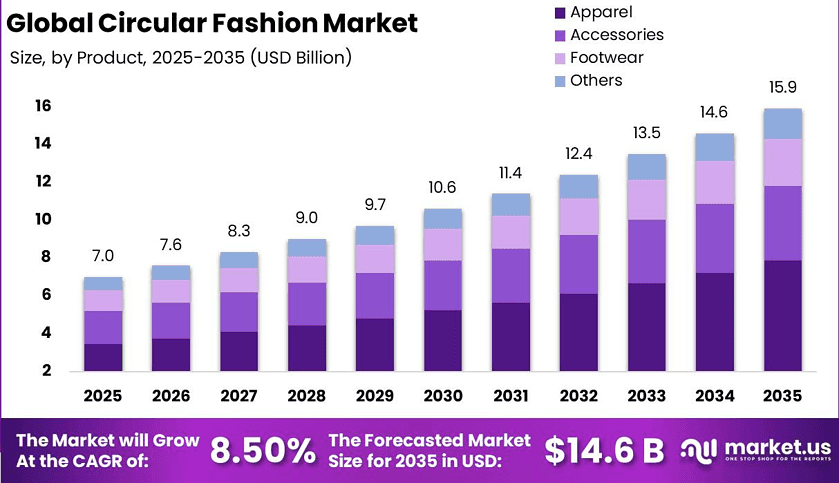
The Global Circular Fashion Market is projected to reach USD 14.6 Billion by 2035, up from USD 7.0 Billion in 2025. Analysts expect a CAGR of 8.50% from 2026 to 2035. Resale, repair, recycling, and reuse are turning fashion into a lasting, value-recovering business.
Circular fashion covers apparel, accessories, and footwear designed for extended product life. Brands and platforms achieve this through resale, repair, recycling, and reuse. The market includes brand-led take-back programs and independent resale platforms operating across digital and physical retail worldwide.
Resale platforms and brand take-back programs lead adoption. Gen Z shoppers buy over 40% of secondhand fashion online, which drives double-digit growth in platform sales. Meanwhile, luxury and near-luxury brands build in-house resale for handbags and accessories, and recyclers turn surplus garments into new fibers.
Technology improves recovery and traceability. Molecular regeneration addresses limits of mechanical polyester recycling, AI sorting separates fiber types that manual sorting misses, and digital product passports embed material data into scannable formats. Consequently, brands can automate resale, repair, and recycling workflows and lower the cost of recycled fiber.
Data-Driven Insights for Smarter Business Decisions: Explore the Full Report
Key Takeaways
- Market size stands at USD 7.0 Billion in 2025 and reaches USD 14.6 Billion by 2035.
- The market grows at a CAGR of 8.50% from 2026 to 2035.
- Apparel leads product type with a 49.40% share.
- Recycled leads textile source with a 34.70% share.
- Female end-users hold the largest share at 46.50%.
- Online dominates distribution with a 67.30% share.
- North America leads with a 45.7% share, valued at USD 3.2 Billion.
Market Segmentation Overview
Apparel dominates the product type segment with a 49.40% share in 2025. Fast fashion creates 2.5 to 5 billion surplus garments yearly, which feeds resale and recycling platforms. Consequently, apparel offers the most commercially viable entry point for circular business models. Policy focus reinforces this lead.
Moreover, accessories hold 25.00% because handbags, belts, and jewelry keep high resale value relative to material weight. Footwear holds 15.60%, but multi-material construction makes disassembly and fiber recovery difficult. Therefore, brands that adopt mono-material or modular shoe designs gain an advantage in footwear resale and recycling.
Recycled textiles lead the textile source segment with a 34.70% share because policy alignment and competitive fiber costs favor them. European textile waste sent to landfill fell from 21% in 2010 to 12% in 2022. This shift raises feedstock availability and strengthens supply economics for recycled input targets.
Additionally, organic textiles hold 25.00%, but certified land and yield limits slow their growth. Reused textiles hold 17.30%, supported by EU used-textile exports that rose from about 550,000 to 1.4 million tonnes between 2000 and 2019. Natural materials hold 13.00% and remain the least developed source.
Female consumers lead the end-user segment with a 46.50% share because of higher purchase frequency and resale platform engagement. Moreover, kids’ clothing suits circular models, since children outgrow items fast. Male buyers remain underpenetrated, so workwear, casualwear, and technical apparel offer low-competition entry points.
Online channels dominate distribution with a 67.30% share because platform scale and Gen Z habits create network effects. Larger platforms attract more buyers and sellers, which narrows the window for new entrants. Offline holds 32.70%, mainly through brand-owned take-back points.
Drivers
EU textile policy enforcement leads the driver table, with a +2.5% impact on CAGR. Rules on durability, repairability, and the destruction ban force brands to build take-back and resale systems. Consequently, circular infrastructure becomes a compliance requirement and a demand source for recovery services.
Moreover, better resale and repair economics lift growth by +2.1%. A 2026 assessment found supportive policy could raise gross margins to 55% for resale and 41 to 44% for repair. Therefore, brands treat resale and repair as profit centers and invest in recommerce platforms and repair networks.
Use Cases
Fashion brands use take-back programs and recycled supply deals to absorb returns and surplus. In June 2025, Syre announced partnerships with Gap Inc., Houdini Sportswear, and Target to scale textile-to-textile recycled polyester. Consequently, major brands secure closed-loop sourcing before production begins.
Additionally, repair services extend garment life in denim, outerwear, luxury, children’s clothing, and technical apparel. Brands run central repair hubs, tailoring networks, and app-based services. Optimized repair models can lift gross margins by up to 41%. Therefore, repair turns costly replacement into repeat customer engagement.
Major Challenges
Reverse logistics costs weigh on profits. Returned garments need collection, sorting, inspection, cleaning, and repair, and per-item handling can cost several euros before resale value returns. Consequently, brands limit circular programs to high-margin categories, and service fees can reduce consumer participation across regions.
However, compliance and skills gaps add friction. From 19 July 2026, large EU companies cannot destroy unsold goods, and reporting rules begin in February 2027. Many brands lack resale, repair, or recycling capacity. Therefore, inventory holding times, storage costs, and labor needs rise, especially for low-priced products.
Data-Driven Insights for Smarter Business Decisions: Explore the Full Report
Business Opportunities
Branded resale profit stacks offer a +2.4% CAGR upside within 2 years. Brands with retail networks can turn stores into collection points at lower cost than standalone logistics. Therefore, offline circular infrastructure, which holds 32.70% yet receives little investment, becomes an attractive entry point.
Additionally, repair-as-a-service adds +1.9%, and fiber-to-fiber premium loops add +2.1%. Latin America and the Middle East and Africa also offer large informal reuse networks. Therefore, operators that formalize collection and grading can serve new consumers and supply EPR-compliant material flows to global brands.
Regional Analysis
North America leads with a 45.7% share, valued at USD 3.2 Billion in 2025. Mature e-commerce, high smartphone use, and a strong Gen Z base drive secondhand adoption. Consequently, regional brands hold operational experience that newer entrants struggle to replicate.
Meanwhile, Europe is the most regulation-driven region, where Ecodesign rules, the destruction ban, and EPR frameworks force structured circular systems. Asia Pacific is significant because Scope 3 targets now cover over 70% of global apparel emissions, pressuring APAC manufacturers toward circular sourcing.
Recent Developments
- June 2025 — Syre announced partnerships with Gap Inc., Houdini Sportswear, and Target for recycled polyester.
- July 2025 — Goldwin Play Earth Fund invested in Ambercycle to expand molecular regeneration technology.
- January 2026 — eBay expanded its Circular Fashion Fund to the EU, Switzerland, and Canada.
- May 2026 — Trosort won the global 2026 eBay Circular Fashion Fund, with a chance at USD 300,000 for AI textile sorting.
Conclusion
The circular fashion market doubles in a decade, rising from USD 7.0 Billion in 2025 at an 8.50% CAGR. Regulation, resale margins, and digital traceability power this growth. However, reverse logistics costs and compliance burdens remain real barriers, so brands must build efficient recovery systems.
Apparel, recycled textiles, female consumers, and online channels lead their segments with shares of 49.40%, 34.70%, 46.50%, and 67.30%. North America leads regionally with 45.7%. Meanwhile, Europe sets the regulatory pace. Each leader reflects scale, policy support, and active digital buyers.
Companies must build take-back and repair networks, secure recycled fiber supply, and adopt digital product passports to capture this opportunity. Brands should also target male buyers and emerging regions. Those that act early will secure leadership as the market reaches USD 14.6 Billion by 2035.
Looking for data tailored to your specific market, region, or business need? Request a custom report or consultation — write to us at sales@market.us
Discuss your needs with our analyst
Please share your requirements with more details so our analyst can check if they can solve your problem(s)