Market Overview
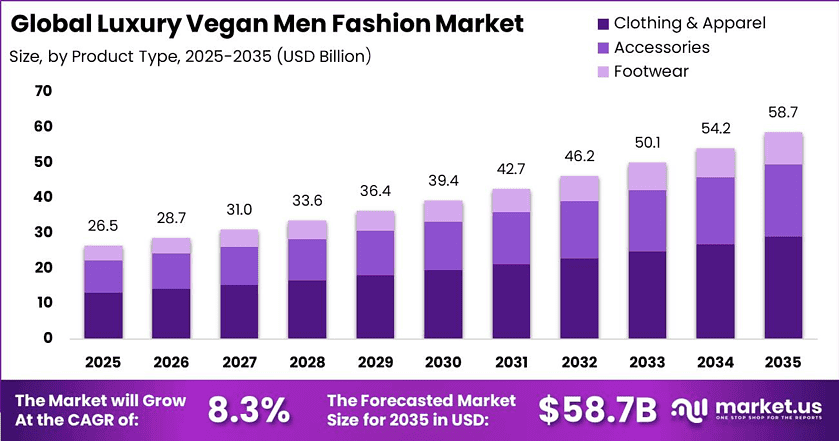
The Global Luxury Vegan Men Fashion Market is projected to reach USD 58.7 Billion by 2035, up from USD 26.5 Billion in 2025. Analysts expect a CAGR of 8.3% from 2026 to 2035. Luxury vegan menswear ranks among the fastest-scaling segments within sustainable fashion.
Luxury vegan men fashion covers premium menswear, accessories, and footwear made without animal-derived materials. Brands use plant-based, mycelium-derived, or lab-engineered alternatives to leather, silk, wool, and exotic skins. Affluent male consumers with verified cruelty-free expectations buy these products through curated retail channels.
Clothing, bags, belts, wallets, and shoes form the core range. Specialty stores, e-commerce, department stores, and hypermarkets sell them. Meanwhile, luxury houses replace exotic skins in men’s accessories and footwear with mycelium, cactus, apple, and bio-based leathers, creating permanent demand for commercial-scale alternatives.
Technology drives differentiation. Hydefy’s Fy material, made from fungi and sugarcane waste and rooted in NASA research, reached luxury handbags through Stella McCartney in 2025. Blockchain traceability also verifies material origin for buyers. Consequently, brands with secured biomaterial supply gain advantages over those relying on animal-derived inputs.
Data-Driven Insights for Smarter Business Decisions: Explore the Full Report
Key Takeaways
- Market value stood at USD 26.5 Billion in 2025 and will reach USD 58.7 Billion by 2035.
- The market expands at a CAGR of 8.3% from 2026 to 2035.
- Clothing & Apparel dominates the product segment with a 49.6% share in 2025.
- Specialty Stores hold the leading channel position at 34.8%.
- North America leads with a 35.6% share, valued at USD 9.42 Billion in 2025.
Market Segmentation Overview
Clothing and apparel dominate the product segment with a 49.6% share in 2025. Ready-to-wear carries high purchase frequency, and premium vegan fabrics now span tailoring, outerwear, and casualwear. Consequently, apparel-led storytelling, such as Stella McCartney’s May 2025 Generation Falabella capsule, activates new luxury buyer groups.
Moreover, accessories hold 32% and serve as the main entry point for new male buyers. Bags, wallets, and belts carry lower commitment than apparel. Footwear holds 18.4% and offers the highest per-unit pricing potential, because mycelium and cactus leather sneakers compete with traditional luxury footwear.
Specialty stores dominate distribution with a 34.8% share because they control the full purchase experience, from material storytelling to certified cruelty-free credentials. Provenance drives willingness to pay in this category. Therefore, retailers that scan Digital Product Passports at point of sale strengthen conversion on high-margin items.
Additionally, e-commerce holds 22% and grows fastest. PwC finds 67% of consumers use social media to discover new brands. Brands pairing strong social presence with smooth checkout own the path from discovery to purchase. Brands without direct digital stores cede early relationships to platform-native rivals.
Meanwhile, hypermarkets and supermarkets hold 18% and attract aspirational male buyers seeking accessible entry points. This channel drives volume across mid-tier price bands, so revenue breadth grows even though per-unit margins stay below specialty and direct formats. Department stores and other formats complete the mix.
Drivers
Bio-based and recycled material scale-up leads all drivers, with a +2.1% CAGR impact. Luxury houses are dropping exotic animal skins from men’s accessories and footwear. Consequently, permanent demand grows for mycelium, cactus, apple, and bio-based leathers at commercial scale, as the March 2025 Stella Ryder handbag launch showed.
Moreover, EU traceability and DPP compliance premiumization adds +1.6%. Early implementation data indicates roughly 25 to 30 consumer-visible data points and up to 126 structured fields per product. Therefore, sustainability claims become auditable metadata that strengthens wholesale acceptance and supports premium pricing in Europe.
Use Cases
Luxury brands use mycelium materials in handbags, footwear, and apparel. In September 2025, Stella McCartney showcased YATAY M mushroom-based material across bags, footwear, and apparel in its Fall 2025 collection. Consequently, mycelium moves from capsule experiments to multi-category commercial use as an alternative to exotic skins.
Additionally, lifestyle collections extend vegan luxury into new settings. In December 2025, Stella McCartney and LeMieux launched a vegan equestrian collection combining performance riding apparel with cruelty-free materials. Therefore, brands that enter sport and lifestyle niches early build defensible positions before larger houses arrive in male segments.
Major Challenges
Premium material consistency gaps limit growth. Next-generation vegan materials still lag full-grain leather in durability for high-wear luxury uses. Consequently, vegan alternatives cannot yet command parity pricing in every category. This narrows the addressable premium range, and the report assigns the gap a -1.3% CAGR drag.
However, shipping volatility disrupts supply. UNCTAD expected maritime trade growth to slow to 0.5% in 2025 from 2.2% in 2024, and disruption can add 10 to 20 days to replenishment cycles. Consequently, brands without nearshore sourcing carry higher safety stock and face lower full-price sell-through.
Data-Driven Insights for Smarter Business Decisions: Explore the Full Report
Business Opportunities
Brand-owned resale loops offer the highest near-term upside, at +2.3% CAGR within 2 years. Buy-back, refurbishment, authentication, and relisting can extend customer lifetime value by 20 to 32% and cut blended acquisition cost by 12 to 20%. Therefore, brands that capture this circular demand grow revenue per customer.
Additionally, bio-material exclusivity adds +1.8%, and the craft-label roll-up platform adds +2.0%. Proprietary biomaterial deals build differentiation before materials become commodities, while consolidating independent ateliers aggregates supply and standardizes DPP compliance. Consequently, well-funded brands can build defensible portfolios serving affluent male buyers across price points.
Regional Analysis
North America leads with a 35.6% share, valued at USD 9.42 Billion in 2025. High-spending Gen Z and millennial men prioritize cruelty-free credentials in premium purchases. Mature direct-to-consumer e-commerce and growing sustainability disclosure rules support brands. Consequently, blockchain-enabled traceability delivers measurable conversion advantages in this market.
Meanwhile, Europe matters strategically because of Ecodesign rules and Digital Product Passports from 2027, with France, Italy, and Germany anchoring luxury manufacturing. Asia Pacific expands through Japan and South Korea, while Latin America and the GCC offer early-stage entry points for digital-first brands.
Recent Developments
- March 2025 — Stella McCartney introduced the Stella Ryder handbag made with Hydefy’s fungi-based Fy material.
- May 2025 — Stella McCartney launched the limited-edition Generation Falabella capsule with vegan and lower-impact materials.
- September 2025 — Stella McCartney showcased YATAY M mushroom-based material in its Fall 2025 collection.
- October 2025 — Stella McCartney unveiled FEVVERS, a plant-based feather alternative, at its Spring/Summer 2026 Paris show.
- December 2025 — Stella McCartney and LeMieux launched a luxury vegan equestrian collection.
- May 2026 — Vêtir secured USD 5.5 Million in Series A funding at a USD 150 Million valuation.
Conclusion
The luxury vegan men fashion market more than doubles, rising from USD 26.5 Billion in 2025 at an 8.3% CAGR. Biomaterial scale-up, traceability rules, and values-driven buyers power this growth. However, premium demand slowdowns, material costs, and tariffs remain constraints, so brands must price and source carefully.
Apparel and specialty stores lead their segments with shares of 49.6% and 34.8%. North America leads regionally with 35.6%. Meanwhile, Europe sets compliance standards and Asia Pacific adds adoption leaders. Each leader reflects frequent purchases, curated retail, and affluent buyers who value verified credentials.
Companies must secure biomaterial supply, build Digital Product Passport systems, and launch brand-owned resale loops to capture this opportunity. Brands should also expand digital-first into Latin America and the GCC. Those that act early will secure leadership as the market reaches USD 58.7 Billion by 2035.
Looking for data tailored to your specific market, region, or business need? Request a custom report or consultation — write to us at sales@market.us
Discuss your needs with our analyst
Please share your requirements with more details so our analyst can check if they can solve your problem(s)