
Market Overview
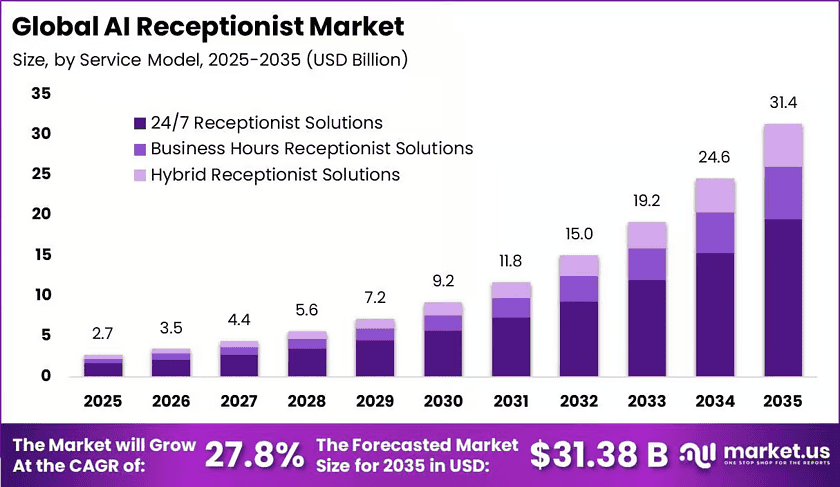
New York, NY – August 20, 2026 – The Global AI Receptionist Market reached USD 2.7 billion in 2025 and may reach USD 31.3 billion by 2035. The market expects a CAGR of 27.8% from 2026 through 2035. Consequently, businesses increasingly adopt automated call handling, booking, lead capture, and call routing tools.
Businesses seek AI receptionist platforms that answer calls around the clock and reduce customer waiting time. According to the U.S. Bureau of Labor Statistics, customer service employment may decline by 5% from 2024 to 2034. However, replacement needs may still create about 341,700 annual openings, supporting demand for automated support tools.
Healthcare providers create major demand because they manage frequent patient calls, booking requests, follow-up questions, and service enquiries. Growing care delivery requires reliable communication without matching front-desk hiring at every location. Moreover, AI voice systems can support appointment scheduling, call triage, reminders, and transfers while staff focus on complex patient needs.
North America led the global market during 2025, holding more than 42.0% share and generating about USD 1.1 billion in revenue. United States businesses support this leadership through strong cloud adoption and high customer-service labor costs. Therefore, regional companies increasingly test voice automation across service-heavy business operations.
Cloud platforms strengthen AI receptionist deployment because providers can update voice models, scripts, integrations, and security features centrally. According to Eurostat, 52.7% of EU enterprises used paid cloud services in 2025, up 7.4 percentage points from 2023. This cloud base helps businesses connect automated call handling with daily software tools.
Key Takeaways
- The AI Receptionist Market reached USD 2.7 billion in 2025 and may reach USD 31.38 billion by 2035, showing strong long-term demand for automated customer communication.
- The market may expand at a CAGR of 27.8% between 2026 and 2035, driven by cloud voice automation and digital service delivery.
- Solutions led the component segment with more than 76.0% share because businesses prefer ready-to-use systems that connect calls, calendars, and customer records.
- Cloud-based deployment led with more than 70.1% share because companies can introduce voice automation without managing local server infrastructure.
- Twenty-four-hour receptionist solutions led the service model with more than 62.3% share because customer-facing businesses need continuous call coverage.
- Small and medium enterprises held more than 61.0% share because smaller firms often need affordable alternatives to expanding front-office staff.
- Voice AI integration led technology with more than 56.1% share, reflecting continued customer preference for immediate telephone assistance.
- Voice reception services led service type with more than 54.5% share because calls remain important for urgent support and booking requests.
- IT and telecom led end use with more than 19% share because these companies manage large volumes of account and technical support calls.
- North America led the market with more than 42.0% share and about USD 1.1 billion in revenue during 2025.
➤ Grab the Exclusive Preview of This Premium Research Report Now – https://market.us/report/ai-receptionist-market/request-sample/
Market Segmentation
Solutions lead the component segment with more than 76.0% share because businesses want ready-to-use platforms for answering calls, booking appointments, and capturing leads. These systems connect with calendars, telephone tools, and customer records. Moreover, providers package automation features into subscriptions that simplify adoption for business teams.
Cloud-based deployment leads with more than 70.1% share because businesses avoid buying and maintaining on-site infrastructure. Central cloud platforms let providers update voice functions, scripts, languages, and integrations across many locations. Additionally, cloud delivery helps operators scale services quickly as call volumes rise during busy periods.
Twenty-four-hour receptionist solutions lead the service model with more than 62.3% share because customers call outside standard office hours. Hospitality, travel, healthcare, and home-service businesses need rapid responses to urgent enquiries. Moreover, always-available voice agents can collect details, schedule appointments, and transfer critical calls to the right person.
Small and medium enterprises lead enterprise size with more than 61.0% share because many operate with limited front-office staff and tight budgets. AI reception platforms provide an accessible way to answer calls, qualify leads, and organize bookings. Additionally, subscription models help smaller businesses avoid the cost of hiring additional reception personnel.
Voice AI integration leads technology with more than 56.1% share because callers value quick, hands-free support. Voice systems understand requests, provide answers, and direct calls without manual operator involvement. Moreover, conversational AI, natural language processing, and speech recognition improve how digital receptionists interpret intent, context, and spoken language.
Voice reception services lead service types with more than 54.5% share because customers often use phone calls for urgent questions, appointments, and service requests. AI agents can greet callers, collect information, and direct each enquiry. Additionally, businesses gain better call coverage during peak periods without increasing manual reception workloads.
Chat reception, appointment scheduling, call routing, lead qualification, and customer support create wider platform value. Each service helps businesses manage a different stage of the customer journey. Therefore, providers that combine voice and digital channels can reduce handoffs, improve record quality, and give customers more convenient ways to contact a business.
IT and telecom lead end use with more than 19% share because technology providers handle high volumes of activation, billing, outage, and technical support calls. Automated reception systems can identify common needs and route customers efficiently. Moreover, connected services create recurring demand for continuous account support and service information.
Regional Analysis
North America leads the AI Receptionist Market with more than 42.0% share and approximately USD 1.13 billion in revenue during 2025. The region benefits from cloud maturity, high labor costs, and early business AI adoption. Therefore, United States and Canadian companies increasingly deploy automated tools for customer calls and scheduling.
Asia Pacific grows fastest as telecom, retail, travel, financial services, and automotive companies expand digital customer support. Europe also offers meaningful potential because companies already use cloud services widely. Moreover, Latin America and Middle East markets can benefit as businesses seek multilingual communication tools and more efficient service delivery.
Drivers
Business AI adoption drives demand because companies increasingly trust software to manage routine tasks and customer interactions. Automated reception tools shift basic call work from fixed staffing needs toward flexible subscriptions. Consequently, firms can introduce call handling, lead capture, and appointment workflows without building large internal customer-service teams.
Front-office labor shortages also encourage adoption because businesses struggle to maintain consistent coverage during busy periods and after normal hours. Digital scheduling demand adds further support as customers expect convenient booking options. Moreover, cloud telephony helps companies connect automated reception with existing phone systems, business calendars, and customer relationship management tools.
Use Cases
Healthcare organizations use AI receptionists to manage appointment requests, patient enquiries, reminders, and call transfers. Voice agents can capture basic information and route sensitive matters to trained staff. Consequently, clinics and hospitals can reduce missed calls while allowing care teams to focus on patient treatment, urgent requests, and complex coordination.
Home-service companies use voice automation to handle job requests, collect service details, confirm availability, and direct emergency calls. Real-estate agencies use similar systems for property enquiries, viewing requests, and lead follow-up. Moreover, these tools help small service businesses remain responsive when owners and employees work away from a desk.
Business Opportunities
Vertical workflow platforms create opportunities because each industry needs different call flows, booking rules, and customer records. Dental practices, legal firms, repair companies, and travel providers need specialized support. Therefore, vendors can build stronger customer value by offering industry templates, focused integrations, and practical tools that solve routine sector-specific tasks.
Outcome-based pricing offers another opportunity because businesses want to link technology spending to useful results. Providers can package services around qualified leads, completed bookings, or resolved enquiries. Additionally, channel partnerships with telecom companies, software vendors, and service agencies can help AI receptionist platforms reach more businesses through trusted sales networks.
Major Challenges
Voice accuracy remains a major challenge because callers use different accents, languages, speaking speeds, and phrases. Poor understanding can frustrate customers and create incorrect transfers or bookings. Consequently, providers must test real call patterns, offer clear escalation paths, and regularly improve speech models for each business setting and customer group.
Data security and consent rules also challenge AI receptionist adoption. The FCC confirms that TCPA restrictions cover AI technologies that generate human voices, requiring prior express consent for applicable calls. Therefore, vendors need clear disclosure scripts, consent records, access controls, and secure handling of customer data.
Top Key Players in the Market
- Dialzara
- Rosie
- Goodcall
- Retell AI
- Zoom
- Quo
- Nextiva
- Moneypenny
- PATLive
- Abby Connect
- Nexa
- PolyAI
- Cognigy
- Five9
- RingCentral
- Aircall
- Smith.ai
- Ruby
- AnswerConnect
- AIRA
Conclusion
The AI Receptionist Market continues to expand as businesses seek reliable, always-available customer communication across phone and digital channels. Cloud deployment, voice intelligence, and workflow integration support wider use among small firms and large organizations. Consequently, providers that improve accuracy, protect customer data, meet consent requirements, and deliver industry-specific results can build lasting value in the evolving customer-service automation market.
Discuss your needs with our analyst
Please share your requirements with more details so our analyst can check if they can solve your problem(s)