Market Overview
The global baby training pants market reaches USD 9.7 billion by 2035, up from USD 4.7 billion in 2025. Analysts project a 7.5% CAGR during the 2026 to 2035 forecast period. This growth shows strong parent demand for comfortable potty-training products.
Baby training pants are pull-on absorbent garments that help toddlers move from diapers to regular underwear. Elastic waistbands let children dress independently, while moisture liners prevent leaks. Parents, daycares, and pediatric institutions buy these products for household and institutional potty training.
Data-Driven Insights for Smarter Business Decisions: Explore the Full Report
Key Takeaways
- The market was valued at USD 4.7 billion in 2025.
- Revenue will reach USD 9.7 billion by 2035.
- The market expands at a 7.5% CAGR from 2026 to 2035.
- Medium holds 53.23% of the size segment, while Extra Large grows fastest.
- Reusable / Cloth Training Pants capture 76.78% and grow fastest by type.
- Hypermarkets & Supermarkets hold 38.78%, while Online grows fastest.
- Asia-Pacific leads with 38.56%, worth USD 1.80 billion, while Middle East & Africa grows fastest.
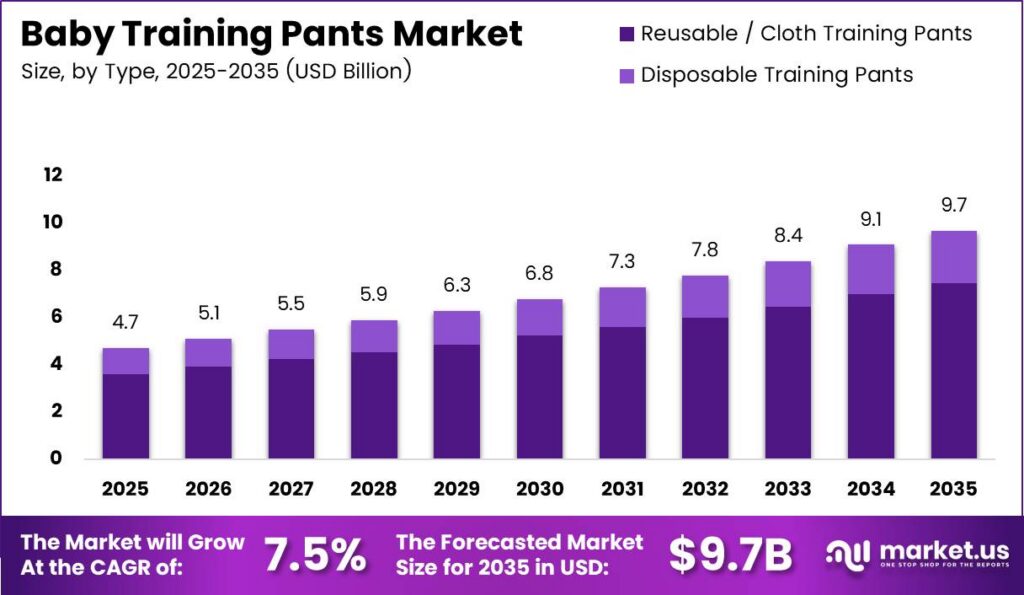
Moreover, disposable lines and washable cloth formats serve household retail, commercial daycares, and pediatric institutions. Hypermarkets, convenience stores, and specialty stores supply families, while online channels grow fastest. Retailers stock these products to reach parents seeking toddler hygiene solutions across channels.
Additionally, manufacturers improve comfort through skin-friendly design. Kimberly-Clark rolled out dermatologist-approved Pull-Ups Skin Essentials with a 100% breathable cover. This move reflects parent demand for gentle materials. Consequently, brands that prove hypoallergenic claims can grow revenue even when birth rates flatten.
Public family policies, municipal waste rules, and childcare subsidies shape adoption across developed economies. European governments expand subsidized public daycare spots, which requires parents to buy pull-on pants that meet institutional independence rules. However, rising landfill fees and plastic taxes push manufacturers toward washable textiles and plant-based absorbent cores.
Eurostat reports EU births fell 3.3% from 3.67 million in 2023 to 3.55 million in 2024. Smaller birth cohorts limit volume growth. Therefore, brands pursue higher revenue per child through premium training pants. The CDC also recorded 3,612,012 U.S. live births in 2025.
Market Segmentation Overview
Medium dominates the size segment with 53.23% share in 2025. Most children begin bladder control around age 2, so retailers devote over half their shelf space to this size. Meanwhile, Small and Large sizes serve younger and older toddlers, and Extra Large grows fastest.
Reusable / Cloth Training Pants lead the type segment with 76.78% share in 2025. Repeat washability delivers household savings, and this format also grows fastest. Moreover, Disposable Training Pants offer single-use convenience for travel, daycares, and overnight containment, so many families combine both formats.
Hypermarkets & Supermarkets hold 38.78% share in 2025 because parents buy bulky boxes during weekly grocery trips. Convenience stores sell emergency single packs, and specialty stores serve parents seeking organic cloth options. Additionally, online grows fastest, while others complete the channel mix.
Data-Driven Insights for Smarter Business Decisions: Explore the Full Report
Drivers
Skin-health premiumization leads growth, adding 0.60 percentage points to the CAGR. Parents now choose training pants for comfort, not just leak control. Consequently, brands that validate hypoallergenic claims earn price premiums, and Kimberly-Clark linked this trend to a 60-basis-point share gain in South Korea.
Underwear-like independent changing adds 0.45 percentage points to growth across global urban toddler households. Children dress themselves in pull-on designs, which supports the move to regular underwear. Therefore, manufacturers invest in underwear-style fits, while toddler-engagement character designs add another 0.25 points.
Use Cases
Households use training pants to move toddlers from diapers to regular underwear. Parents choose washable cloth pants at home and smaller disposable packs for outings. Consequently, this dual-usage pattern protects category revenue across income brackets, since budget-conscious families buy both formats.
Commercial daycares and pediatric institutions use disposable training pants for overnight containment and single-use convenience. Pull-on designs let children dress independently while preventing accidental leaks. Moreover, childcare institutional supply contracts offer 0.25 points of potential CAGR upside in urban formal-childcare markets.
Major Challenges
However, maritime supply route volatility creates the largest friction, dragging growth by 0.30 percentage points. Import-dependent distributors face margin compression because shipments of wood pulp, polymers, and finished pants cross chokepoints. When ocean freight equals 4% of cost, a 50% freight spike raises delivered cost by 2%.
Moreover, limited income in developing regions restrains growth by 0.45 percentage points. Over 824 million people lived in extreme poverty in 2024, according to the World Bank. Consequently, high retail prices push low-income parents toward unbranded cloth alternatives and weaken repeat disposable purchases.
Business Opportunities
Adaptive toddler training systems offer the top opportunity, with 0.30 points of potential CAGR upside. Toddlers with disabilities struggle with standard waistbands, which creates a gap for easy-open designs. Additionally, a 15% price premium with an 8% cost increase lifts gross margin from 35% to 39%.
Moreover, reusable hybrid training platforms add 0.20 points of upside in Western Europe, Oceania, and North America. Waste rules favor washable formats, so hybrids pair cloth comfort with disposable convenience. Fragmented regional converter acquisitions in Latin America and Southeast Asia add another 0.10 points.
Data-Driven Insights for Smarter Business Decisions: Explore the Full Report
Regional Analysis
Asia-Pacific leads with 38.56% share, valued at USD 1.80 billion in 2025. UNICEF counts nearly 490 million children under 18 in East Asia and Pacific, the world’s largest youth base. Rapid urbanization and rising dual-income female employment in China, India, and Southeast Asia also replace older habits with pull-on pants.
However, Middle East & Africa grows fastest during the forecast period. Expanding birth cohorts and modernizing retail drive demand, as the regional population reached 828,025,185 in 2025 with 1.8% annual growth. Therefore, early entrants offering affordable mid-tier packs through expanding supermarket chains in Gulf and African cities will capture long-term share.
Recent Developments
- October 2026 — KCWW launched Big Dreams diapers from USD 8.99 and wipes from USD 7.99 on Amazon U.S.
- September 2026 — Drylock opened a 450,000 square foot North Carolina plant, investing USD 31 million for 212 workers.
- August 2026 — Essity agreed to buy Kenvue’s Brazilian hygiene unit for USD 284 million, adding BRL 800 million in sales.
- July 2026 — KCWW and Suzano launched the USD 3.4 billion Arbex tissue venture; Suzano paid USD 1.3 billion for 51%.
- June 2026 — KCWW debuted Pull-Ups with Learning Layer technology across Canadian retailers.
- June 2026 — Procter & Gamble completed a USD 501 million Lima, Ohio expansion, adding 120 jobs and 40% capacity.
- March 2026 — Millie Moon launched Ms. Rachel Training Pants at Walmart Canada, passing 8,000 retail locations.
- February 2026 — Essity completed the USD 339 million Edgewell North America purchase, adding 500 employees, and launched Libero diapers.
- June 2025 — First Quality raised North American training pant capacity by 50% and protective underwear by over 25%.
- February 2025 — Unicharm opened its 3rd Indian factory with USD 131 million, lifting capacity 30% and adding 1,000 jobs.
- February 2025 — Kudos raised USD 3 million, reaching over USD 6.2 million in funding, and expanded to 375 Target stores.
Conclusion
The baby training pants market grows steadily from USD 4.7 billion in 2025 at a 7.5% CAGR. Skin-health premiumization and independent-dressing designs power this momentum across urban toddler households. Consequently, brands now compete on comfort and fit, not only on absorbency.
Medium sizes, Reusable / Cloth Training Pants, and Hypermarkets & Supermarkets lead their segments with 53.23%, 76.78%, and 38.78% shares. Moreover, Asia-Pacific commands 38.56% of revenue, while Middle East & Africa grows fastest. Online channels and Extra Large sizes also grow fastest.
Companies must act on two priorities. First, brands should validate hypoallergenic claims and build adaptive, reusable hybrid products. Additionally, producers must regionalize converting lines to reduce freight risk. Therefore, early movers can capture growth as the market reaches USD 9.7 billion by 2035.
Looking for data tailored to your specific market, region, or business need? Request a custom report or consultation — write to us at sales@market.us
Discuss your needs with our analyst
Please share your requirements with more details so our analyst can check if they can solve your problem(s)