
Market Overview
New York, NY – August 18, 2026 – The Global Database Management System Market is projected to grow from USD 111.6 billion in 2025 to USD 337.4 billion by 2035. This outlook reflects an 11.7% compound annual growth rate, showing that enterprises continue to prioritize reliable data platforms for digital operations.
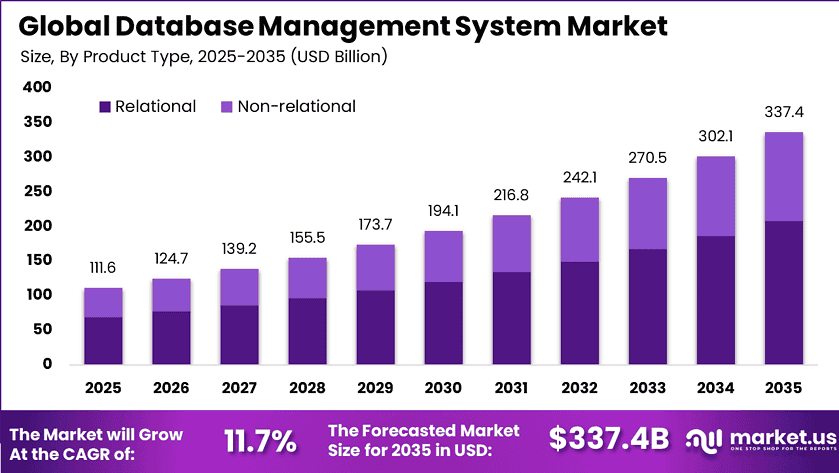
Database management systems store, organize, retrieve, protect, and govern business information. Companies use relational, document, graph, vector, and other database models for transactions, analytics, cloud workloads, and artificial intelligence pipelines. Moreover, these platforms help teams connect applications, websites, operational systems, and enterprise data without losing control of information.
Cloud-native development strengthens demand for modern database services. According to CNCF, the global cloud-native developer population reached 19.9 million in early 2026, rising from 15.6 million in late 2025. This 28% increase signals a larger builder community that needs flexible data infrastructure.
Software teams also continue to rely on established database skills, 58.6% of respondents used SQL during 2025. This result shows that structured data management remains essential, even as organizations adopt AI-ready, non-relational, and cloud-based information systems.
Enterprises now seek platforms that manage mixed workloads, real-time analysis, large applications, and governed AI data. Consequently, database vendors compete through automation, scalability, security, and hybrid-cloud support. Finance, retail, healthcare, telecommunications, manufacturing, government, and digital services each depend on dependable data operations to improve decisions and customer experiences.
Key Takeaways
- Relational databases led the market in 2025 with a 61.8% share, reflecting continued demand for structured, reliable data management.
- Cloud deployment held a 71.4% share, showing that organizations favor scalable and cost-efficient data infrastructure.
- Large enterprises represented a 67.7% share because they manage extensive data volumes and complex business systems.
- BFSI captured a 24.3% share, driven by secure transaction processing, compliance monitoring, and fraud management.
- The U.S. market reached USD 42.3 billion in 2025 and is forecast to expand at a 9.5% CAGR.
- North America held more than a 41.6% share and generated USD 46.4 billion in revenue.
➤ Access the Exclusive Sample Report Featuring Full TOC, Data Tables & Figures – https://market.us/report/global-database-management-system-market/request-sample/
Market Segmentation
Relational databases led the type segment with a 61.8% share in 2025. These systems organize information into linked tables and support dependable transaction processing. Moreover, businesses use relational platforms for complex queries, stable reporting, and consistent records across finance, operations, customer service, and other structured workflows.
Non-relational systems serve applications that handle flexible formats, high data volumes, and fast-changing content. Consequently, developers select document, graph, key-value, and vector databases for digital products, recommendation engines, connected devices, and AI retrieval. These models help organizations adapt data structures without relying on rigid table-based designs.
Cloud deployment held a 71.4% share in 2025, making it the leading delivery model. Cloud database services let companies scale storage and processing as demand changes. Additionally, managed services reduce upgrade and maintenance work, allowing internal teams to focus more closely on business applications and innovation.
On-premises deployment remains important for organizations with strict control, security, or local processing needs. However, businesses often combine local systems with public cloud services to support hybrid environments. This approach helps teams preserve sensitive workloads while gaining flexible capacity for analytics, development, and customer-facing applications.
Large enterprises accounted for a 67.7% share in 2025 because they operate complex systems across many departments. These organizations need centralized governance, controlled access, and strong performance. Therefore, they invest in advanced database platforms that connect operational, customer, financial, and analytical information across large business environments.
Small and medium-sized enterprises increasingly adopt managed database services to avoid large infrastructure commitments. Cloud tools give these firms access to scalable storage, backup, security, and analytics features. Consequently, smaller companies can support online sales, customer applications, and digital operations without building extensive internal database teams.
BFSI held a 24.3% share in 2025, leading vertical demand for database platforms. Banks, insurers, and financial firms process sensitive customer records and transactions. Moreover, these organizations use data systems for fraud detection, compliance monitoring, risk assessment, and accurate reporting across increasingly digital service channels.
IT and telecom providers, retailers, healthcare organizations, governments, manufacturers, media companies, and other industries also create broad demand. These sectors need secure information access and timely insights. Consequently, database software supports network operations, online commerce, patient systems, public services, production planning, and personalized digital content.
Regional Analysis
North America held more than a 41.6% market share and generated USD 46.4 billion in revenue during 2025. Advanced technology infrastructure supports this leadership. Moreover, regional enterprises invest early in cloud computing, analytics, cybersecurity, and AI programs that require scalable, governed database environments.
The U.S. market reached approximately USD 42.3 billion in 2025 and is expected to grow at a 9.5% CAGR. This scale highlights strong demand from enterprise applications and cloud services. Consequently, Asia Pacific, Europe, Latin America, and Middle East markets offer further growth through digital modernization and regional data programs.
Drivers
Cloud-native migration drives database demand because companies move workloads from licensed software toward managed consumption services. This model gives customers flexible capacity and recurring operational support. Moreover, cloud providers invest heavily in data platforms, which expands service choices and encourages enterprises to modernize older technology estates.
Generative AI and real-time analytics also increase demand for faster data access and AI-ready pipelines. Companies need systems that process live transactions, connected-device inputs, and business events without delays. Therefore, vendors that combine governance, automation, and high-performance processing can support stronger operational decisions across global industries.
Use Cases
Financial institutions use database platforms to process payments, protect account records, identify suspicious activity, and meet reporting obligations. Moreover, reliable data systems give banking teams a consistent view of customers and transactions. This capability supports faster service while helping organizations maintain trust in digital banking and insurance operations.
Retailers and digital service providers use modern data platforms to manage product catalogs, orders, customer activity, and recommendations. Consequently, teams can analyze demand and personalize online experiences more quickly. Healthcare organizations also use secure information systems to connect patient records, clinical workflows, research data, and care coordination processes.
Business Opportunities
Vector and AI-native database products create a major opportunity for vendors that package advanced search as a focused service. These platforms help applications locate relevant content for AI responses and recommendations. Moreover, specialized offerings can help businesses build useful AI tools while improving data governance, performance, and commercial product differentiation.
Sovereign cloud services and regional data centers also open growth paths for database providers. Organizations want local control over sensitive information while maintaining modern cloud capabilities. Consequently, vendors can partner with regional infrastructure operators and serve small businesses that are beginning their digital transformation across developing markets.
Major Challenges
Database administrator shortages can slow implementations and delay expansion plans. Companies need skilled professionals who can design systems, manage performance, protect information, and support migrations. However, limited talent increases service costs and creates pressure on vendors to deliver simpler automation, training, and self-managing database tools.
Legacy migration complexity and multi-cloud lock-in also create major barriers. Organizations must move critical applications without disrupting customers, employees, or compliance processes. Consequently, businesses need interoperable tools, clear governance, and careful migration plans. Cybersecurity risks add further pressure because expanding data environments create more points that attackers may target.
Top Key Players in the Market
- Amazon Web Services
- Google Cloud
- IBM Corporation
- Microsoft
- MongoDB, Inc.
- Oracle
- Redis
- SAP SE
- Snowflake Inc.
- Teradata
- PostgreSQL
- Couchbase
- SQLite
- Redis Labs
- MariaDB Corporation
Conclusion
The database management system market will benefit from cloud migration, AI adoption, real-time analytics, and enterprise modernization. Relational platforms remain central, while cloud services and specialized database models expand buyer choices. Moreover, regional data needs and emerging-market digitization create opportunities, although talent shortages, migration difficulty, security concerns, and vendor lock-in require careful planning.
Discuss your needs with our analyst
Please share your requirements with more details so our analyst can check if they can solve your problem(s)