Market Overview
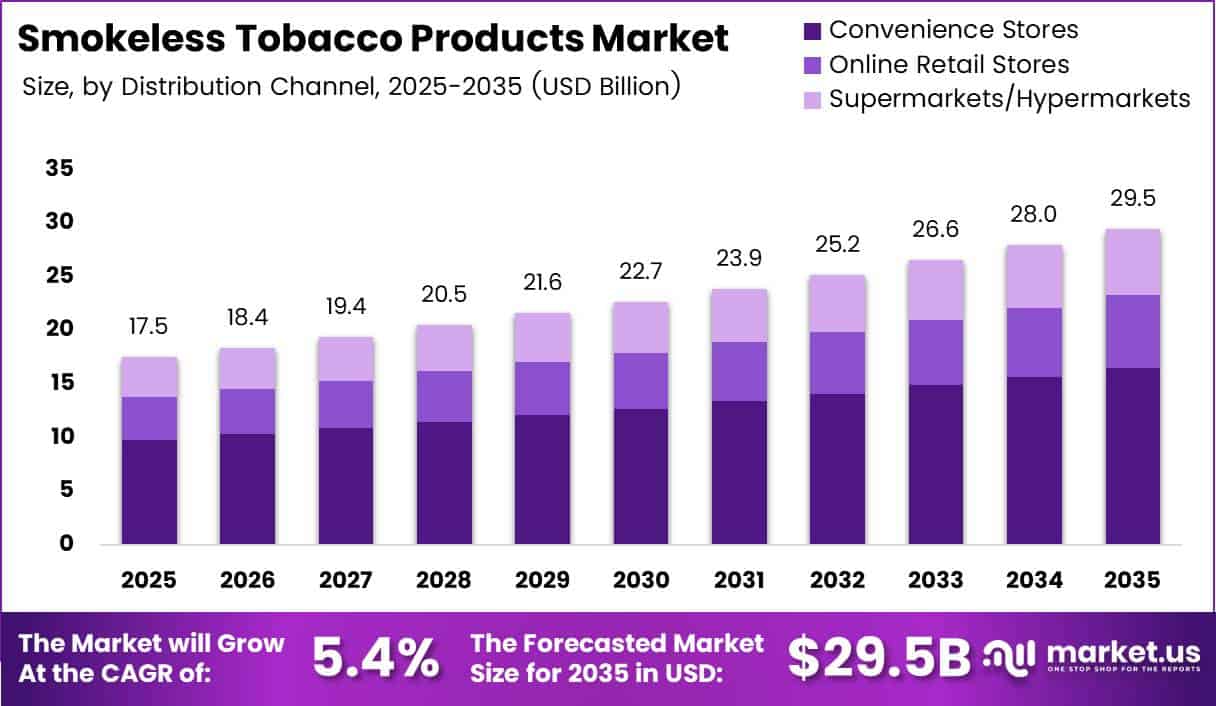
The global smokeless tobacco products market reached USD 17.5 Billion in 2025 and will hit USD 29.5 Billion by 2035. Revenue expands at a 5.4% CAGR from 2026 to 2035. Rising cigarette taxes push adult smokers toward lower-cost oral alternatives. Consequently, manufacturers prioritize portioned oral lines to capture steady recurring revenues.
Moreover, oral tobacco formats include snuff, chewing leaf, dipping varieties, and dissolvable items. These non-combustible products deliver nicotine through oral tissues without smoke inhalation. Adult consumers use these smoke-free options to avoid combustion toxins. Therefore, users comply easily with strict public and workplace smoking bans worldwide.
Additionally, convenience stores, supermarkets, and digital retailers drive commercial adoption across urban and rural sectors. Hospitality and outdoor industrial workers rely on smoke-free items during work shifts. U.S. Census Bureau data shows convenience store sales hit USD 68,021 million in September 2026, rising 28.1% annually. Consequently, retail chains expand oral backbar displays.
Furthermore, manufacturers integrate permeable fleece membranes and moisture-lock can liners into modern packaging. High-speed form-fill-seal machines regulate salivary moisture entry for controlled nicotine release. Hermetic polymer seals prevent volatile flavors from evaporating during storage. Therefore, brands upgrading container barriers reduce retail returns caused by stale pouches.
Meanwhile, federal health agencies accelerate commercial growth through formal premarket authorizations. In January 2025, the U.S. Food and Drug Administration authorized 20 pouch products in 3 mg and 6 mg strengths. By October 30, 2026, 67 pouch items held legal marketing orders. Consequently, authorized producers secure national convenience store shelf space.
Finally, World Health Organization data shows global adult prevalence hit 7.0%, or 359 million active users, in 2025. Centers for Disease Control and Prevention figures indicate 2.6% of U.S. adults, totaling 6.56 million people, used oral formats in 2024. This large user base guarantees predictable cash flows for processors.
Data-Driven Insights for Smarter Business Decisions: Explore the Full Report
Key Takeaways
- The global Smokeless Tobacco Products Market size was valued at USD 17.5 Billion in 2025.
- The global market is projected to reach USD 29.5 Billion by 2035.
- The market is forecast to expand at a CAGR of 5.4% during the forecast period from 2026 to 2035.
- In the Product segment, Snuff held a dominant 54.78% market share in 2025 and represents the fastest-growing product category.
- In the Packaging segment, Pouches accounted for a leading 78.78% market share in 2025 and stand as the fastest-growing packaging format.
- In the Distribution Channel segment, Convenience Stores captured a dominant 54.89% share in 2025, while Online Retail Stores represent the fastest-growing channel.
- Asia-Pacific dominated the global market in 2025 with a 39.90% share valued at USD 6.98 Billion, whereas North America is the fastest-growing region.
- The analytical forecast period for this market assessment spans from 2026 to 2035.
Market Segmentation Overview
Snuff captured a dominant 54.78% product share in 2025 and leads category growth. Alcohol and Tobacco Tax and Trade Bureau data shows U.S. snuff output reached 84,471,330 pounds in 2025. Pasteurized snuff delivers rapid nicotine absorption without spitting. Consequently, manufacturers expand snuff capacity to serve switching cigarette smokers, while chewing, dipping, and dissolvable formats serve niche users.
Moreover, pouches held a leading 78.78% packaging share in 2025, outpacing traditional cans. Altria Group filings show U.S. oral volume rose 14% in late 2025 due to mess-free pouch adoption. Permeable fleece pouches offer discreet portion control without loose leaf debris. Therefore, packaging vendors invest in automated pouch machinery to win brand contracts.
Additionally, convenience stores secured a 54.89% distribution share in 2025, ahead of supermarkets. Daily commuter refueling trips generate habitual single-can impulse purchases at gas stations. Meanwhile, online retail stores grow fastest as U.S. e-commerce sales reached USD 340.2 billion in second-quarter 2026. Consequently, emerging brands use age-verified websites to sell bulk subscriptions.
Drivers
Rising cigarette excise taxes and lung health concerns drive adult smokers toward oral nicotine alternatives. North American and Scandinavian cigarette shipments dropped 4.5% to 6.8% annually during 2024 and 2025, while pouches grew 7.2% to 9.4%. Oral products cost 28% to 34% less per use. Consequently, producers earn 62% to 68% gross operating margins.
Moreover, strict indoor smoking bans and digital loyalty programs accelerate category expansion. Manufacturers shifted over 35% of trade budgets to oral lines between 2024 and 2026. Age-gated direct-to-consumer rewards cut customer acquisition costs by 18% and add +2.1% to the CAGR forecast. Therefore, automated pouch producers achieve resilient cash flows.
Use Cases
Adult smokers in corporate offices and hospitality venues use portioned pouches to satisfy nicotine cravings discreetly. Non-woven fleece pouches require no spitting or combustion during indoor work hours. In third-quarter 2026, U.S. shipments for a leading pouch producer rose 4.2% to 3.2 billion pouches. Consequently, white-collar workers drive steady convenience store demand.
Additionally, rural agricultural and outdoor construction workers use loose-leaf chewing and dipping formats during long shifts. Alcohol and Tobacco Tax and Trade Bureau figures show U.S. chewing leaf output hit 11,135,803 pounds in 2024. Cured whole leaf strips release natural alkaloids slowly through chewing. Therefore, legacy brands maintain chewing lines as steady cash cows.
Major Challenges
Statutory sales bans under European Union Directive 2014/40/EU and Indian regulations block formal retail access. These laws prohibit snus across 26 European nations and impose 40% Indian tax levies in 2025. Producers lose access to 38% of European adult nicotine users. Consequently, factory utilization drops to 58%, cutting -1.6% from the global CAGR.
However, strict nitrosamine limits below 1.0 microgram per gram also strain leaf curing supply chains. Processors must replace open-flame barns with humidity-controlled curing facilities, raising leaf procurement costs by 12% to 17%. Quality testing extends fermentation by 10 weeks and rejects 11.2% of humid harvests. Therefore, compliance costs create a -0.8% growth drag.
Business Opportunities
Tobacco manufacturers can unlock high margins by securing formal reduced-risk regulatory marketing orders. Currently, fewer than 8% of global smokeless SKUs hold formal modified-risk authorizations. Approved products qualify for 30% to 50% excise tax cuts in risk-proportionate markets. Consequently, early movers expand gross margins by 450 to 600 basis points and add +1.5% CAGR upside.
Furthermore, brands can develop ultra-low-moisture micro-portions, dissolvable lozenges, and recyclable metal cans to capture new buyers. U.S. Environmental Protection Agency data shows aluminum recycling reached 37% across 5,099 facilities in 2025. Upgraded micro-portion formats add +1.1% to the CAGR forecast. Therefore, sustainable packaging and dissolvable lines attract eco-conscious retailers.
Regional Analysis
Asia-Pacific dominated the global market in 2025 with a 39.90% share valued at USD 6.98 Billion. World Health Organization data shows 288 million adult users live in South-East Asia, representing 80% of global consumers. Strong cultural habits in India drive daily chewing demand. Consequently, regional producers focus on low-cost pouch formats.
Meanwhile, North America represents the fastest-growing market due to rapid adult migration toward authorized pouches. United States Department of Agriculture data shows domestic leaf output rose 11% to 359 million pounds in 2025. Stable leaf supply and 67 FDA product authorizations eliminate grey-market rivals. Therefore, multinational brands capture premium North American pricing.
Recent Developments
- October 2026 — Reynolds American Inc. received FDA Marketing Granted Orders for 24 VELO Mini Pouch products featuring a 400 mg weight and 4 mg nicotine strength.
- August 2026 — Altria Group, Inc. secured FDA approval for 4 new on! pouch products in 2 mg and 4 mg strengths, reaching 30 authorized items.
- July 2026 — Philip Morris International Inc. opened its Aurora, Colorado ZYN plant, doubling investment to USD 1.2 billion through 2028 to create 500 direct jobs.
- June 2026 — Swedish Match USA received FDA Modified Risk Tobacco Product orders for 20 ZYN pouch products in 3 mg and 6 mg strengths across 10 flavors.
- February 2026 — Swisher International Group Inc. partnered with LIFT JAX under its USD 135 million Jacksonville expansion to allocate 60 of 240 new jobs to local residents.
- January 2026 — Helix Innovations obtained FDA approval for 6 on! PLUS pouch products in 6 mg and 9 mg strengths across 3 flavors.
- December 2025 — Swisher International Group Inc. announced a USD 135 million investment to build its Jacksonville Automated Pouch Operation and create 240 jobs by 2027.
- November 2025 — Imperial Brands PLC scaled its Zone pouch line across 100,000 U.S. stores to hit 2.8% share and 69.8% Americas next-generation revenue growth.
- December 2024 — Scandinavian Tobacco Group A/S acquired Mac Baren for DKK 535 million and bought the remaining 50% stake in !Act A/S on December 18, 2024.
- October 2024 — Japan Tobacco Inc. acquired 100% of Vector Group Ltd. at USD 15.00 per share for USD 2.4 billion on October 7, 2024.
Key Players
- Altria Group, Inc.
- British American Tobacco p.l.c.
- Imperial Brands PLC
- Universal Corporation
- Reynolds American Inc.
- Philip Morris International Inc.
- Japan Tobacco International AG
- Swisher International Group Inc.
- Scandinavian Tobacco Group A/S
- Other Key Players
Conclusion
The global smokeless tobacco industry continues steady expansion as adult smokers replace cigarettes with oral formats. Rising excise taxes and indoor smoking bans fuel this structural shift across international markets. Oral products offer 28% to 34% lower per-use costs for consumers. Consequently, manufacturers enjoy strong recurring demand and expanding operating margins.
Moreover, snuff holds a 54.78% product share while pouches capture 78.78% of global packaging volume. Convenience stores lead distribution with a 54.89% share, supported by fast-growing online retail portals. Asia-Pacific commands 39.90% of global revenue at USD 6.98 Billion, while North America leads growth. Therefore, established retail networks anchor industry revenues.
Consequently, producers must invest in automated pouch machinery, nitrosamine-compliant curing barns, and reduced-risk regulatory dossiers. Localizing factory production also protects brands from shipping delays and cross-border tariff costs. Companies executing these strategies will capture premium retail shelf space as the market reaches USD 29.5 Billion by 2035.
Looking for data tailored to your specific market, region, or business need?
Request a custom report or consultation — write to us at
sales@market.us
Discuss your needs with our analyst
Please share your requirements with more details so our analyst can check if they can solve your problem(s)