Market Overview
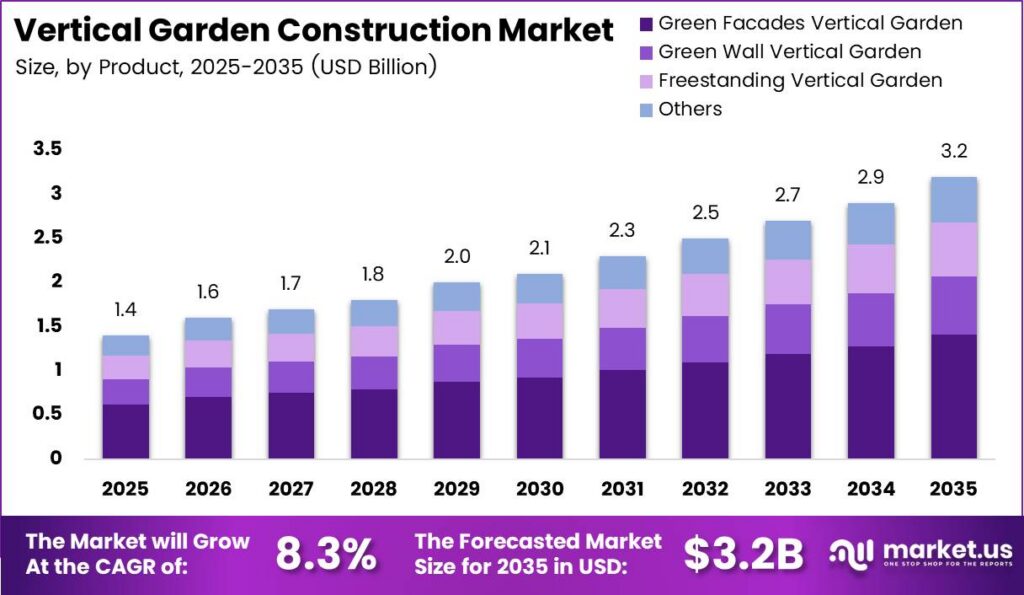
The global vertical garden construction market reached USD 1.4 Billion in 2025 and will hit USD 3.2 Billion by 2035. Industry revenue expands at an 8.3% CAGR from 2026 to 2035. Strict urban zoning codes push property developers toward vegetative retrofits. Consequently, facade contractors capture funds directly from building efficiency budgets.
Moreover, living wall assemblies combine structural sub-frames, automated irrigation lines, and growing media to attach live plants onto building envelopes. Commercial developers and residential architects use these biological surfaces to cool concrete exteriors and filter air. Vegetated panels also block solar heat gain. Therefore, building owners reduce mechanical air-conditioning loads.
Get further insight into the global trends shaping the future of the vertical garden construction industry.
Request Sample
Key Takeaways
- The global Vertical Garden Construction Market was valued at USD 1.4 Billion in 2025.
- Market revenue will reach USD 3.2 Billion by 2035.
- The industry will expand at a CAGR of 8.3% during the forecast period from 2026 to 2035.
- By Type, Outdoor Vertical Garden Wall led the segment with a 65.89% share in 2025, while Indoor Vertical Garden Wall represents the fastest growing category.
- By Application, Commercial Construction captured the dominant 78.67% share in 2025 and also registers the fastest growth rate.
- By Product, Green Facades Vertical Garden held the largest share of 43.89% in 2025 and stands as the fastest growing product segment.
- By Material, Hydroponic Systems accounted for the leading 38.89% share in 2025, whereas Soil-based Systems represent the fastest growing material category.
- North America dominated the regional landscape in 2025 with a 33.89% market share valued at USD 0.47 Billion, while Asia-Pacific is the fastest growing region.
Additionally, commercial offices, transit hubs, data centers, and apartment towers drive adoption. U.S. Census Bureau data shows private nonresidential construction hit USD 790.6 billion in September 2026, while residential spending reached USD 917.9 billion in 2024. Retail centers install exterior plant walls to boost shopper dwell times. Consequently, suppliers win repeat commercial orders.
Furthermore, manufacturers integrate automated fertigation networks, fire-rated aluminum panels, and lifecycle modeling software into modern systems. In August 2026, Green Living Tech launched a software platform that models financial returns over a 40 year horizon. Automated sensors also track facade temperatures. Therefore, vendors with digital return calculators win early architectural specifications.
Meanwhile, municipal green plot laws and carbon rules mandate exterior foliage on new builds. After the United Kingdom enforced 10% biodiversity gain rules in January 2024, Singapore, Tokyo, and Paris expanded green ratios in 2025. Buildings over 5,000 square meters require 30% to 45% plant coverage. Consequently, architects specify modular walls.
Finally, United Nations Environment Programme data shows buildings consume 32% of global energy and generate 34% of carbon emissions. Annual building efficiency spending reached USD 275 billion in 2024. Organisation for Economic Co-operation and Development figures indicate green buildings offer a USD 24.7 trillion opportunity by 2030. This spending fuels installer demand.
Market Segmentation Overview
Outdoor vertical garden walls held a 65.89% type share in 2025, while indoor walls grow fastest. JTC Corporation sensors on a 1,035.4 square meter wall recorded a 1°C cooling effect on exterior concrete. Meanwhile, commercial construction led applications with a 78.67% share in 2025 ahead of residential builds. Consequently, corporate carbon mandates drive exterior commercial installations.
Moreover, green facades captured a 43.89% product share in 2025, outpacing modular green walls and freestanding partitions. Tensioned stainless steel trellis cables shed wind loads and lower structural framing expenses for commercial buyers. Additionally, hydroponic systems led materials with a 38.89% share over soil-based, mineral wool, and recycled media. Food and Agriculture Organization data shows hydroponics cuts water use by 90%, helping engineers retrofit weight-restricted facades.
Drivers
Mandatory municipal green envelope rules compel developers to fund living walls for building permits. Cities like Singapore, Tokyo, and Paris mandate 30% to 45% plant coverage on commercial builds exceeding 5,000 square meters. This driver adds +2.6% to the CAGR and cuts customer acquisition costs by 18% to 24%. Consequently, vendors secure 5 to 10 year contracts.
Moreover, general contractors now specify modular facade vendors during early schematic design. Standardized trellis and irrigated panel lines capture 62% of compliant facade allocations across regulated urban corridors. Early specification shortens project conversion timelines by 3.5 months. Therefore, bundled maintenance deals lift recurring service revenues to 35% of total contract value.
Use Cases
Commercial offices and hyperscale data centers install exterior living walls to shade glass facades and cut cooling electricity bills. International Energy Agency data shows building electricity demand rose 5%, or 600 TWh, in 2024. Viritopia cut summer cooling energy by 12% on a 500 square meter London office wall. Consequently, data center operators adopt exterior vegetative cladding.
Additionally, corporate employers install indoor hydroponic walls to clean lobby air and absorb office noise. United States Environmental Protection Agency data shows indoor pollutant levels sit 2 to 5 times higher than outdoors. In October 2025, Biotecture installed a 134 square meter wall with 8,257 plants in London. Therefore, interior contractors use living walls for acoustic wellness.
Major Challenges
Strict fire safety regulations on buildings over 11 to 18 meters block plastic trays and peat substrates. European fire codes force vendors to use aluminum and mineral wool, adding USD 280 to USD 420 per square meter in material costs. Installed prices hit USD 1,650 per square meter. Consequently, developers cancel 34% of high-rise tenders, cutting -2.1% from the CAGR.
However, extreme wind shear above the 8th floor also causes severe plant mortality. Wind speeds over 55 kilometers per hour increase water loss by 140% to 210%, causing 18% to 26% annual plant replacement rates. Contractors absorb USD 95 to USD 160 per square meter in annual warranty costs. Therefore, high-altitude stress creates a -1.4% CAGR drag.
Business Opportunities
Facade engineers can turn passive living walls into biological greywater treatment reactors for high-rise buildings and hotels. A 200 square meter ceramic bio-media wall filters 4,500 to 7,000 liters of washbasin water daily for toilet flushing. This functional upgrade raises system prices by 38% to 52%. Consequently, contractors earn 42% to 48% gross margins and add +2.2% CAGR upside.
Furthermore, manufacturers can monetize artificial intelligence predictive fertigation software and highway particulate bio-filtration barriers. Smart irrigation software adds +1.6% to the CAGR forecast, while rail and highway pollution barriers add +1.3% upside. Automated telemetry prevents emitter scaling and root desiccation across tall walls. Therefore, software subscriptions generate high-margin recurring revenues for system vendors.
Regional Analysis
North America led the global market in 2025 with a 33.89% share valued at USD 0.47 Billion. U.S. Census Bureau figures show total national construction spending hit an annual rate of USD 2,186.1 billion in September 2026. Commercial offices and data centers install living facades for stormwater credits. Consequently, regional turnkey installers maintain high operating margins.
Meanwhile, Asia-Pacific represents the fastest-growing regional market due to dense high-rise urbanization. Organisation for Economic Co-operation and Development data shows East Asia and Pacific holds USD 17.8 trillion of the USD 24.7 trillion emerging green building opportunity through 2030. Strict green plot laws in Singapore and Tokyo mandate facade foliage. Therefore, global vendors form local Asian nursery partnerships.
Recent Developments
- May 2026 — Viritopia advanced 10 hyperscale data center living wall projects totaling 30,000 square meters and cut summer HVAC energy use by 12% in London.
- April 2026 — Sempergreen completed a 79 square meter Flexipanel facade for the Green Hotel in Genk, Belgium, absorbing 2.3 kilograms of CO2 per square meter annually.
- November 2025 — Sempergreen and Armada Groupe established Sempergreen Türkiye near Istanbul to supply SemperGreenwall systems across 6 Turkish metropolitan markets.
- October 2025 — Biotecture Ltd completed 2 rooftop hydroponic BioPanel walls spanning 110 square meters with 6,270 plants across 10 species in Moorgate, London.
- September 2025 — Ambius acquired 2 Austin, Texas plantscaping firms, Creative Plant Designs and Plant Management Associates, both operating for 40 years since 1978.
- June 2025 — Viritopia delivered 2,252 square meters of living walls across 3 UK data centers and a 1,000 square meter wall with 50,000 plants in Frankfurt.
- November 2024 — Sotech Limited and Vertical Meadow Limited launched the Optima Meadow rainscreen wall built from 94% recycled aluminum to meet the 10% UK biodiversity mandate.
- October 2024 — Biotecture Ltd delivered a 229 square meter BioPanel facade with 22,000 plants in Sheffield and a 115 square meter wall with 9,300 plants in London.
Key Players
- Sempergreen
- ZTC International Landscape Solutions
- American Hydrotech
- Livewall
- Four Leaf Landscape
- A+ Lawn & Landscape
- Biotecture
- The Greenwall Company
- ANS Group Global
- GreenWalls Bioengineering
- Other Key Players
Conclusion
The global vertical garden construction industry expands rapidly as cities enforce mandatory green plot ratios and building decarbonization rules. Commercial landlords install vegetated cladding to shade glass facades and cut summer air-conditioning loads. Early schematic specification shortens project timelines by 3.5 months. Consequently, system manufacturers secure predictable multi-year installation and maintenance revenues.
Moreover, outdoor walls hold a 65.89% type share while commercial construction captures 78.67% of total application demand. Green facades lead products at 43.89%, and hydroponic systems top materials with a 38.89% share. North America leads global revenue at USD 0.47 Billion, while Asia-Pacific grows fastest. Therefore, urban commercial corridors anchor industry expansion.
Consequently, facade vendors must engineer fire-rated aluminum panels, greywater treatment modules, and predictive irrigation software to protect profit margins. Localizing metal fabrication and wind-hardening nursery plants also reduces freight delays and warranty replacement costs. Companies executing these strategies will capture prime commercial tenders as the market reaches USD 3.2 Billion by 2035.
Looking for data tailored to your specific market, region, or business need?
Request a custom report or consultation — write to us at
sales@market.us
Discuss your needs with our analyst
Please share your requirements with more details so our analyst can check if they can solve your problem(s)