Market Overview
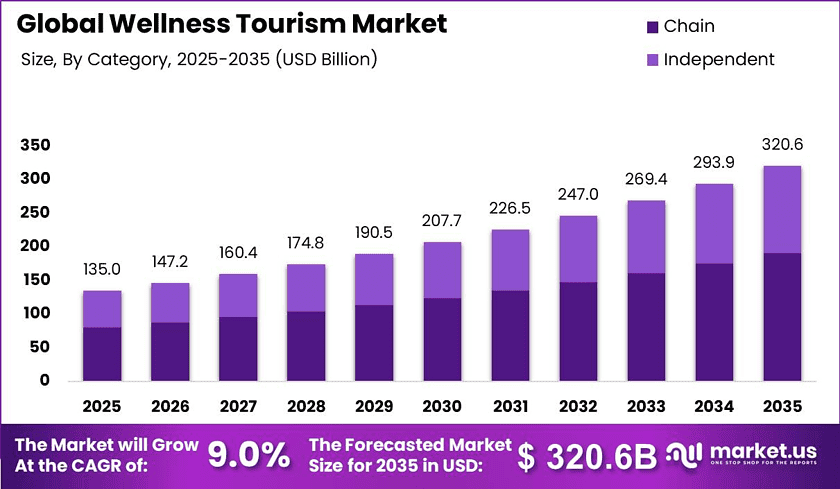
The Global Wellness Tourism Market is projected to reach USD 320.6 Billion by 2035, up from USD 135.0 Billion in 2025. Analysts expect a CAGR of 9.0% from 2026 to 2035. This growth reflects a structural shift in how consumers allocate discretionary health spending globally.
Wellness tourism covers trips where health improvement, disease prevention, and recovery are primary motivations. Offerings include resort and spa stays, medical wellness retreats, Ayurvedic programs, burnout recovery travel, and longevity-focused health travel. Individual consumers and institutional buyers such as corporate employers book these experiences.
Resorts, business hotels, and airport hotels lead adoption. Resorts offer full-immersion therapy and nutrition programs. Business hotels help executives manage stress between meetings, and airport hotels give transit travelers quick rest. Meanwhile, older travelers and corporate employers drive demand for preventive and recovery stays.
Technology and distribution tools shape how travelers book and personalize stays. Online travel agencies handle 51.5% of bookings through price comparison and digital convenience. Meanwhile, operators collect first-party guest health data through direct channels. Operators also add health diagnostics and coaching to premium programs. Consequently, CRM tools help properties personalize treatments and protect margins.
Data-Driven Insights for Smarter Business Decisions: Explore the Full Report
Key Takeaways
- Market value stands at USD 135.0 Billion in 2025.
- The market reaches USD 320.6 Billion by 2035, at a CAGR of 9.0%.
- Chain hotels dominate the category segment with a 59.7% share in 2025.
- Resorts and Spa lead the type segment with a 39.6% share.
- Online Travel Agencies account for 51.5% of bookings.
- North America leads with a 47.50% share, valued at USD 64.15 Billion.
Market Segmentation Overview
Chain hotels dominate the category segment with a 59.7% share in 2025. Centralized procurement, brand-level wellness certification, and cross-property loyalty programs drive repeat bookings. Consequently, independent operators struggle to match chains on price and consistency at scale. Standardized service delivery reinforces this lead.
Moreover, independent properties hold 40.3% by offering cultural authenticity and specialized treatment protocols. They pay higher acquisition costs but keep pricing flexibility for premium niches. In January 2026, Indian Hotels Company completed a 51% stake purchase in Sparsh Infratech, owner of Atmantan Wellness Resort, signaling active consolidation.
Resorts and spa dominate the type segment with a 39.6% share because they combine therapeutic treatments, nutrition programs, and fitness under one roof. Consequently, operators earn the highest per-night yields in wellness hospitality. Business hotels capture 25% by embedding wellness amenities into corporate travel.
Additionally, airport hotels hold 17% by serving transit travelers who need sleep, hydration, and decompression between long-haul flights. Flight schedules, not seasons, drive their demand. As a result, this sub-segment enjoys predictable foot traffic and steady occupancy. Holiday hotels and other formats complete the type mix.
Online travel agencies lead booking mode with a 51.5% share because travelers value price comparison and digital convenience. However, their pricing leverage squeezes independent resorts as commission rates rise. Direct booking and travel agents still matter. Direct channels capture full revenue and guest data, while specialist agents vet clinical credentials for high-net-worth longevity clients.
Drivers
Healthy ageing drives long-term demand. The global population aged 60 and above will grow from 1.0 billion in 2020 to 1.4 billion by 2030. Older travelers stay four to seven nights, generating higher yield per visit. Therefore, destinations with accessibility and medical support capture this expanding group.
Moreover, cross-border travel normalization leads the driver table at +2.4% on CAGR. Wellness trips also rose from 524.4 million in 2012 to 936.4 million in 2019. This volume growth shows wellness travel moving beyond high-net-worth buyers. Consequently, operators can serve multiple price points.
Use Cases
Corporate employers fund wellness retreats to reduce burnout and improve retention. Programs run two to four days and combine wellness experiences with coaching and team-building. Contracts commonly reach $800 to $2,500 per employee. Consequently, operators gain a scalable B2B revenue stream.
Additionally, older and high-net-worth travelers book longevity, medical screening, and recovery programs. Travel agents curate multi-property itineraries that combine screenings, retreats, and post-treatment stays across destinations. Therefore, specialist agents manage complex cross-border logistics and vet clinical credentials for these clients.
Major Challenges
Climate stress threatens destinations. In 2025, parts of Spain recorded temperatures near 45.8 degrees Celsius, prompting heat-related limits on outdoor hospitality. European travelers now shift toward cooler locations and off-season trips. Consequently, outdoor yoga and nature programs lose viability, and operators must diversify calendars.
However, adaptation costs keep rising. Operating and capital costs for climate adaptation may increase by 5 to 15% over a decade, and tourism emissions may rise 25% by 2030 under business-as-usual. Therefore, operators face higher cooling, insurance, and compliance burdens that favor climate-resilient locations.
Data-Driven Insights for Smarter Business Decisions: Explore the Full Report
Business Opportunities
Employer-funded retreats offer a +1.9% CAGR upside within 2 years. Direct employer partnerships cut customer acquisition costs by 30 to 50%, and extras such as coaching, diagnostics, and family options lift contract value by 15 to 25%. Therefore, operators that build corporate sales teams improve per-booking profitability.
Additionally, longevity clinic travel offers the biggest upside at +2.6% CAGR, with senior preventive programs adding +2.3%. Secondary-city medical wellness hubs add +2.1% across India, Southeast Asia, Eastern Europe, Latin America, and MENA. Consequently, early movers can build clinical credibility and demand in new destinations.
Regional Analysis
North America leads with a 47.50% share, valued at USD 64.15 Billion in 2025. High per-capita health spending, established corporate wellness purchasing, and medically accredited resorts drive this lead. Consumers also pay premium rates for preventive health travel. Consequently, the region keeps a structural lead over every other region.
Meanwhile, Europe ranks second, anchored by spa towns in Germany and Austria and Mediterranean resorts, though climate shifts reshape seasonal demand. Asia Pacific grows through Thailand, India, Japan, South Korea, and Indonesia, where Ayurveda and Traditional Chinese Medicine offer differentiated treatments. Middle East operators add longevity programming to new resorts.
Recent Developments
- November 2025 — Indian Hotels Company acquired a 51% stake in Sparsh Infratech, owner of Atmantan Wellness Resort.
- 2025 — Accor announced luxury openings, including wellness-integrated Fairmont Tokyo and Fairmont Udaipur with full spa facilities.
- 2025 — Accor published its 2025 Wellness Trends framework on science-based wellness, spa innovation, and nature-focused retreats.
- January 2026 — Indian Hotels Company completed its 51% acquisition, making Atmantan Wellness Resort a subsidiary.
Conclusion
The wellness tourism market is on a strong growth path, rising from USD 135.0 Billion in 2025 at a 9.0% CAGR. Healthy ageing, travel normalization, and premium wellness spending drive this climb. However, climate risk and travel cost inflation remain meaningful constraints, so operators must plan investments carefully.
Chain hotels, resorts and spa, and online travel agencies lead their segments with shares of 59.7%, 39.6%, and 51.5%. North America leads regionally with 47.50%. Meanwhile, Europe and Asia Pacific add heritage destinations and traditional medicine strengths. Each leader reflects scale, integrated programming, and digital convenience.
Companies must build corporate partnerships, direct booking channels, and climate-resilient properties to capture this opportunity. Operators should also add longevity and senior preventive programs. Those that act early will secure loyal guests and premium revenue as the market reaches USD 320.6 Billion by 2035.
Looking for data tailored to your specific market, region, or business need? Request a custom report or consultation — write to us at sales@market.us
Discuss your needs with our analyst
Please share your requirements with more details so our analyst can check if they can solve your problem(s)