
Market Overview
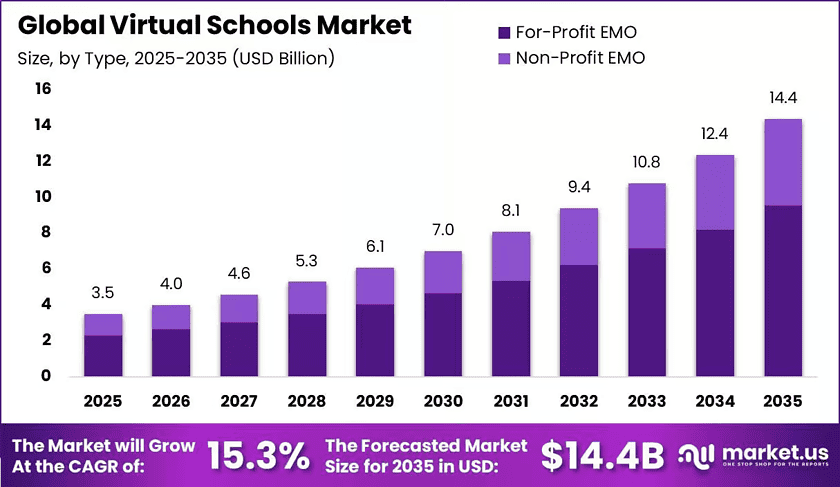
New York, NY – November 04, 2026 – The Global Virtual Schools Market was worth USD 3.5 billion in 2025. Analysts expect the market to reach USD 14.4 billion by 2035, with a CAGR of 15.3%. Consequently, families and schools now see online education as a lasting way to learn, not a short-term fix.
According to NCES, U.S. public K–12 enrollment stood at 48.9 million students in 2022–23. Fully virtual public schools enrolled 562,659 of these students. Moreover, this figure is nearly 2.8 times the 200,343 students recorded in 2013–14. This rise shows that more parents now choose full-time online schooling for its flexibility.
Additionally, virtual-school enrollment jumped to 590,267 students in 2020–21, almost double the year before. U.S. charter-school enrollment also grew from 2.269 million in 2012–13 to 3.7 million in 2022–23. This gain of nearly 64% reflects rising demand for school choice. Therefore, digital-first education models now reach a wider audience.
Global connectivity data shows 5.5 billion people, or 68% of the world population, used the internet in 2024. Moreover, mobile-cellular subscriptions reached 9.1 billion. This wide reach gives online learning platforms a large base of connected students. Consequently, providers can deliver lessons to learners far beyond their local school districts.
However, according to UNESCO, only 40% of primary schools, 50% of lower-secondary schools, and 65% of upper-secondary schools have internet access. About 1.3 billion children aged 3–17 lack home internet. This gap limits reach today. However, it also creates a long-term growth opportunity for digital education services.
Key Takeaways
- The Virtual Schools Market was worth USD 3.5 billion in 2025. Analysts expect it to reach USD 14.4 billion by 2035, with a CAGR of 15.3%.
- The For-Profit EMO segment led the type category with a 66.3% share.
- The High Schools segment led the application category with a 37.2% share.
- North America led the market in 2025 with a 40.3% share and about USD 1.4 billion in revenue.
➤ Unlock the Sample Version of This Premium Report with Detailed Tables & Figures – https://market.us/report/global-virtual-schools-market/request-sample/
Market Segmentation
By Type
The For-Profit EMO segment leads the market with a 66.3% share. These operators run large online-school networks with shared technology, curriculum, and teacher support. Consequently, their cost per student falls as enrollment grows. Non-profit EMOs also serve many learners. However, they usually run smaller school networks with fewer students.
According to research supported by the U.S. Department of Education, for-profit EMOs ran 180 full-time virtual schools in 2021–22. These schools served 266,970 students, or 46.1% of total enrollment. Moreover, average enrollment reached 1,483 students per school. This scale gives operators stronger buying power for cloud platforms and learning tools.
By Application
The High Schools segment holds a 37.2% share. Students in grades 9–12 want flexible schedules, credit recovery, and exam preparation. According to NCES, public high-school enrollment reached 15.6 million in fall 2023, up from 15.2 million in 2019. Therefore, high schools remain the strongest customer group for online courses.
Additionally, the other application segments are elementary schools, middle schools, and adult education. Digital platforms let certified teachers reach students in many locations. Consequently, schools can offer more courses without hiring specialist teachers at every site. Adult learners also use online programs to finish diplomas and build career skills.
Regional Analysis of Online Schooling
North America led the market in 2025 with a 40.3% share and about USD 1.4 billion in revenue. According to NCES, 97% of children aged 3–18 had home internet in 2021. Moreover, 58% of U.S. public schools gave every student a school laptop or tablet in 2024–25. Together, these factors support virtual learning at large scale.
However, Asia Pacific is expected to be the fastest-growing region. According to the World Bank, East Asia and the Pacific has around 331 million school-age children. This equals about one-quarter of the world’s school-age population. Consequently, better internet, devices, and cloud services will open a vast market for online schools.
Growth Drivers
District adoption of digital courses is a strong growth driver. U.S. public-school enrollment stayed close to 49 million students in 2023. This large base creates steady demand for online courses, learning systems, and digital tests. Moreover, this driver adds an estimated +2.2% to market CAGR, mainly in North America over the short term.
Additionally, flexible high-school course options fuel demand in North America and Europe. Students want advanced subjects, career courses, and world languages. Virtual schools fill these gaps where local teachers are scarce. Consequently, this driver adds about +1.8% to market CAGR, while cloud-based learning adds another +1.5% worldwide.
Key Use Cases
Credit recovery is a key use case. High-school students who fail or miss a course can retake it online at their own pace. Moreover, schools keep these students on track to graduate without adding extra classrooms. This approach saves school resources and supports better results for students.
Additionally, student athletes and young artists use virtual schools to balance training with study. These learners fit individual online courses around games, rehearsals, and travel. Consequently, families get flexible schedules and still keep a structured curriculum. Rural students also gain access to specialist subjects that their local schools cannot offer.
Business Opportunities
Licensing courses across borders is a strong future opportunity. Providers can adapt one approved digital course for schools in many countries. However, they must first meet local curriculum, language, and data rules. Consequently, firms that localize content well can turn fixed development costs into steady subscription revenue in Asia, the Middle East, and Africa.
Moreover, AI tutoring subscriptions open new revenue streams for virtual-school providers. AI tutors give students instant help, practice questions, and personal feedback. Additionally, career credential programs link online courses to real job skills. These offerings help providers attract adult learners and career-focused high-school students.
Major Challenges
The school connectivity gap is still a major challenge. Many schools and homes lack reliable internet and learning devices. Consequently, providers must invest in offline content, platforms that work on slow connections, and local support teams. These extra needs raise operating costs and slow growth in rural and lower-income markets.
Additionally, oversight of virtual charter schools creates pressure in the United States. Regulators closely review public funding, student testing, and financial reporting at online charter schools. Therefore, stricter approval and renewal rules can slow new school openings. Gaps in teachers’ digital skills and cybersecurity threats also add cost and risk for providers.
Top Key Players in the Market
- Charter Schools USA
- Discovery Education Inc.
- Florida Virtual School
- Lincoln Learning Solutions
- Ontario Virtual School Inc.
- Pansophic Learning
- American School
- Apex Learning Inc.
- Arizona State University
- Basehor Linwood Virtual School
Conclusion
The virtual schools market shows strong momentum as families, school districts, and adult learners embrace flexible online education. For-profit operators and high-school programs lead demand, while North America holds the top regional position. Moreover, Asia Pacific offers fast growth, although connectivity gaps and stricter oversight remain real hurdles. Consequently, providers that invest in local content, AI tools, and secure platforms will gain a lasting advantage.
Discuss your needs with our analyst
Please share your requirements with more details so our analyst can check if they can solve your problem(s)