
Market Overview
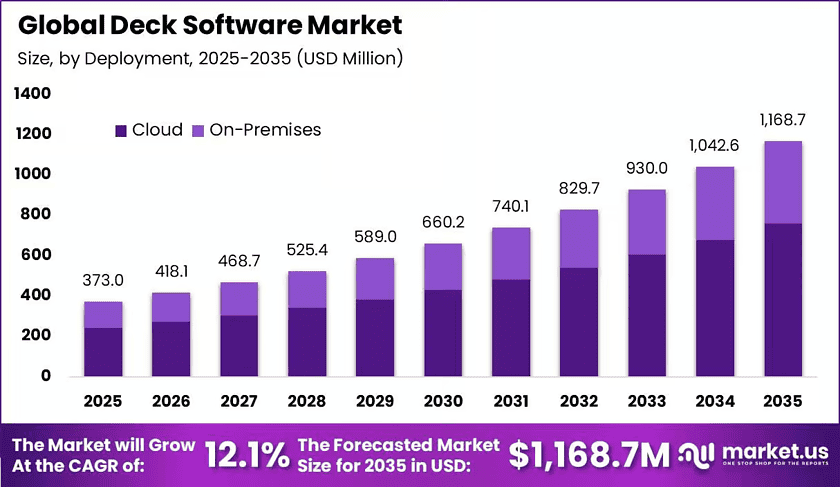
New York, NY – November 19, 2026 – The Global Deck Software Market reached USD 373.0 million in 2025. Analysts expect it to hit USD 1,168.7 million by 2035, growing at a 12.1% CAGR. This steady growth shows that contractors and homeowners are moving from manual deck planning to digital design tools. North America led the industry in 2025 with a more than 43.5% share and about USD 162.3 million in revenue.
Additionally, US construction spending reached a yearly rate of USD 2,136.2 billion in mid-2025, according to US Census Bureau data. Residential projects made up USD 883.1 billion of this total. This large spending base creates steady demand for software that plans decks, estimates costs, and calculates materials.
Furthermore, US authorities approved about 1,425,200 housing units through building permits in 2025. Builders also completed 1,497,800 housing units in the same year. Each new home creates a chance for outdoor features. Therefore, builders increasingly use digital layout tools before construction begins.
However, new homes are not the only growth source. Existing homes need regular deck repair, replacement, and redesign work. Outdoor living spaces have become a key part of home upgrades. As a result, deck planning software should see rising use across both new building and renovation projects through 2035.
Key Takeaways
- The Deck Software Market was valued at USD 373.0 million in 2025 and is projected to reach USD 1,168.7 million by 2035, at a CAGR of 12.1%.
- Cloud deployment held a dominant 65.2% share of the market.
- The commercial application segment held a dominant 54.7% share.
- Architects and builders held a dominant 45.6% share of the end-use segment.
- North America led the market in 2025 with a 43.5% share, generating approximately USD 162.3 million in revenue.
➤ Evaluate the Report Quality with an Exclusive Sample Download – https://market.us/report/deck-software-market/request-sample/
Deck Software Market Segmentation
By Deployment
Cloud deployment held a leading 65.2% share of the market. Sales teams, designers, estimators, and installers need fast online teamwork. According to Eurostat, 52.74% of EU firms with at least 10 employees used paid cloud services in 2025. This trend shows that businesses are ready for online deck design tools.
Moreover, 42% of EU construction businesses used advanced or intermediate cloud services in 2025, according to Eurostat. This figure shows that contractors are becoming more comfortable with digital tools. Consequently, field teams can update deck designs during site visits. Meanwhile, office staff can change estimates and orders right away.
By Application
The commercial segment held a leading 54.7% share of the market. Hotels, restaurants, offices, and event venues need professionally designed outdoor spaces. According to the US Census Bureau, private non-residential construction spending reached USD 738.8 billion a year in June 2025. Therefore, commercial projects create large and complex deck design work.
Additionally, this spending included USD 119.1 billion for commercial buildings and USD 23.6 billion for lodging. These projects often include rooftop decks, outdoor dining areas, and pool surrounds. Consequently, commercial developers depend on accurate planning software. These tools help them manage bigger layouts and stricter safety standards.
By End-Use
Architects and builders held a leading 45.6% share of the end-use segment. These professionals guide project design, costing, and construction. According to available licensing data, US licensed architects grew by 6% to 123,398 in 2025. This growing talent pool directly expands the user base for deck design platforms.
Furthermore, the US construction and extraction workforce reached 6.43 million workers in May 2025, according to the US Bureau of Labor Statistics. This group included 812,210 first-line supervisors. Remodelers, interior designers, and other users also add demand. Therefore, software that checks dimensions and creates 3D designs serves a broad audience.
Regional Analysis of Deck Software Adoption
North America held a 43.5% share in 2025 and earned about USD 162.3 million. The United States leads because of its large housing stock. According to the 2023 American Housing Survey, 123.8 million occupied US homes had a porch, deck, balcony, or patio. This base supports constant repair and redesign work.
However, Asia Pacific should grow the fastest during the forecast period. Australia, Japan, China, India, and Southeast Asia are seeing more urban building and cloud software use. Consequently, local contractors are replacing manual planning with digital visual tools. These tools help them estimate costs faster and work more efficiently.
Key Growth Drivers
Home improvement demand is the strongest growth driver, adding about 2.1% to CAGR in North America. Homeowners often pay for decks from renovation budgets. According to the US Census Bureau, private residential construction reached USD 892.8 billion a year in April 2025. Therefore, renovation spending keeps deck projects moving steadily.
Moreover, cloud workflow adoption adds about 1.7% to CAGR across North America and Europe. Contractors want one online platform for drawings, material lists, and customer approvals. According to Statistics Canada, building investment reached CAD 24.5 billion in November 2025. Consequently, active construction markets keep pushing demand for connected design tools.
Practical Use Cases
Residential contractors use deck software to show homeowners realistic 3D designs before work begins. Clients can compare board colors, railing styles, and layouts on screen. Consequently, contractors win approvals faster and avoid costly changes later. Moreover, clear visuals build trust and help small firms close more sales.
Additionally, commercial builders use these tools to plan rooftop decks, outdoor dining areas, and pool surrounds. The software calculates material needs and checks dimensions with care. Therefore, project teams cut waste and control budgets more easily. Furthermore, accurate plans help builders meet safety rules and local permit requirements.
Business Opportunities in Deck Design
Dealer-connected material marketplaces offer a major untapped opportunity. Most deck platforms still stop at design and quotes. However, software providers can turn approved layouts into live supplier orders. Consequently, vendors can earn recurring income from transactions. Contractors also save ordering time and stay loyal to the platform.
Moreover, AI-assisted deck setup creates a strong global growth path. Smart tools can suggest layouts, materials, and structural options within minutes. Therefore, small teams can handle more projects without hiring extra staff. Additionally, permit automation tools can help contractors prepare plans that local authorities approve quickly.
Major Market Challenges
Changing material data is the main operating challenge for software providers. Accurate deck estimates depend on board prices, freight charges, and delivery dates. However, shipping problems and energy price swings make these costs shift often. Consequently, vendors must update pricing data constantly to keep estimates reliable.
Additionally, poor compatibility between tools slows wider adoption. Many deck programs cannot share files easily with CAD, estimating, or accounting systems. Therefore, contractors often enter the same data twice. Moreover, tight budgets at small contractors limit software spending, because labor, tools, and insurance come first.
Top Key Players in the Market
- Autodesk Inc.
- Delta Software International LLC.
- Chief Architect, Inc.
- Dassault Systemes
- Deckorators, Inc.
- Drafix Software, Inc.
- Trimble Inc.
- Idea Spectrum, Inc.
- MoistureShield
- RoomSketcher AS
- Simpson Strong-Tie Company, Inc.
- SmartDraw, LLC
- Cedreo
- Trex Company, Inc.
- The AZEK Company Inc.
Conclusion
The Deck Software Market shows strong long-term promise as contractors and homeowners adopt digital planning tools. Home renovation demand, cloud workflows, and commercial outdoor projects drive steady growth. North America leads the market today, while Asia Pacific is growing fast. However, changing material costs and tight contractor budgets remain real barriers. Consequently, vendors that offer smart, connected, and affordable platforms will capture the strongest future opportunities.
Discuss your needs with our analyst
Please share your requirements with more details so our analyst can check if they can solve your problem(s)